
Indian Astronomers are researching towards establishing a new mean time 'Dongla Mean Time (DMT)'. Village Dongla is situated in which district of Madhya Pradesh?
- (a)Dewas
- (b)Ujjain
- (c)Dhar
- (d)Barwani
Correct — B, Ujjain. Dongla is a village in the Mahidpur tehsil of Ujjain district, and it is astronomically interesting for one reason: the Tropic of Cancer (about 23°26′ N) runs through it, and it sits close to the meridian of Ujjain — the line that classical Indian astronomy, from the Surya Siddhanta onwards, treated as India's zero meridian. That is the same latitude–longitude coincidence for which Ujjain itself was called the 'Greenwich of India'. Because of it, an observatory named after Varahamihira, with a planetarium, has been developed at Dongla, and the proposal for a 'Dongla Mean Time' is the idea of computing a reference mean time at this meridian in the old Ujjaini tradition.
- (a)Dewas — A neighbouring Malwa district of Ujjain division — close enough to be a tempting guess, but Dongla, its observatory and the mean-time proposal all belong to Ujjain district.
- (c)Dhar — A western Malwa district known for Bhojshala and the Mandu fort complex. It has no connection with the Dongla observatory or with Ujjain's meridian tradition.
- (d)Barwani — A Nimar district in the far south-west of the state, on the Narmada. It lies well south of the Tropic of Cancer, so it could not host a site whose whole significance is that the Tropic passes through it.
Every place has its own local mean time, fixed by the longitude of its meridian: the Earth turns 15° of longitude in one hour, so 1° equals 4 minutes of time. A country then picks one meridian as its standard — India uses 82°30′ E, which makes Indian Standard Time UTC+5:30. Classical Indian astronomy did the same thing much earlier, but with Ujjayini (Ujjain) as the prime meridian; the Surya Siddhanta describes the zero meridian as passing through Avanti (Ujjain) and Rohitaka (Rohtak). Ujjain's other claim is latitude — the Tropic of Cancer runs through the district, which made it the natural reference point for solar observation. Dongla, a village in Mahidpur tehsil of the same district, sits on that Tropic, and 'Dongla Mean Time' is a proposal to revive a meridian-based Indian reference time there.
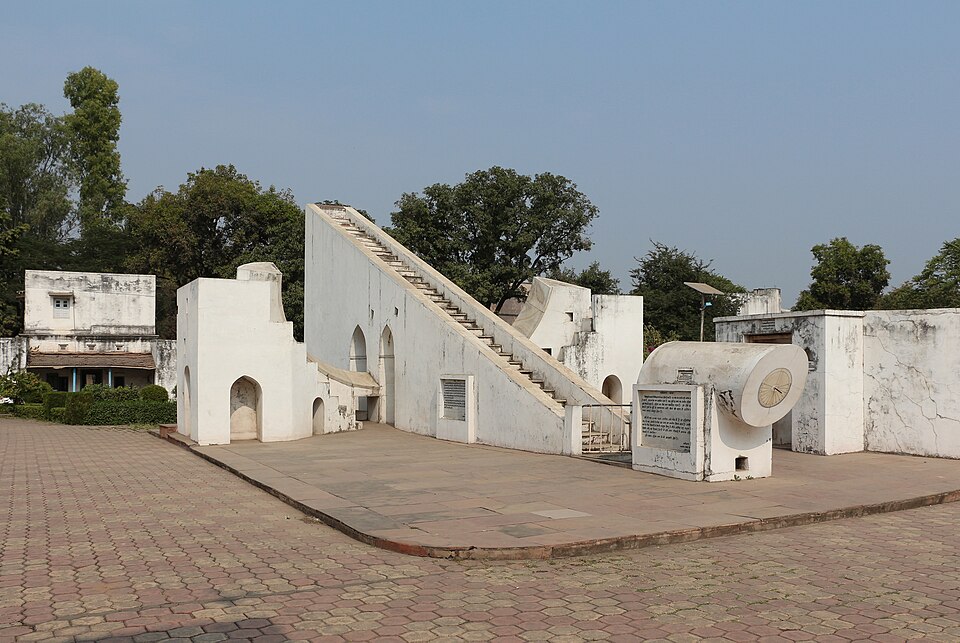
The question looks like pure local trivia, but it is really asking whether you know why Ujjain matters in astronomy. Once you hold the chain 'Ujjain = India's ancient prime meridian + Tropic of Cancer', the district follows by itself, because any modern 'mean time' project would be sited on that meridian and nowhere else. The distractors are the three neighbouring Malwa/Nimar districts, and they are there to catch anyone who has only heard the village name. A second useful anchor: Ujjain also holds the Vedh Shala (Jantar Mantar), one of the observatories built by Sawai Jai Singh II of Jaipur in the eighteenth century, today the Government Jiwaji Observatory.
- Dongla is a village in Mahidpur tehsil, Ujjain district, Madhya Pradesh, lying on the Tropic of Cancer
- The Surya Siddhanta places India's zero meridian through Ujjayini (Ujjain), which is why Ujjain is called the 'Greenwich of India'
- Ujjain's Vedh Shala (Jantar Mantar), now the Government Jiwaji Observatory, was built by Sawai Jai Singh II of Jaipur in the 18th century
- Indian Standard Time is based on the 82°30′ E meridian and is UTC+5:30
- Varahamihira, Brahmagupta and Bhaskaracharya are all associated with Ujjain's astronomical tradition — the Dongla observatory is named after Varahamihira
- Placing Dongla in Dewas or Dhar because they are the nearby Malwa districts
- Assuming the Tropic of Cancer passes through Indore district — it does not, though it crosses Ujjain, Bhopal and Vidisha districts
- Thinking India's standard meridian passes through Ujjain — IST is fixed on 82°30′ E, which runs near Mirzapur in Uttar Pradesh, not on Ujjain's meridian
MPPSC asks the place-to-district mapping — which district holds this village, observatory, dam or fort — often built around a recent news item. UPSC keeps the same content but asks the physics and geography behind it: which city is nearest the Tropic of Cancer, how a longitude difference converts into a time difference.
Among the following cities, which one is nearest to the Tropic of Cancer?
- (a) Delhi
- (b) Kolkata
- (c) Jodhpur
- (d) Nagpur
Answer(b) Kolkata
The same idea from the latitude side — where the Tropic of Cancer actually runs across India. Dongla is significant precisely because the Tropic passes through it.
When there is noon at the G.M.T. meridian, people at another place of the Earth are taking their 6 o’clock morning tea. The longitude of the place is
- (a) 17° 30′ E
- (b) 7° 30′ W
- (c) 172° 30′ E
- (d) 90° W
Answer(d) 90° W
The concept behind any 'mean time' proposal — a place's mean time is set by its meridian, and every 15° of longitude shifts it by one hour.
Through which of the following districts of Madhya Pradesh does the Tropic of Cancer NOT pass?
- (a) Vidisha
- (b) Bhopal
- (c) Ujjain
- (d) Indore
Answer(d) Indore
MPPSC has already tested that the Tropic of Cancer passes through Ujjain district — the very fact that makes Dongla, inside that district, the site chosen for the mean-time proposal.
- practice — not a real PYQ
Indian Standard Time is calculated on the basis of which meridian?
- (a)75°30′ E
- (b)82°30′ E
- (c)88°30′ E
- (d)90°00′ E
Answer(b) 82°30′ E — the standard meridian of India, which makes IST five and a half hours ahead of UTC. - practice — not a real PYQ
A place situated at 90° E longitude will have its local mean time ahead of Indian Standard Time by:
- (a)15 minutes
- (b)30 minutes
- (c)45 minutes
- (d)60 minutes
Answer(b) 30 minutes — the place is 7°30′ east of the 82°30′ E standard meridian, and 7.5° × 4 minutes = 30 minutes.