
Baihar plateau of Balaghat is known for which mineral deposits?
- (a)Zinc
- (b)Iron ore
- (c)Dolomite
- (d)Bauxite
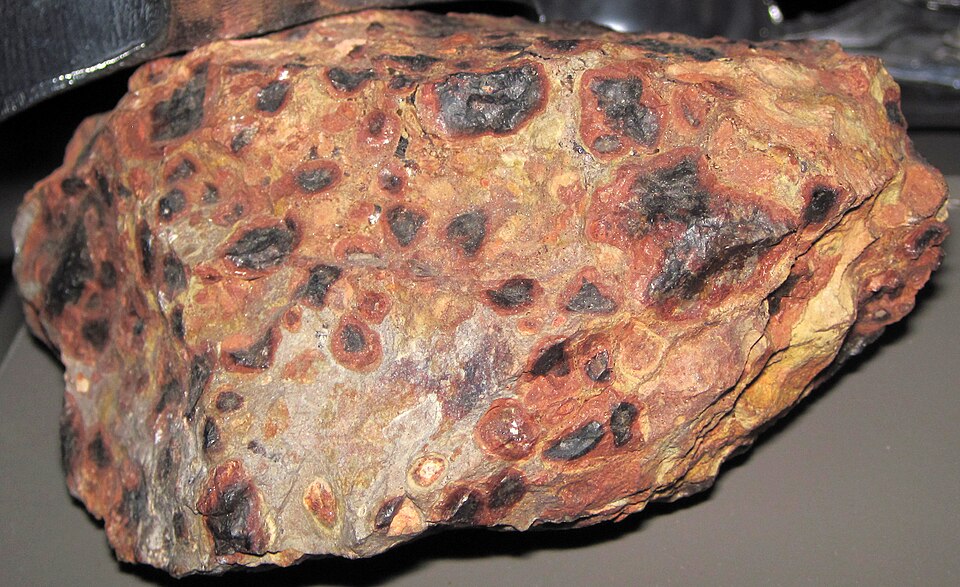
Correct — D, bauxite. The Baihar plateau is the high, flat-topped upland in the eastern part of Balaghat district, and like the other bauxite tracts of Madhya Pradesh it owes its deposits to laterite. Under a hot, seasonally wet tropical climate, silica and the soluble bases are steadily leached out of aluminium-bearing parent rock on a flat, well-drained upland surface, leaving behind a residual crust of hydrated aluminium oxides — bauxite. That is why the state's bauxite is found capping elevated plateau surfaces (Katni, Shahdol–Anuppur, Mandla, Jabalpur and the Baihar plateau of Balaghat) rather than in valleys, and why the question deliberately names a plateau.
- (a)Zinc — India's lead–zinc mining is concentrated in Rajasthan — Rampura Agucha and the Zawar belt. Madhya Pradesh has no zinc mining of any consequence, so this option is out on state grounds alone.
- (b)Iron ore — India's major iron-ore belts lie in Chhattisgarh (Bailadila), Odisha, Jharkhand and Karnataka. Iron ore is not what the Baihar plateau is identified with, and Balaghat's mineral reputation rests on copper, manganese and the plateau's bauxite instead.
- (c)Dolomite — The strongest distractor, because Balaghat district genuinely is one of Madhya Pradesh's dolomite-producing districts and the state is a leading dolomite producer nationally. But dolomite is a sedimentary carbonate rock worked from limestone belts, not from a laterite-capped upland; it is the Baihar plateau specifically — the elevated, laterite-covered surface — that is identified with bauxite.
Bauxite is the principal ore of aluminium, and it is a residual deposit rather than a vein or a bedded one. Prolonged chemical weathering in a warm, humid climate with a marked dry season strips silica, calcium, sodium and potassium out of aluminium-rich rock and concentrates the insoluble aluminium (and iron) oxides in place — the process of laterisation. Flat plateau tops give the two things laterisation needs, free drainage and a stable surface, which is why bauxite in India occurs as cappings on uplands: Panchpatmali and the Kalahandi–Koraput belt in Odisha, the Amarkantak–Maikal surfaces and the Baihar plateau in central India.
Balaghat is one of the districts MPPSC returns to again and again, because it is unusually mineral-rich: the Malanjkhand copper project of Hindustan Copper Ltd, MOIL's manganese mines in the Balaghat belt, dolomite, and the bauxite of the Baihar plateau. That richness is also the trap — every option in a Balaghat question sounds plausible unless you attach the mineral to the specific landform named. The word 'plateau' is the setter's own hint: a flat-topped upland surface points to a laterite-derived ore, and bauxite is the laterite ore in the list.
- Bauxite is the ore of aluminium and forms as a residual laterite capping under humid tropical weathering
- In Madhya Pradesh bauxite occurs on plateau surfaces — Katni, Shahdol–Anuppur, Mandla, Jabalpur and the Baihar plateau of Balaghat
- Odisha holds India's largest bauxite reserves and output
- Balaghat district is also known for the Malanjkhand copper deposit and for manganese mining
- Laterisation removes silica and bases and leaves aluminium and iron oxides in place — hence bauxite sits on top, not at depth
- Assuming a mineral-rich district is known for only one mineral — Balaghat carries copper, manganese, dolomite and bauxite at once, so the question's landform matters
- Placing zinc in Madhya Pradesh; India's zinc is overwhelmingly Rajasthan's
- Treating bauxite as a deep-seated ore — it is a surface residual capping, which is why it is tied to plateau tops
MPPSC asks it as a straight mineral-to-place pairing, very often as a List-I/List-II match of minerals with their 'main area', and it reuses the same handful of places (Panna, Malanjkhand, Baihar, Shahdol, Katni). UPSC prefers the process and the industry angle — how bauxite forms, which state leads, or which minerals occur in a named state.
Consider the following statements : 1. Balaghat is known for its diamond mines. 2. Majhgawan is known for its manganese deposits. Which of the statements given above is/are correct?
- (a) 1 only
- (b) 2 only
- (c) Both 1 and 2
- (d) Neither 1 nor 2
Answer(d) Neither 1 nor 2 — the pairing is swapped: Majhgawan (Panna) is the diamond area, while Balaghat is the manganese district.
UPSC testing exactly this Balaghat mineral association, and warning against the same error — attaching the wrong mineral to a mineral-rich Madhya Pradesh locality.
Which of the following minerals are found in a natural way in the State of Chhattisgarh? 1. Bauxite 2. Dolomite 3. Iron ore 4. Tin Select the correct answer using the code given below:
- (a) 1, 2 and 3 only
- (b) 1 and 3 only
- (c) 2 and 4 only
- (d) 1, 2, 3 and 4
Answer(d) 1, 2, 3 and 4 — all four occur in Chhattisgarh.
Same mineral set — bauxite, dolomite and iron ore — asked for the neighbouring state carved out of Madhya Pradesh, which is the region whose bauxite–laterite geology continues into the Baihar plateau.
Match List-I with List-II and select the correct answer using the codes given below the lists : List-I (Minerals): (i) Copper (ii) Diamond (iii) Slate (iv) Bauxite; List-II (Main area): 1. Mandsaur 2. Shahdol 3. Baihar 4. Hinota Codes :
- (a) (i)-2, (ii)-1, (iii)-4, (iv)-3
- (b) (i)-3, (ii)-4, (iii)-1, (iv)-2
- (c) (i)-4, (ii)-3, (iii)-2, (iv)-1
- (d) (i)-2, (ii)-4, (iii)-1, (iv)-3
Answer(b) (i)-3, (ii)-4, (iii)-1, (iv)-2
The previous year's mineral–place match, containing both Baihar and bauxite. Worth noting the commission's own usage: in 2025 it read Baihar through the Malanjkhand copper belt of the same Balaghat upland, and in 2026 it reads the Baihar plateau through its bauxite — the district carries both, and copper is not on offer here.
Out of these, which State has the largest deposits of Bauxite?
- (a) Andhra Pradesh
- (b) Odisha
- (c) Jharkhand
- (d) Gujarat
Answer(b) Odisha
The same mineral asked from the national side two years earlier — MPPSC pairs a bauxite-in-India question with a bauxite-in-MP question across cycles, so both halves are worth holding.
In which of the following districts are large deposits of manganese found?
- (a) Balaghat
- (b) Neemuch
- (c) Sagar
- (d) Damoh
Answer(a) Balaghat
Same district, different mineral — proof that MPPSC mines Balaghat repeatedly and that you must attach the mineral to the exact locality or landform named.
- practice — not a real PYQ
Bauxite deposits are typically formed as:
- (a)Placer deposits in river beds
- (b)Residual laterite cappings on plateau surfaces in humid tropical regions
- (c)Vein deposits along deep fault zones
- (d)Evaporite beds in salt lakes
Answer(b) Residual laterite cappings on plateau surfaces — leaching of silica and bases leaves aluminium oxides behind in situ. - practice — not a real PYQ
Malanjkhand in Balaghat district of Madhya Pradesh is associated with which mineral?
- (a)Copper
- (b)Bauxite
- (c)Diamond
- (d)Rock phosphate
Answer(a) Copper — Malanjkhand is the site of Hindustan Copper Ltd's copper project.