
When did the Tebhaga Movement begin in Bengal?
- (a)September 1946
- (b)August 1945
- (c)January 1938
- (d)March 1935
Correct — A, September 1946. In September 1946 the Bengal Provincial Kisan Sabha, led by the Communists, called on sharecroppers to enforce the tebhaga demand — that the bargadar (adhiar, bhagchasi) keep two of the three shares of the crop, that is two-thirds instead of the customary half. The demand was not invented on the spot: the Floud Commission (the Land Revenue Commission of Bengal, which reported in 1940) had itself recommended a two-thirds share for the sharecropper. The action was carried out on the winter (aman) harvest of 1946-47, when sharecroppers cut the paddy and carried it to their own threshing floor instead of the jotedar's, and it was strongest in the north Bengal districts. It faded through 1947 amid communal violence, the failed Bargadari Bill and Partition.
- (b)August 1945 — August 1945 is the end of the Second World War and the eve of the INA trials — the political churn that preceded the peasant upsurge, but the Kisan Sabha's tebhaga call came a year later.
- (c)January 1938 — The Floud Commission, whose recommendation the movement demanded be implemented, was only appointed in 1938 and reported in 1940 — so a movement to enforce it could not have started in January 1938.
- (d)March 1935 — 1935 is remembered for the Government of India Act; the tebhaga agitation is a post-war, pre-Partition movement, more than a decade later.
Under colonial Bengal's agrarian structure, land had passed into the hands of jotedars (rich, land-controlling peasants) who had it cultivated by bargadars — sharecroppers with no occupancy right, who handed over half the crop as rent. 'Tebhaga' literally means three shares: the sharecropper keeps two, the owner one. The movement of 1946-47 was an attempt by the Kisan Sabha to enforce this share directly in the field rather than wait for legislation, and it belongs with Telangana and Punnapra-Vayalar in the cluster of post-war peasant upsurges that immediately preceded independence.
This is a pure date question, so anchor it in the sequence rather than memorising a bare number: Floud Commission recommendation (1940) → post-war upsurge → Kisan Sabha call in September 1946 → action on the 1946-47 winter harvest → collapse in 1947 with communal violence and Partition. Anything before the Second World War is automatically wrong, which eliminates 1935 and 1938 straight away.
- Tebhaga = 'three shares' — the sharecropper keeps two-thirds of the produce instead of the customary one-half
- Called by the Bengal Provincial Kisan Sabha in September 1946; the action fell on the winter (aman) harvest of 1946-47
- Its charter was the Floud Commission (Land Revenue Commission of Bengal, report 1940), which had recommended a two-thirds share for the bargadar
- Strongest in north Bengal — Dinajpur, Rangpur, Jalpaiguri — with the call to take the paddy to the sharecropper's own khamar (threshing floor)
- Part of the post-war peasant upsurge along with Punnapra-Vayalar (Travancore, 1946) and Telangana (1946-51); women's Nari Bahini squads were a striking feature
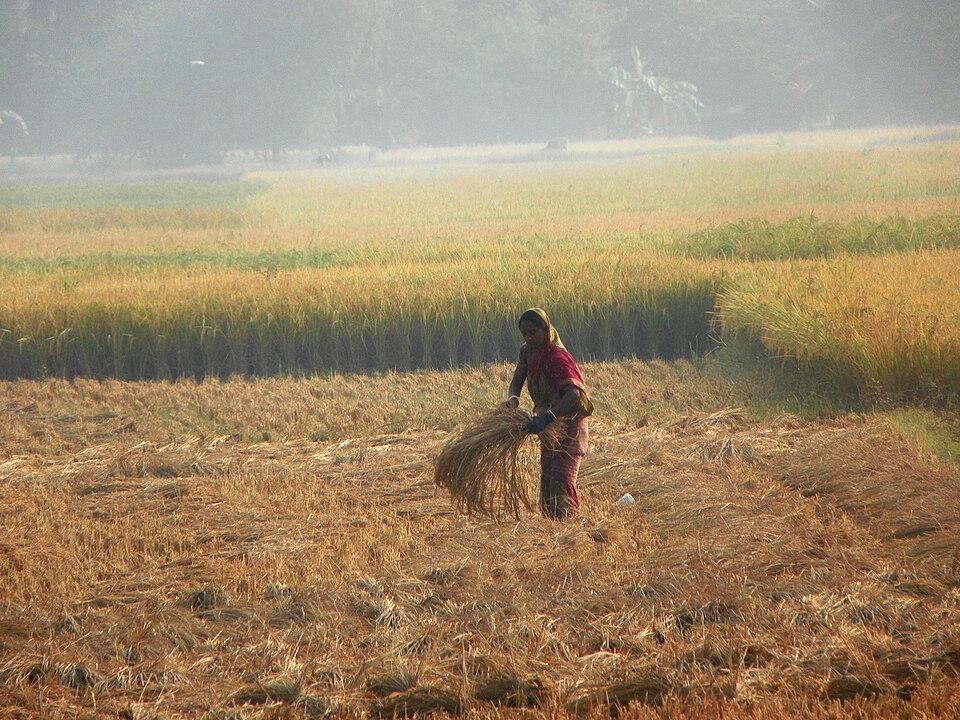
- Reading 'tebhaga' as one-third for the peasant — it is two-thirds for the sharecropper
- Confusing Tebhaga (sharecroppers' crop share, Bengal) with Telangana (armed struggle against the Nizam's landlords)
- Dating it to 1947 because that is when it collapsed, not when it began
MPPSC asks the bare year or month; UPSC asked the demand itself in 2013 (share reduced from one-half to one-third for the landlord). Fix both faces: September 1946, and two-thirds of the crop to the bargadar.
The demand for the Tebhaga Peasant Movement in Bengal was for
- (a) the reduction of the share of the landlords from one-half of the crop to one-third
- (b) the grant of ownership of land to peasants as they were the actual cultivators of the land
- (c) the uprooting of Zamindari system and the end of serfdom
- (d) writing off all peasant debts
Answer(a) the reduction of the share of the landlords from one-half of the crop to one-third
The same movement asked from the other side — UPSC wanted its demand (two-thirds to the sharecropper), MPPSC wants its date.
- practice — not a real PYQ
The Tebhaga movement of 1946-47 was organised by:
- (a)The Bengal Provincial Kisan Sabha
- (b)The Bengal Landholders' Association
- (c)The Home Rule League
- (d)The Bengal Provincial Congress Committee
Answer(a) The Bengal Provincial Kisan Sabha — the Communist-led provincial unit of the All India Kisan Sabha. - practice — not a real PYQ
Operation Barga, which recorded sharecroppers and secured their share of the crop, was carried out in:
- (a)Kerala
- (b)West Bengal
- (c)Bihar
- (d)Andhra Pradesh
Answer(b) West Bengal — launched in 1978, it registered bargadars and gave them permanent, heritable cultivation rights, delivering by law what the tebhaga agitation had demanded in the field.