
Optical fibre cables are used for high-speed and long-distance data transmission. Splicing of optical fibres means:
- (a)Bending of optical fibres
- (b)Drawing of optical fibres
- (c)Joining of optical fibres
- (d)Cutting of optical fibres
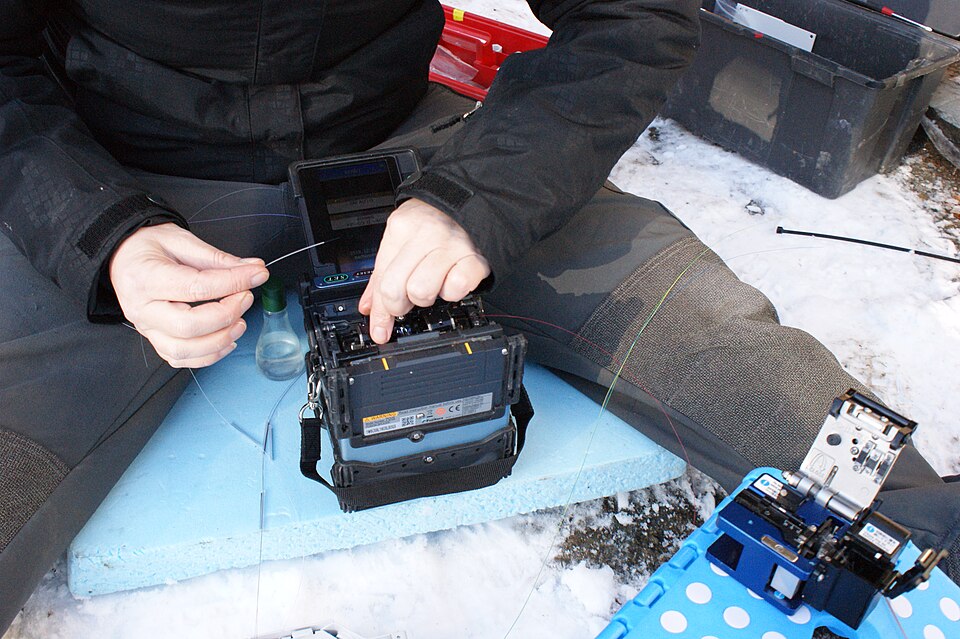
Correct — C, joining of optical fibres. Splicing is the permanent joining of two fibre ends so that light crosses the junction with minimal loss. It is done either by fusion splicing — the two cleaved ends are aligned and melted together with an electric arc — or by mechanical splicing, where the ends are held aligned in a sleeve with an index-matching gel. Long-haul cables have to be built from fibre lengths of limited size, so splices are what turn many spools into one continuous link; a splice is permanent and has lower insertion loss than a removable connector.
- (a)Bending of optical fibres — Bending is not a joining operation — and excessive bending is a defect, not a technique: macrobends and microbends let light escape the core, causing 'bend loss'. Installation standards specify a minimum bend radius for exactly this reason.
- (b)Drawing of optical fibres — Drawing is a manufacturing step, not a field operation: fibre is drawn (pulled) from a heated glass preform in a drawing tower to produce the hair-thin fibre in the first place. It happens before the cable ever reaches the site.
- (d)Cutting of optical fibres — The controlled cut of a fibre has its own name — cleaving, done with a cleaver to leave a flat, perpendicular end face. Cleaving is the preparation step just before splicing, not splicing itself.
An optical fibre guides light by total internal reflection: a glass core of higher refractive index is surrounded by cladding of lower refractive index, so light striking the boundary beyond the critical angle is reflected back into the core and travels the length of the fibre. Because fibre is manufactured and shipped in finite lengths, a real network is assembled by joining lengths end to end — permanently by splicing, or removably by connectors. Every joint costs some signal (splice loss), so the alignment quality of the joint is what decides link performance over long distances.
The question is really a vocabulary check on the optical-fibre lifecycle: drawing (making it) → cleaving (cutting it cleanly) → splicing (joining it) → bending (what you must avoid). Each wrong option is a genuine fibre-optics term used for a different step, which is what makes them tempting. Reason by stage rather than by the sound of the word.
- Splicing = permanently joining two optical fibres; two methods — fusion splicing (electric arc fuses the ends) and mechanical splicing (alignment sleeve with index-matching gel).
- Optical fibre transmits light by total internal reflection; the core has a higher refractive index than the cladding.
- Cleaving is the precise cut that prepares a flat end face before splicing; drawing is pulling fibre from a heated preform during manufacture.
- A splice is a permanent joint with low insertion loss; a connector is a removable joint with higher loss.
- Fibre is preferred for long-distance, high-speed links because of very low attenuation, huge bandwidth and immunity to electromagnetic interference.
- Reading 'splicing' as 'slicing' and selecting cutting — the cutting operation is called cleaving.
- Assuming optical fibre works by ordinary refraction; it works by total internal reflection.
- Thinking a bend is a technique — bending is a loss mechanism, controlled by a minimum bend radius.
UPSC asks the physics ('optical fibre works on the principle of…', 'endoscopy is based on…'); MPPSC asks the technology vocabulary and applications. Prepare the pair together: principle = total internal reflection, and the process words drawing / cleaving / splicing.
Optical fibre works on the principle of
- (a) total internal reflection
- (b) refraction
- (c) scattering
- (d) interference
Answer(a) total internal reflection
The same technology, tested one layer deeper — UPSC asks the physical principle that makes a spliced fibre link carry light at all.
Endoscopy, a technique used to explore the stomach or other inner parts of the body is based on the phenomenon of
- (a) total internal reflection
- (b) interference
- (c) diffraction
- (d) polarisation
Answer(a) total internal reflection
Optical-fibre bundles again — the medical application of the same fibre-optic principle, a favourite UPSC framing of this topic.
- practice — not a real PYQ
Optical fibre transmits light signals over long distances mainly because of:
- (a)Total internal reflection within the core
- (b)Diffraction at the fibre ends
- (c)Polarisation of light in the cladding
- (d)Interference between adjacent fibres
Answer(a) Total internal reflection — the core's refractive index is higher than the cladding's, so light beyond the critical angle stays trapped in the core. - practice — not a real PYQ
In fibre-optic work, 'cleaving' refers to:
- (a)Coating the fibre with a protective buffer
- (b)Making a clean, flat cut across the fibre end before joining
- (c)Permanently fusing two fibres with an electric arc
- (d)Pulling fibre from a heated glass preform
Answer(b) Making a clean, flat cut across the fibre end — the preparation step before splicing.