
In computer, BIOS stands for:
- (a)Binary Input/Output System
- (b)Basic Input/Output System
- (c)Bit Input/Output System
- (d)Byte Input/Output System
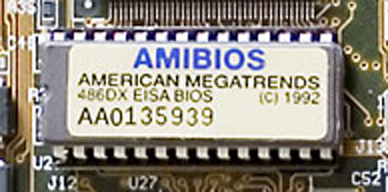
Correct — B, Basic Input/Output System. BIOS is the firmware permanently held on a non-volatile chip (ROM/flash) on the motherboard. The moment a PC is switched on, the BIOS runs the POST (Power-On Self-Test), initialises the basic input and output hardware — keyboard, display, drives — and then loads the bootloader, handing control to the operating system. The name describes exactly that job: the basic routines through which the processor talks to input/output devices.
- (a)Binary Input/Output System — 'Binary' sounds plausible because computers work in binary, and that is precisely why this is the most-chosen wrong option — but there is no firmware standard by this name. The B in BIOS is 'Basic'.
- (c)Bit Input/Output System — Not a real term. A bit is the smallest unit of data; it has nothing to do with what the boot firmware is called.
- (d)Byte Input/Output System — Not a real term either. A byte (8 bits) is a unit of storage, not the name of the motherboard's start-up firmware.
BIOS is firmware — software burned into a hardware chip — that sits between the physical machine and the operating system. It is stored on a non-volatile ROM/flash chip on the motherboard so it survives power-off, unlike anything held in RAM. On power-up it performs the POST, detects and initialises attached hardware, and then reads the boot sector and passes control to the operating system's loader. User-changeable settings (boot order, system time, hardware toggles) are kept in a small CMOS memory powered by a button-cell battery on the board.
MPPSC's computer-awareness block is dominated by acronym full-forms — BIOS, RAM, ROM, URL, W3C, MPEG, DNS. The examiner builds the wrong options by swapping in a computing word that 'feels' technical (Binary, Bit, Byte). The safe habit is to recall what the device actually does — 'the basic routines for input/output' — and let the meaning fix the word, instead of picking the most technical-sounding option.
- BIOS = Basic Input/Output System — firmware stored on a ROM/flash chip on the motherboard (non-volatile, not in RAM).
- On start-up it runs POST (Power-On Self-Test), initialises hardware, then loads the bootloader and hands over to the OS.
- BIOS settings are stored in CMOS memory kept alive by a small button-cell battery on the motherboard.
- The term was coined by Gary Kildall and first appeared in the CP/M operating system in 1975.
- Modern PCs use UEFI (Unified Extensible Firmware Interface), which has largely replaced legacy BIOS though people still call it 'the BIOS'.
- Choosing 'Binary' because computers are binary — the B stands for Basic.
- Believing BIOS is loaded into RAM at start-up; it lives on a non-volatile chip precisely so it is available before RAM holds anything useful.
- Confusing BIOS (firmware in hardware) with the operating system kernel (software loaded from disk).
Almost always a straight full-form MCQ ('BIOS/ROM/DNS stands for…') or a one-line function question ('which program runs first when a computer is switched on?'). Lock the pair: BIOS ↔ Basic Input/Output System ↔ runs POST and boots the machine.
The central part of the UNIX Operating System is:
- (a) Command Shell
- (b) Kernel
- (c) Directories and Program
- (d) Files
Answer(b) Kernel
Same concept tested from the other side of the boot handover — MPPSC 2024 asked for the core of the operating system (kernel), 2026 asks for the firmware layer beneath it (BIOS) that loads that kernel.
- practice — not a real PYQ
In a personal computer, the BIOS is stored in:
- (a)RAM
- (b)Cache memory
- (c)A non-volatile ROM/flash chip on the motherboard
- (d)The hard disk's data partition
Answer(c) A non-volatile ROM/flash chip on the motherboard — it must be available before RAM or the disk is usable. - practice — not a real PYQ
The self-check of hardware performed immediately when a computer is switched on is called:
- (a)POST (Power-On Self-Test)
- (b)Defragmentation
- (c)Formatting
- (d)Compilation
Answer(a) POST — the Power-On Self-Test carried out by the BIOS/UEFI firmware before the operating system loads.