
LED is a digital display used in calculators, watches etc. LED stands for:
- (a)Light Emitting Display
- (b)Liquid Electronic Display
- (c)Light Emitting Diode
- (d)Liquid Electronic Diode
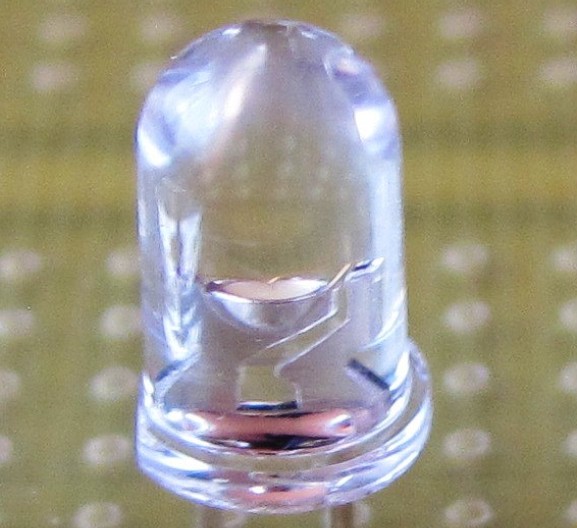
Correct — C, Light Emitting Diode. An LED is a semiconductor p–n junction diode that gives out light when it is forward biased: electrons crossing the junction recombine with holes and release the energy as photons, a process called electroluminescence. The colour depends on the band gap of the semiconductor used. The seven-segment displays in calculators and digital watches are simply small LEDs arranged in a figure-of-eight pattern, which is why the question ties the acronym to those devices.
- (a)Light Emitting Display — The first half is right but the 'D' is Diode, not Display. The LED is the individual light-emitting component; a display is what you build by arranging many of them (as in a seven-segment or LED panel display).
- (b)Liquid Electronic Display — This mixes LED up with LCD — Liquid Crystal Display. An LCD contains liquid crystals that only block or pass light and therefore needs a backlight or ambient light; an LED generates its own light. Note also that 'Liquid Electronic' is not the expansion of LCD either.
- (d)Liquid Electronic Diode — No such device exists. There is nothing liquid in an LED — it is a solid-state semiconductor component made from doped crystals such as gallium arsenide or indium gallium nitride.
A diode is a p–n junction that conducts in one direction only. In an LED the semiconductor is chosen so that the energy released when electrons and holes recombine comes out as visible (or infrared) light rather than only heat — electroluminescence. Because the photon energy equals the band gap, the material fixes the colour: gallium arsenide gives infrared/red, gallium phosphide green, indium gallium nitride blue. Combining a blue LED with a yellow phosphor is how white LED lamps are made.
Exams pair LED with LCD to see whether you know that one emits light and the other merely controls it. Remember the display chain: LED (emits) → LCD (needs a backlight) → OLED (organic, self-emitting and flexible). If the expansion has 'Liquid' in it, it belongs to LCD, not LED.
- LED = Light Emitting Diode — emits light when forward biased (electroluminescence)
- Colour is set by the band gap of the semiconductor material, not by any coating or filter
- Nick Holonyak Jr. made the first practical visible-spectrum (red) LED in 1962 at General Electric
- The 2014 Nobel Prize in Physics went to Isamu Akasaki, Hiroshi Amano and Shuji Nakamura for efficient blue LEDs, which made white LED lighting possible
- LCD (Liquid Crystal Display) does not emit light of its own — it needs a backlight or reflected light
- Expanding the 'D' as Display instead of Diode
- Swapping LED and LCD — 'Liquid' always belongs to LCD
- Thinking an LED works in reverse bias; it emits only when forward biased
MPPSC keeps it at acronym level; UPSC goes one step deeper into properties and advantages (its 2017 question compared OLED with LCD). Prepare both the expansion and the emits-vs-blocks distinction.
Organic Light Emitting Diodes (OLEDs) are used to create digital display in many devices. What are the advantages of OLED displays over Liquid Crystal displays? 1. OLED displays can be fabricated on flexible plastic substrates. 2. Roll-up displays embedded in clothing can be made using OLEDs. 3. Transparent displays are possible using OLEDs. Select the correct answer using the code given below:
- (a) 1 and 3 only
- (b) 2 only
- (c) 1, 2 and 3
- (d) None of the above statements is correct
Answer(c) 1, 2 and 3
Same concept one level up — light-emitting diode displays (the organic version) set against liquid crystal displays, exactly the LED-vs-LCD distinction this MPPSC question is testing through its distractors.
- practice — not a real PYQ
A light emitting diode (LED) produces light when it is:
- (a)reverse biased
- (b)forward biased
- (c)unbiased
- (d)short circuited
Answer(b) forward biased — electrons and holes recombine across the junction and release the energy as photons. - practice — not a real PYQ
The Nobel Prize in Physics 2014 was awarded for the invention of efficient LEDs of which colour, which made bright white LED lamps possible?
- (a)Red
- (b)Blue
- (c)Green
- (d)Infrared
Answer(b) Blue — awarded to Isamu Akasaki, Hiroshi Amano and Shuji Nakamura; red and green LEDs already existed, and the blue one completed the set needed for white light.