
In computer, EPROM stands for:
- (a)Electrically Programmable Read-Only Memory
- (b)Electronically Programmable Read-Only Memory
- (c)Extended Programmable Read-Only Memory
- (d)Erasable Programmable Read-Only Memory
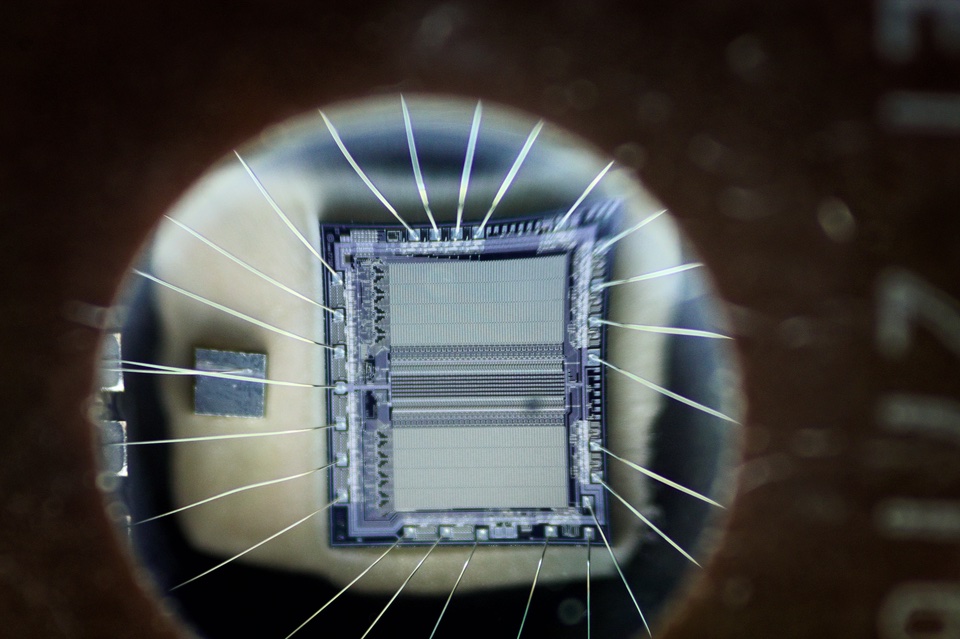
Correct — D, Erasable Programmable Read-Only Memory. An EPROM is a non-volatile ROM chip (it keeps its contents with the power off) that, unlike an ordinary PROM, can be wiped clean and re-programmed. It is erased by shining ultraviolet light through the transparent quartz window on top of the package — that window is the visual give-away of an EPROM — and is then re-written with a special programming voltage. The first one, Intel's 1702 (1971), was designed by Dov Frohman at Intel.
- (a)Electrically Programmable Read-Only Memory — The tempting near-miss. The first 'E' in EPROM is Erasable, not Electrically. 'Electrically' belongs to the next member of the family — EEPROM (Electrically Erasable PROM), which is erased by applying a voltage instead of ultraviolet light.
- (b)Electronically Programmable Read-Only Memory — Not a standard term. Every ROM variant is programmed electronically, so the word distinguishes nothing; the name has to convey what is special about the chip, which is that it can be erased and reused.
- (c)Extended Programmable Read-Only Memory — There is no such device. The recognised ROM family is MROM (mask-programmed at the factory), PROM (one-time programmable), EPROM, EEPROM and flash memory — 'Extended PROM' is not among them.
Computer memory splits first by volatility. RAM is volatile — switch the power off and its contents vanish. ROM is non-volatile — it holds data without power, which is why the boot firmware/BIOS lives there. Within ROM there is a ladder of increasing re-writability: MROM is fixed at manufacture, PROM can be written once by the user, EPROM can be erased with UV light and re-written many times, EEPROM is erased electrically byte-by-byte, and flash memory (the basis of pen drives and SSDs) erases electrically in blocks.
MPPSC almost always asks this as a pure acronym expansion, and the paper-setter's trap is to put a plausible 'Electrically…' option next to the true 'Erasable…' one. Fix the meaning to the mechanism: E-PROM is the chip you erase with ultraviolet light, EE-PROM is the one you erase electrically. Once the mechanism is in your head, the expansion follows automatically.
- EPROM = Erasable Programmable Read-Only Memory — non-volatile, but erasable and re-programmable
- Erased by ultraviolet light through the quartz window on the chip package; EEPROM is erased electrically
- ROM family in order of flexibility: MROM → PROM (one-time) → EPROM → EEPROM → flash
- Intel 1702 (1971), designed by Dov Frohman, was the first EPROM
- ROM is non-volatile (keeps data without power); RAM is volatile (loses it)
- Reading the 'E' in EPROM as 'Electrically' — that is EEPROM
- Assuming ROM can never be written to; EPROM/EEPROM/flash are all ROM-family chips that can be re-written
- Calling RAM a type of secondary memory — RAM is primary memory
Both MPPSC and UPSC keep this at the definition level — 'X stands for', 'which memory is non-volatile', 'which of these is NOT secondary memory' — so learn the acronym and the volatility table together.
No directly related past PYQ was found.
- practice — not a real PYQ
An EPROM chip is normally erased by exposing it to:
- (a)a strong magnetic field
- (b)ultraviolet light
- (c)X-rays
- (d)high-pressure steam
Answer(b) ultraviolet light — shone through the quartz window on the chip; EEPROM, by contrast, is erased electrically. - practice — not a real PYQ
Which one of the following computer memories is volatile, i.e. it loses its contents when the power is switched off?
- (a)ROM
- (b)EPROM
- (c)RAM
- (d)Flash memory
Answer(c) RAM — random access memory is volatile; ROM, EPROM and flash all retain data without power.