
From where was Chandrayaan-3 launched and what was unique about its landing site?
- (a)Satish Dhawan Space Centre (SHAR), Sriharikota — Near the moon's south polar region
- (b)Vikram Sarabhai Space Centre, Thiruvananthapuram — Equatorial region of the moon
- (c)Sriharikota — Near the moon's north pole
- (d)SDSC, Sriharikota — On the far side of the moon
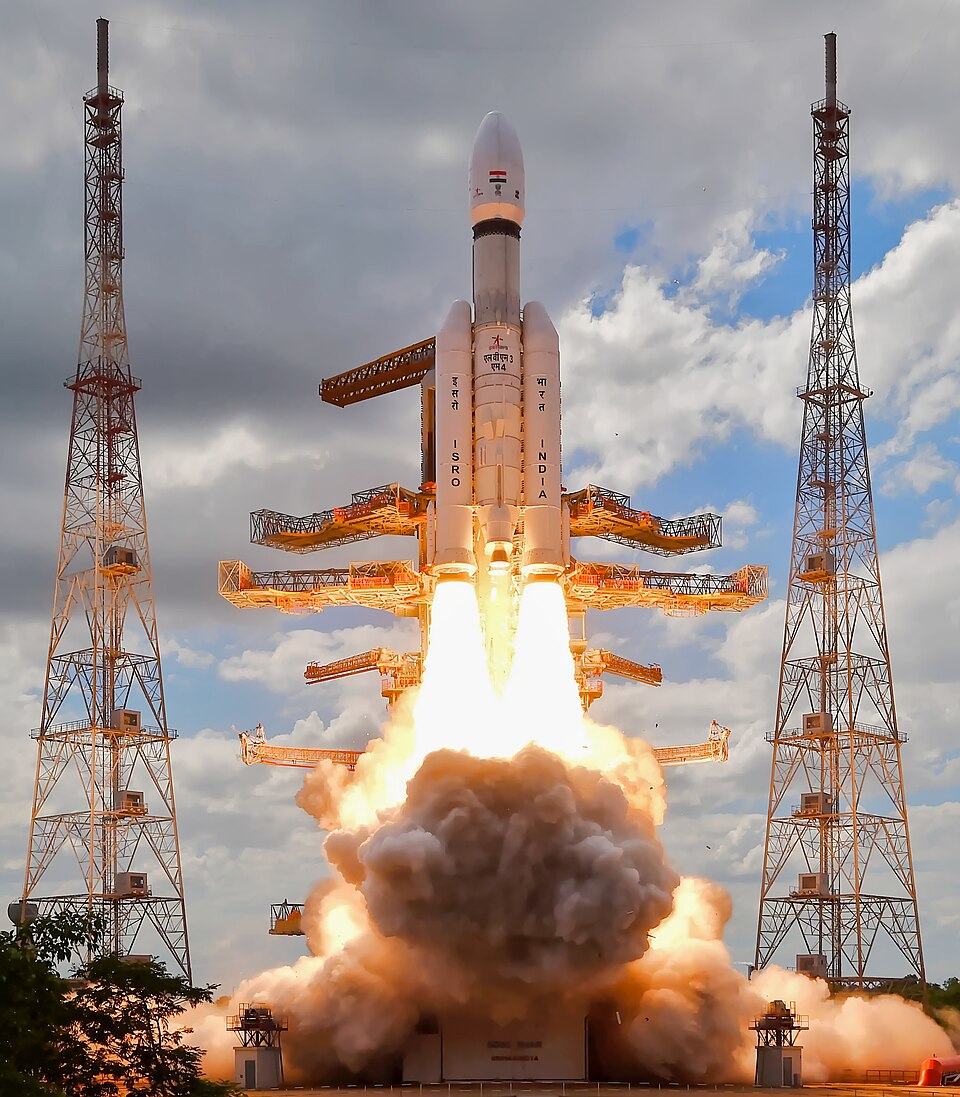
Correct — A. Chandrayaan-3 lifted off on 14 July 2023 aboard an LVM3 (mission LVM3-M4) from the Second Launch Pad of the Satish Dhawan Space Centre, SDSC-SHAR, Sriharikota — India's only orbital launch site. Its Vikram lander made a soft landing on 23 August 2023 at roughly 69° south latitude, in the rugged high-latitude terrain near the Moon's south polar region. That made India the first country to soft-land near the lunar south pole, and the fourth country to soft-land on the Moon at all after the USSR, the USA and China.
- (b)Vikram Sarabhai Space Centre, Thiruvananthapuram — Equatorial region of the moon — Both halves are wrong. VSSC at Thiruvananthapuram is ISRO's launch-vehicle design and development centre, not a launch site — India's orbital launches all go from Sriharikota. And the landing was in the southern high latitudes, not near the lunar equator (where earlier Soviet and American landers touched down).
- (c)Sriharikota — Near the moon's north pole — The launch site is right but the pole is wrong. The whole scientific interest of Chandrayaan-3 lay in the south polar region, where permanently shadowed craters may hold water ice.
- (d)SDSC, Sriharikota — On the far side of the moon — The launch site is right, but Vikram landed on the near side of the Moon. Only China's Chang'e missions have soft-landed on the lunar far side.
Chandrayaan-3 was ISRO's follow-up to the Chandrayaan-2 landing failure of 2019: a propulsion module, the Vikram lander and the Pragyan rover, with a redesigned, failure-tolerant landing sequence. It carried no orbiter of its own because Chandrayaan-2's orbiter, still healthy in lunar orbit, provided the relay and imaging support. The south polar region was chosen because the Sun stays low there and crater floors never receive sunlight, so volatiles such as water ice can survive — but the same low Sun angle and broken terrain make landing far harder than at the equator.
The question pairs two facts, so eliminate on either half. VSSC is a development centre, not a launch pad — that removes (b) at once. Sriharikota is common to (a), (c) and (d), so the decision rests entirely on the landing site: south polar region, near side. If you remember '23 August, near the south pole, National Space Day', the answer falls out.
- Launched 14 July 2023 on LVM3-M4 from the Second Launch Pad, SDSC-SHAR, Sriharikota
- Vikram soft-landed on 23 August 2023 at about 69° S — at the time the highest-latitude lunar landing by any country (later passed by the US IM-1 lander at 80.13° S in February 2024)
- India became the fourth nation to soft-land on the Moon and the first to land near the south pole
- The landing site was named 'Shiv Shakti' (Statio Shiva Shakti); the rover carried was Pragyan
- 23 August is now observed in India as National Space Day
- Confusing VSSC, Thiruvananthapuram (launch-vehicle development) with SDSC-SHAR, Sriharikota (the launch site)
- Saying Chandrayaan-3 landed 'at the south pole' — it landed near the south polar region, at about 69° S
- Assuming it landed on the far side; far-side soft landings have been achieved only by China's Chang'e missions
Expect launch date, launch vehicle, launch site, landing date and landing-site name to be shuffled into pairs or match-the-list sets. Lock the full string: 14 July 2023 · LVM3-M4 · Sriharikota · 23 August 2023 · Shiv Shakti · ~69° S.
- practice — not a real PYQ
On which date did the Vikram lander of Chandrayaan-3 soft-land on the Moon?
- (a)22 July 2019
- (b)23 August 2023
- (c)14 July 2023
- (d)6 September 2019
Answer(b) 23 August 2023 — 14 July 2023 was the launch date, and the 2019 dates belong to Chandrayaan-2. - practice — not a real PYQ
Why is the Moon's south polar region of special scientific interest?
- (a)Its permanently shadowed craters may hold water ice
- (b)It is the only part of the Moon with an atmosphere
- (c)It has active volcanoes
- (d)It is the only region visible from the Earth
Answer(a) Crater floors there never receive sunlight, so volatiles such as water ice can survive — a potential resource for future missions.