
How were the members of the Indian Constituent Assembly elected?
- (a)Directly by the people of India
- (b)Indirectly by the members of the Provincial Legislative Assemblies
- (c)Nominated by the Governor-General
- (d)Indirectly by the Provincial Committees of the Congress
Correct — B, indirectly by the members of the Provincial Legislative Assemblies. The Constituent Assembly was constituted in 1946 under the Cabinet Mission Plan: the seats allotted to each British-Indian province were filled by the elected members of that province's Legislative Assembly, voting by the single transferable vote system of proportional representation. No seat was filled by a popular vote — the electoral college was the provincial legislators themselves, who had been returned in the 1946 provincial elections on a restricted (non-universal) franchise. The princely states' seats were not elected at all; those representatives were to be nominated by the rulers of the states.
- (a)Directly by the people of India — There was no direct election to the Constituent Assembly and no universal adult franchise behind it. India's first direct election on universal adult franchise was the 1951-52 general election, held after the Constitution had already been adopted and brought into force.
- (c)Nominated by the Governor-General — The Governor-General had no power to nominate members of the Assembly. Nomination applied only to the seats reserved for the princely states, and there the nominating authority was the ruler of the state concerned — not the Governor-General.
- (d)Indirectly by the Provincial Committees of the Congress — Party organisations had no formal role in the election. The Congress, the Muslim League and others won seats in proportion to their strength inside each Provincial Legislative Assembly — the electing body was the legislature, not any party committee.
The Constituent Assembly was an indirectly elected body created under the Cabinet Mission Plan of 1946. Of its total strength of 389, 296 seats were allotted to British India and 93 to the princely states. The British-Indian seats were distributed among the provinces roughly in proportion to population — about one seat per million people — and, within each province, among three communities: Muslims, Sikhs and General. The elected members of each Provincial Legislative Assembly then chose their province's representatives by proportional representation with a single transferable vote.
The word 'elected' is the trap: it invites you to think of a popular vote. It was an election, but an indirect one, with sitting provincial legislators acting as the electoral college. Two clean tests settle almost every question in this area — (i) the Assembly was NOT based on universal adult franchise, and (ii) princely-state members were nominated by rulers, not elected at all. That indirect, limited-franchise base is exactly why the Assembly's representative character was contested at the time.
- Constituted in 1946 under the Cabinet Mission Plan; total strength 389 (296 British India + 93 princely states), reduced to 299 after Partition.
- Provincial members were elected by the elected members of the Provincial Legislative Assemblies through proportional representation with a single transferable vote.
- Seats were allotted to provinces roughly in proportion to population (about one seat per million) and divided within each province among Muslims, Sikhs and General.
- Representatives of the princely states were to be nominated by the rulers, not elected.
- First sitting: 9 December 1946. Dr Sachchidananda Sinha was the provisional Chairman; Dr Rajendra Prasad was elected permanent President on 11 December 1946.
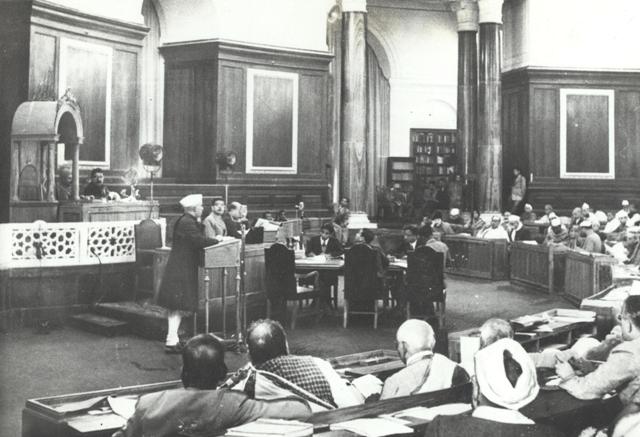
- Reading 'elected' as 'directly elected by the people' — it was an indirect election by provincial legislators.
- Assuming princely-state members were also elected — they were nominated by the rulers.
- Confusing the Cabinet Mission Plan, which actually created the Assembly, with the Cripps Mission, which only proposed one.
MPPSC and UPSC both ask this as a one-line factual — 'the members of the Constituent Assembly were ___'. Lock three anchors: Cabinet Mission Plan, indirect election by Provincial Legislative Assemblies, nomination for the princely states.
With reference to Indian History, the Members of the Constituent Assembly from the Provinces were
- (a) directly elected by the people of those Provinces
- (b) nominated by the Indian National Congress and the Muslim League
- (c) elected by the Provincial Legislative Assemblies
- (d) selected by the Government for their expertise in constitutional matters
Answer(c) elected by the Provincial Legislative Assemblies
Same question in all but wording — UPSC 2013 tests the identical fact that provincial members of the Constituent Assembly were chosen by the Provincial Legislative Assemblies, not by the people.
The members of the Constituent Assembly which drafted the Constitution of India were
- (a) nominated by the British Parliament
- (b) nominated by the Governor General
- (c) elected by the Legislative Assemblies of various provinces
- (d) elected by the Indian National Congress and Muslim League
Answer(c) elected by the Legislative Assemblies of various provinces
UPSC 2002 used the same four traps — British Parliament, Governor-General, provincial legislatures, party bodies — and the same correct idea: indirect election by the provincial legislatures.
The Constituent Assembly was formed under which plan?
- (a) Cripps Mission Plan
- (b) Cabinet Mission Plan
- (c) Simon Commission
- (d) None of these
Answer(b) Cabinet Mission Plan
The other half of the same fact: MPPSC 2023 asked which plan created the Assembly — the Cabinet Mission Plan is precisely the scheme that prescribed indirect election by the Provincial Legislative Assemblies.
- practice — not a real PYQ
The Constituent Assembly of India was constituted under the provisions of:
- (a)The Cripps Mission proposals, 1942
- (b)The Cabinet Mission Plan, 1946
- (c)The Government of India Act, 1935
- (d)The Mountbatten Plan, 1947
Answer(b) The Cabinet Mission Plan, 1946 — under which elections to the provincial quota were held in July-August 1946. - practice — not a real PYQ
Which voting method did the Provincial Legislative Assemblies use to elect members to the Constituent Assembly?
- (a)First-past-the-post in single-member constituencies
- (b)Proportional representation by means of a single transferable vote
- (c)Open ballot decided by a simple majority
- (d)Nomination by the Governor of the province
Answer(b) Proportional representation by means of a single transferable vote.