
While living in which Ashram did a person have to perform the rituals of Panch Mahayagya ?
- (a)Brahmacharya Ashram
- (b)Grihastha Ashram
- (c)Vanaprastha Ashram
- (d)Sanyas Ashram
Correct — B, Grihastha Ashram. The Panch Mahayajnas are the five 'great sacrifices' laid down as the daily duty of the householder: brahma-yajna (study and recitation of the Vedas, the debt to the sages), deva-yajna (the fire offering, homa, to the gods), pitri-yajna (tarpana, the offering to the ancestors), bhuta-yajna (bali, food set aside for all creatures) and manushya-yajna or atithi-yajna (hospitality to the guest). Every one of these presupposes what only a grihastha has — a home, a maintained domestic fire, dependants, guests at the door and the means to feed others. The Grihya Sutras and Manusmriti (Chapter III) prescribe them precisely for the householder, and this is the stage in which the three rinas (debts) — to the rishis, the devas and the pitris — are discharged.
- (a)Brahmacharya Ashram — The student stage. The brahmachari's duties are Vedic study under a guru, celibacy, service and living on alms — he keeps no household of his own, no domestic fire and no dependants, so the five daily offerings that revolve around the home cannot be his obligation. He is in fact one of those whom the householder supports.
- (c)Vanaprastha Ashram — The forest-dweller does not drop the five great sacrifices — Manusmriti VI.4-5 has him carry the sacred fires and domestic implements into the forest and go on offering them with wild food. But they are the householder's defining daily round, sustained from his own hearth and stores, which is what the question is asking about.
- (d)Sanyas Ashram — The renunciant abandons the sacred fires and outward ritual altogether — the fires are said to be internalised — and lives by begging. Since the mahayajnas are fire-and-household observances, they are the one thing sanyasa formally sets aside.
The ashrama scheme divides an ideal life into four stages — brahmacharya (student), grihastha (householder), vanaprastha (forest-dweller) and sanyasa (renunciant) — and assigns a different set of duties to each. The householder stage is the economically and ritually productive one: it supports the other three, and it carries the daily ritual load, of which the Panch Mahayajna is the core. The whole scheme, together with varna, forms the varnashrama-dharma of the Dharmashastra texts.
The temptation is to associate 'yajna' with priests and asceticism and therefore with the vanaprastha or sanyasa stages. Reverse the reasoning: ask which stage owns the things the five sacrifices need — a house, a fire, a family, guests. That is only the grihastha. Manusmriti makes the same point directly, saying that as all beings depend on air, so all the other ashramas depend on the householder.
- The five: brahma-yajna (Vedic study), deva-yajna (fire offering/homa), pitri-yajna (tarpana to ancestors), bhuta-yajna (bali, food for all creatures), manushya-yajna (atithi-puja, hospitality to guests).
- They are prescribed for the householder in the Grihya Sutras and in Manusmriti, Chapter III.
- The three rinas — debts to the rishis (repaid by study), the devas (by sacrifice) and the pitris (by raising a family) — are discharged in the grihastha stage.
- Manusmriti treats the grihastha ashrama as the support of all four stages, because the student, the forest-dweller and the renunciant are all sustained by the householder.
- The four ashramas in order: brahmacharya, grihastha, vanaprastha, sanyasa.
- Sanyasa involves formally giving up the sacred fires and outward ritual; brahmacharya is defined by study, celibacy and service to the guru.
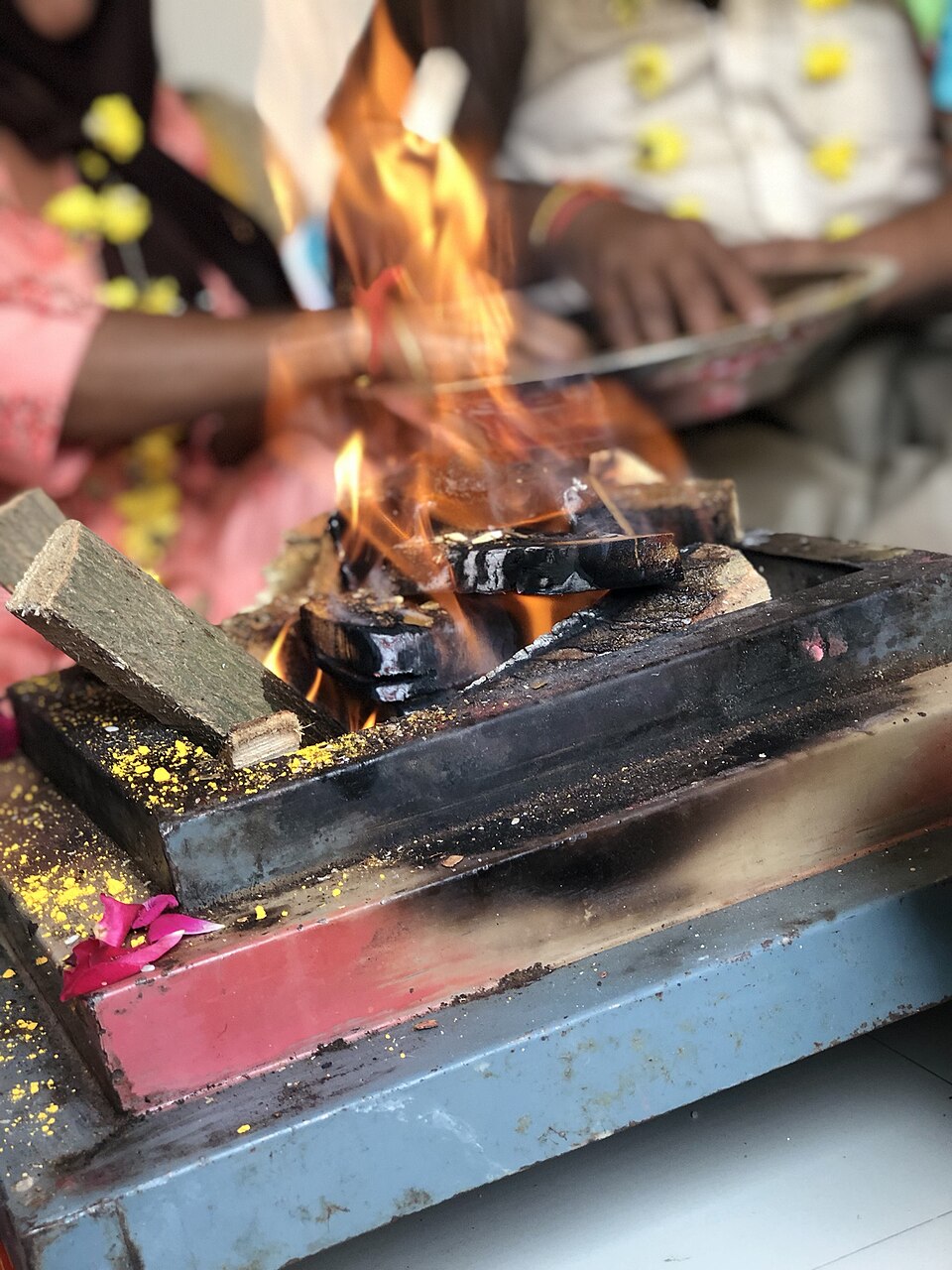
- Assuming ritual duty grows heavier as one moves towards renunciation — it is the opposite; sanyasa sheds the fires and the rites
- Confusing the five daily Panch Mahayajnas with the great shrauta sacrifices such as Rajasuya or Ashvamedha, which are royal and occasional
- Mixing up varna (the four-fold social order) with ashrama (the four stages of an individual life) — MPPSC has asked about both
MPPSC asks it as direct recall — name the stage, name the five, or match a Sanskrit term to its meaning. UPSC prefers to test the same ancient-social-institutions block through terminology and text-attribution questions, so keep each Sanskrit term tied to both its meaning and the text that prescribes it.
The religion of early Vedic Aryans was primarily of
- (a) Bhakti
- (b) image worship and Yajnas
- (c) worship of nature, and Yajnas
- (d) worship of nature and Bhakti
Answer(c) worship of nature, and Yajnas
Same underlying idea — yajna, not image worship or bhakti, was the organising act of Vedic religious life; the Panch Mahayajna is that obligation reduced to a householder's daily routine.
- practice — not a real PYQ
Which one of the following is NOT one of the Panch Mahayajnas?
- (a)Brahma-yajna
- (b)Deva-yajna
- (c)Rajasuya-yajna
- (d)Bhuta-yajna
Answer(c) Rajasuya-yajna — a royal consecration sacrifice, not one of the five daily household offerings; the fifth is manushya-yajna (hospitality to guests). - practice — not a real PYQ
The three rinas (debts) that a householder is traditionally expected to discharge are owed to:
- (a)Devas, Rishis and Pitris
- (b)Devas, Guru and the King
- (c)Rishis, Guests and Animals
- (d)Pitris, Brahmanas and Agni
Answer(a) Devas, Rishis and Pitris — repaid respectively through sacrifice, Vedic study and raising a family, all duties of the grihastha stage.