
Which of the following books was not written by Keshavdas?
- (a)Ramchandrika
- (b)Kavipriya
- (c)Ratan Bavani
- (d)Ram Rasayan
Correct — D, Ram Rasayan. Keshavdas Mishra (c. 1555–1617), the court poet of Orchha, has a well-fixed canon: Ratan Bavani (his earliest work, c. 1581), Rasikpriya (1591), Kavipriya, Ramchandrika, Chhandmala, Virsinghdev Charit, Vigyan Gita and Jahangir Jas Chandrika. 'Ram Rasayan' does not appear anywhere in that list — the title belongs to a separate body of later Rama-devotional writing by other authors. The question is a 'which one is NOT his' pattern, and the odd title out is the one option that is never listed among Keshavdas's works.
- (a)Ramchandrika — This IS by Keshavdas — his Braj-bhasha retelling of the Rama story, and one of his best-known compositions. MPPSC itself asked in 2023 'Whose famous work is Ramchandrika?' with Keshavdas as the answer.
- (b)Kavipriya — This IS by Keshavdas — a lakshan-grantha (a treatise that defines poetic devices with illustrations), composed at the Orchha court alongside his other work on poetics.
- (c)Ratan Bavani — This IS by Keshavdas — regarded as his earliest work (c. 1581), a 'bavani' (52-verse) eulogy of a Bundela hero of Orchha.
Keshavdas is the hinge figure between Hindi's Bhakti-kaal and its Riti-kaal. He served the Bundela rulers of Orchha — Madhukar Shah and his son Indrajit Singh — and wrote in Braj bhasha. His Rasikpriya (1591) is a lakshan-grantha: a systematic manual of poetics, nayak–nayika classification and rasa, illustrated with his own verses. Because he codified poetry into rules, he is called the father of the Riti-kaal, the 'mannered' phase in which craft and convention took priority over devotional feeling.
'Which is NOT written by X' questions are answered by knowing the canon, not the outlier. Three of these four titles — Ramchandrika, Kavipriya, Ratan Bavani — appear in every standard list of Keshavdas's works, and MPPSC has itself examined two of them before. The fourth title is the only one you will never find in those lists, which is exactly why it was chosen as the answer.
- Keshavdas Mishra (c. 1555–1617) was court poet at Orchha (Madhya Pradesh) under the Bundela rulers Madhukar Shah and Indrajit Singh.
- Rasikpriya (1591) is his foundational lakshan-grantha; Keshavdas is therefore called the father of the Riti-kaal of Hindi literature.
- His accepted works include Ratan Bavani (c. 1581), Rasikpriya, Kavipriya, Ramchandrika, Chhandmala, Virsinghdev Charit, Vigyan Gita and Jahangir Jas Chandrika.
- The Rasikpriya's love themes became one of the most frequently illustrated subjects in Rajput and Bundelkhandi miniature painting.
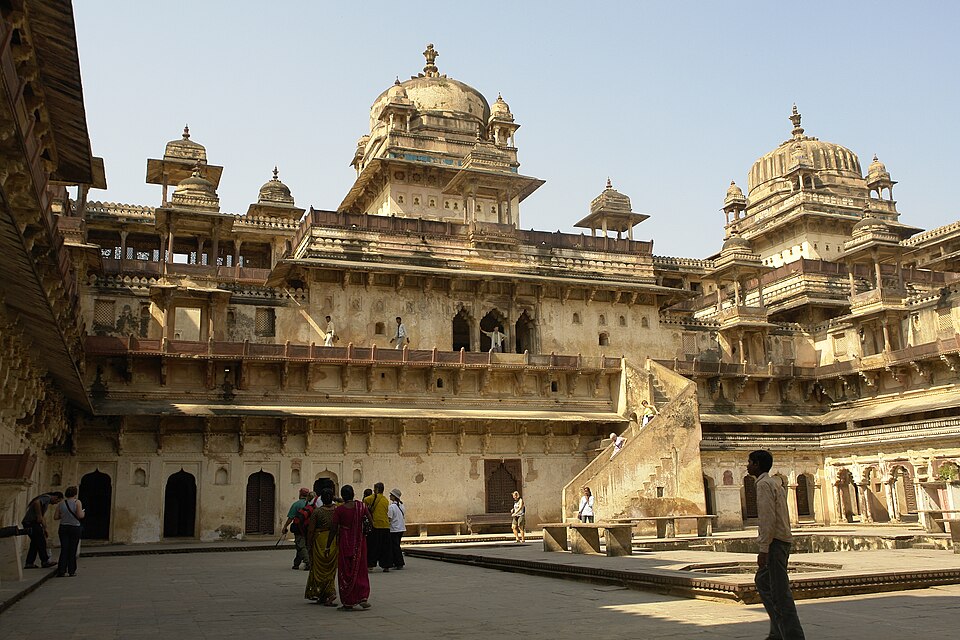
- Assuming any Rama-titled book must belong to a famous Rama poet — Ramchandrika is Keshavdas's, but 'Ram Rasayan' is not.
- Confusing Keshavdas (Riti-kaal Hindi poet of Orchha) with Keshab Chandra Sen (Brahmo Samaj reformer), whom MPPSC asked about in 2024.
MPPSC works this fact from both ends — 'whose famous work is Ramchandrika' (2023) and 'which book is NOT by Keshavdas' (2025) — so memorise the whole list, not one title.
Which of the following pairs are correctly matched? I. Mrichchhakatikam — Shudraka II. Buddhacharita — Vasuvandhu III. Mudrarakshasha — Vishakhadatta IV. Harshacharita — Banabhatta Select the correct answer using the codes given below:
- (a) I, II, III and IV
- (b) I, III and IV
- (c) I and IV
- (d) II and III
Answer(b) I, III and IV — only Buddhacharita is mismatched (it is by Ashvaghosha)
The same book-to-author test, and the same 'spot the one wrong attribution' logic that Q62 uses.
Whose famous work is “Ramchandrika”?
- (a) Padmakar
- (b) Bhushan
- (c) Keshavdas
- (d) Bhavabhuti
Answer(c) Keshavdas
The identical fact asked two years earlier from the opposite direction — 2023 gave the book and asked for the poet, 2025 gives the poet and asks which book is not his.
Which of the following pairs is NOT correctly matched?
- (a) Harishankar Parsai – “Hansate Hain Rotey Hain”, “Rani Nagfani Ki Kahani”
- (b) Bhavani Prasad – “Geet Farosh”, “Satpura Ke Ghane Jangal”, “Himatarangini”
- (c) Gajanan Madhav Muktibodh – “Chand Ka Munh Tedha Hai”, “Kaath Ka Sapna”
- (d) Keshavdas – “Rasikpriya”, “Kavi Priya”
Answer(b) Bhavani Prasad – “Geet Farosh”, “Satpura Ke Ghane Jangal”, “Himatarangini”
The same author-to-works matching, and option (d) of that paper is the Keshavdas canon itself — Rasikpriya and Kavipriya, listed as a correct pair.
- practice — not a real PYQ
Rasikpriya, the foundational lakshan-grantha of the Riti-kaal in Hindi literature, was written by:
- (a)Keshavdas
- (b)Bihari
- (c)Bhushan
- (d)Padmakar
Answer(a) Keshavdas — Rasikpriya (1591) is why he is called the father of the Riti-kaal. - practice — not a real PYQ
Keshavdas was the court poet of which principality of present-day Madhya Pradesh?
- (a)Orchha
- (b)Rewa
- (c)Panna
- (d)Datia
Answer(a) Orchha — the Bundela court of Madhukar Shah and his son Indrajit Singh.