
Match List-I with List-II and select the correct answer using the codes given below the lists : List-I (River): (i) Betwa (ii) Tapti (Tapi) (iii) Kshipra (iv) Wainganga; List-II (Place/Town): 1. Balaghat 2. Ujjain 3. Multai 4. Orchha Codes :
- (a)(i)-3, (ii)-2, (iii)-1, (iv)-4
- (b)(i)-4, (ii)-1, (iii)-2, (iv)-3
- (c)(i)-2, (ii)-4, (iii)-3, (iv)-1
- (d)(i)-4, (ii)-3, (iii)-2, (iv)-1
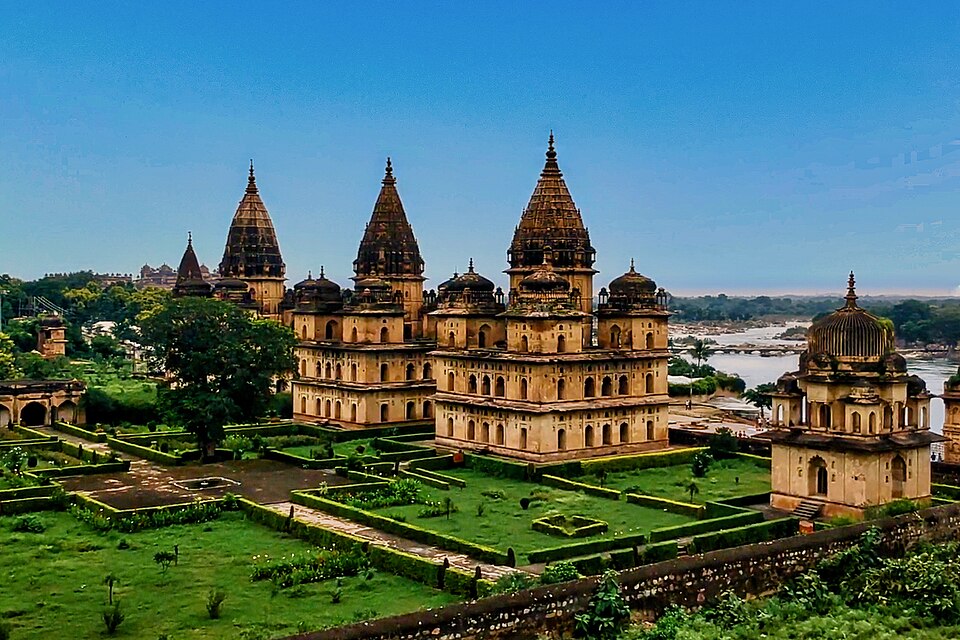
Correct — D, (i)-4, (ii)-3, (iii)-2, (iv)-1. Betwa–Orchha: the Betwa rises in the Vindhyan uplands of Raisen district, flows past Vidisha and then past Orchha (Niwari district), where the Bundela chhatris stand on its bank, before entering Uttar Pradesh to join the Yamuna. Tapti (Tapi)–Multai: the Tapti rises at Multai in Betul district — the town's name comes from 'Multapi', 'mother Tapi' — and then flows west to the Arabian Sea. Kshipra–Ujjain: the Kshipra (Shipra) is Ujjain's river, lined by the Mahakaleshwar Jyotirlinga and the bathing ghats of the twelve-yearly Simhastha; it drains into the Chambal. Wainganga–Balaghat: the Wainganga rises in Seoni district and runs south through Balaghat district into Maharashtra, where it joins the Wardha to form the Pranhita, a tributary of the Godavari.
- (a)(i)-3, (ii)-2, (iii)-1, (iv)-4 — Every pair is displaced. It gives Multai to the Betwa (Multai is the Tapti's source town), Ujjain to the Tapti (Ujjain is on the Kshipra), Balaghat to the Kshipra (Balaghat is on the Wainganga) and Orchha to the Wainganga (Orchha is on the Betwa).
- (b)(i)-4, (ii)-1, (iii)-2, (iv)-3 — The half-right trap. Betwa–Orchha and Kshipra–Ujjain are correct, but the remaining two are swapped: the Tapti is sent to Balaghat and the Wainganga to Multai. The Tapti never touches Balaghat — it flows west from Betul, while Balaghat lies in the Godavari-draining south-east.
- (c)(i)-2, (ii)-4, (iii)-3, (iv)-1 — Only Wainganga–Balaghat survives. It puts the Betwa at Ujjain (Ujjain belongs to the Kshipra), the Tapti at Orchha (Orchha is on the Betwa, a Yamuna tributary, hundreds of kilometres from the Tapti basin) and the Kshipra at Multai (Multai is the Tapti's source).
These four rivers belong to four different drainage systems, and MPPSC likes to test that by hanging a town on each. The Betwa flows north-east into the Yamuna and thence the Ganga. The Tapti flows west in a trough south of the Satpura range to the Arabian Sea. The Kshipra flows north across the Malwa plateau into the Chambal (also a Yamuna feeder). The Wainganga flows south into the Godavari system. Fix the system and the town follows.
You do not need all four pairs. Two anchors — Ujjain ↔ Kshipra and Multai ↔ Tapti — kill options (a), (b) and (c) between them: (a) and (c) misplace the Kshipra, and (b) misplaces the Tapti. That leaves (d) standing without ever recalling Balaghat or Orchha. Note also that the printed Codes block is a bare digit grid under the (i)(ii)(iii)(iv) headers; read it column by column in that order or you will pick a shuffled option by accident.
- Betwa: rises in the Vindhyan uplands of Raisen district, flows past Vidisha and Orchha, and joins the Yamuna at Hamirpur (UP).
- Tapti (Tapi): rises at Multai in Betul district — a west-flowing peninsular river reaching the Arabian Sea near Surat.
- Kshipra (Shipra): Ujjain's river — Mahakaleshwar Jyotirlinga and the twelve-yearly Simhastha are on its bank; it drains into the Chambal.
- Wainganga: rises in Seoni district, flows south through Balaghat, and joins the Wardha in Maharashtra to form the Pranhita, a Godavari tributary.
- Kshipra and Chambal are both Malwa rivers, but only the Kshipra flows through Ujjain.
- The Wainganga (also spelt Vainganga) drains to the Godavari, not to the Narmada — its southward course misleads students who assume every MP river feeds the Narmada or Yamuna.
- In a bare Codes grid, always read the option in the printed (i)(ii)(iii)(iv) column order; a mis-read column is the commonest silly loss in match-the-pairs.
MPPSC returns to MP river matching almost every year and rotates the second column: river ↔ parent river (2021), river ↔ area of origin (2024), river ↔ town (2025). UPSC has used the identical town ↔ river format for the same region in 2007.
Match List-I with List-II and select the correct answer using the code given below the Lists : List-I (Town) A. Betul B. Jagdalpur C. Jabalpur D. Ujjain List-II (River) 1. Indravati 2. Narmada 3. Shipra 4. Tapti
- (a) A-1 B-4 C-2 D-3
- (b) A-4 B-1 C-2 D-3
- (c) A-4 B-1 C-3 D-2
- (d) A-1 B-4 C-3 D-2
Answer(b) A-4 B-1 C-2 D-3 — Betul–Tapti, Jagdalpur–Indravati, Jabalpur–Narmada, Ujjain–Shipra
The same town ↔ river format, and two of the same pairs — UPSC matched Betul to the Tapti and Ujjain to the Shipra.
Match List-I with List-II and select the correct answer using the codes given below the lists: List-I (Tributary Rivers) a. Betwa b. Kshipra c. Vainganga d. Tawa List-II (Rivers) i. Chambal ii. Yamuna iii. Narmada iv. Godavari Codes: a b c d
- (a) iii iv ii i
- (b) ii i iv iii
- (c) iii iv i ii
- (d) i iii ii iv
Answer(b) ii i iv iii
Three of the four rivers here are the same (Betwa, Kshipra, Wainganga) — matched to their parent river instead of a town on their bank.
Match the following rivers with their Area of Origin and identify the correct code: Rivers: (1) Kaveri (2) Sabarmati (3) Tapti (Tapi) (4) Damodar Area of Origin: (i) Satpura range (ii) Brahmagiri hills (iii) Mewad hills (iv) Chota Nagpur Plateau
- (a) (i) (ii) (iii) (iv)
- (b) (iii) (iv) (i) (ii)
- (c) (ii) (iii) (i) (iv)
- (d) (iv) (ii) (iii) (i)
Answer(c) (ii) (iii) (i) (iv)
The Tapti's source region asked one year earlier — the same river-and-place knowledge that this question tests through Multai.
- practice — not a real PYQ
The Tapti (Tapi) river originates at Multai, which lies in which district of Madhya Pradesh?
- (a)Betul
- (b)Burhanpur
- (c)Khandwa
- (d)Harda
Answer(a) Betul — Multai in Betul district is the source of the Tapti. - practice — not a real PYQ
The Wainganga river belongs to which drainage system?
- (a)Ganga system
- (b)Godavari system
- (c)Narmada system
- (d)Mahanadi system
Answer(b) Godavari system — the Wainganga joins the Wardha to form the Pranhita, which flows into the Godavari.