
In which style is the Kailasanathar temple of Kanchi built?
- (a)Rajsimha style
- (b)Mamalla style
- (c)Mahendra style
- (d)Nandivarman style
Correct — A, Rajsimha (Rajasimha) style. The Kailasanathar temple at Kanchipuram was built by the Pallava king Narasimhavarman II, who bore the title Rajasimha, in the early 8th century CE. Pallava architecture is conventionally split into four phases named after rulers, and the phase of free-standing structural temples built of dressed stone is called the Rajasimha style after this king — the Kanchi Kailasanathar and the Shore Temple at Mahabalipuram are its two flagship monuments.
- (b)Mamalla style — The Mamalla phase, under Narasimhavarman I 'Mamalla', produced the monolithic rathas and the sculptured mandapas at Mamallapuram — monuments carved out of living rock, not built up from stone blocks, and not at Kanchi.
- (c)Mahendra style — The Mahendra phase is the earliest Pallava phase, under Mahendravarman I, and consists of rock-cut cave temples (mandapas) scooped into hillsides. It produced no structural temple of the Kailasanathar type.
- (d)Nandivarman style — The Nandivarman phase comes after Rajasimha, under Nandivarman II Pallavamalla, and is represented by smaller structural temples such as the Vaikuntha Perumal temple at Kanchi — later than, and modest beside, the Kailasanathar.
Pallava temple building moved through four stages: rock-cut caves (Mahendra), monolithic rathas (Mamalla), structural stone temples (Rajasimha), and later smaller structural temples (Nandivarman). The shift from carving into rock to building with quarried, dressed stone is the single dividing line, and Rajasimha's Kailasanathar at Kanchi is the standard example of the built phase. The Pallava structural temple set the vocabulary of the Dravida order — a pyramidal vimana over the sanctum, a pillared mandapa in front, and an enclosing prakara wall lined with subsidiary cells.
Two names in the question do real work. 'Kailasanathar' invites confusion with the Kailasa temple at Ellora, which is Rashtrakuta and carved from a single rock, while 'Kanchi' is the Pallava capital — so the answer must be a Pallava phase, and specifically the built-stone one. Anchor each phase to one monument and the four options separate instantly.
- Kailasanathar temple, Kanchipuram — built by Narasimhavarman II 'Rajasimha' in the early 8th century CE, which is why the phase carries his name.
- Four Pallava phases: Mahendra (rock-cut caves) → Mamalla (monolithic rathas at Mamallapuram) → Rajasimha (structural temples) → Nandivarman (later structural temples).
- The Shore Temple at Mahabalipuram belongs to the same Rajasimha phase as the Kanchi Kailasanathar.
- Mahendravarman I's Mandagapattu inscription records a shrine made without brick, timber, metal or mortar — the signature of the rock-cut Mahendra phase.
- Chola temple building, including the Brihadeeswara at Thanjavur, grew out of this Pallava structural tradition.
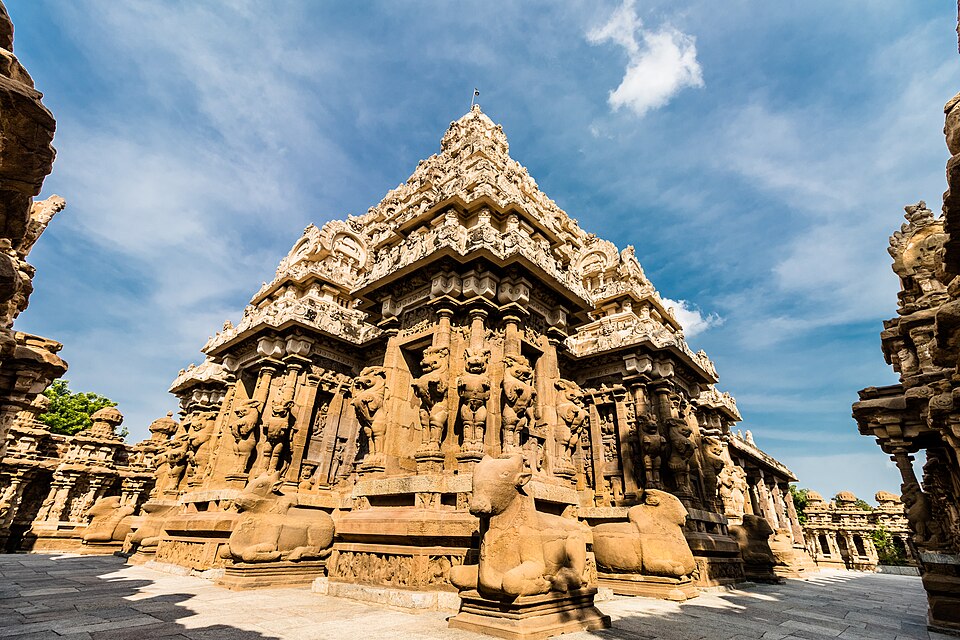
- Reading 'Kailasanathar' as the Ellora Kailasa — Ellora's is a Rashtrakuta monolith cut from the hillside; Kanchi's is a Pallava temple built from blocks.
- Swapping Mamalla and Rajasimha — Mamalla means monolithic rathas at Mamallapuram, Rajasimha means structural temples.
- Assuming every Kanchipuram temple is Pallava-era; the town also has large Chola and Vijayanagara period additions.
MPPSC asks it as a one-line 'which style / which dynasty built X'; UPSC prefers matching a monument to its dynasty or ordering monuments chronologically. Fix one monument per Pallava phase and both formats are covered.
Match List I with List II and select the correct answer using the code given below the lists: List I I. Gupta II. Chandella III. Chalukya IV. Pallava List II A) Badami B) Panamalai C) Khajuraho D) Deogarh
- (a) I–D, II–C, III–A, IV–B
- (b) I–D, II–B, III–C, IV–A
- (c) I–B, II–C, III–D, IV–A
- (d) I–C, II–D, III–A, IV–B
Answer(a) Gupta–Deogarh, Chandella–Khajuraho, Chalukya–Badami, Pallava–Panamalai
Same idea of tying a dynasty to its temple site — and the Pallava site in the pair, Panamalai, is itself a Rajasimha-phase structural temple.
What is/are common to the two historical places known as Ajanta and Mahabalipuram? 1. Both were built in the same period. 2. Both belong to the same religious denomination. 3. Both have rock-cut monuments. Select the correct answer using the code given below.
- (a) 1 and 2 only
- (b) 3 only
- (c) 1 and 3 only
- (d) None of the statements given above is correct
Answer(b) 3 only
Tests the Pallava monuments at Mahabalipuram — the rock-cut and monolithic phases that come just before the structural Rajasimha temples of Kanchi.
Where is the most famous Kailash temple located among the cave temples?
- (a) In the caves of Ajanta
- (b) In the caves of Ellora
- (c) In the caves of Elephanta
- (d) In the caves of Kanheri
Answer(b) In the caves of Ellora
The exact name-trap in the other direction — MPPSC's 'Kailash temple' among cave temples is the Rashtrakuta monolith at Ellora, not the Pallava Kailasanathar at Kanchi.
- practice — not a real PYQ
The Shore Temple at Mahabalipuram was built during the reign of:
- (a)Mahendravarman I
- (b)Narasimhavarman I Mamalla
- (c)Narasimhavarman II Rajasimha
- (d)Nandivarman II Pallavamalla
Answer(c) Narasimhavarman II Rajasimha — the Shore Temple belongs to the same structural phase as the Kanchi Kailasanathar. - practice — not a real PYQ
The Kailasa temple at Ellora differs from the Kailasanathar temple at Kanchi in that the Ellora temple is:
- (a)a structural temple built from dressed stone blocks
- (b)a monolithic temple carved downward out of a single rock mass
- (c)a brick-and-timber temple
- (d)a cave with painted walls and no sculpture
Answer(b) a monolithic temple carved downward out of a single rock mass — excavated under the Rashtrakuta ruler Krishna I.