
Which of the following National Parks is the first in India to officially introduce a mascot named "Bhoorsingh the Barasingha"?
- (a)Kanha National Park
- (b)Pench National Park
- (c)Bandhavgarh National Park
- (d)Satpura National Park
Correct — A, Kanha National Park. Kanha (Kanha Tiger Reserve, Madhya Pradesh) became the first protected area in India to adopt an official mascot, 'Bhoorsingh the Barasingha', launched in 2017 to raise awareness about the hard-ground barasingha (swamp deer) that survives in the wild only here.
- (b)Pench National Park — Well known for its tiger population and its association with the landscape that inspired Kipling's Jungle Book, but it is not the reserve with the Bhoorsingh mascot.
- (c)Bandhavgarh National Park — Famous for one of India's highest tiger densities, not for this mascot.
- (d)Satpura National Park — Known for its rugged, forested terrain and walking/canoe safaris, not for this mascot.
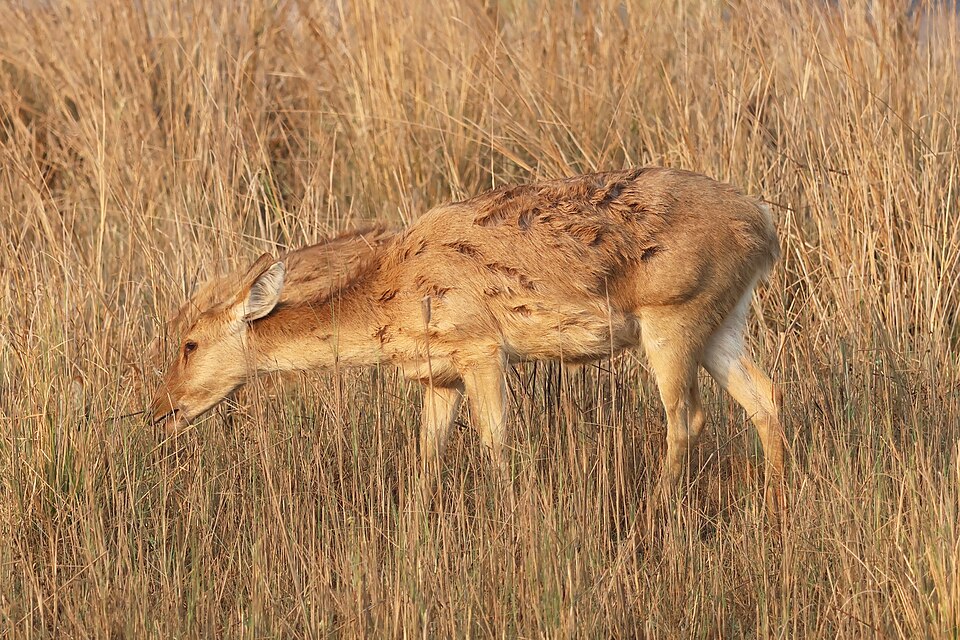
Kanha holds the last wild population of the 'hard-ground' barasingha (a swamp-deer subspecies adapted to firm grassland rather than marshland, and exclusively graminivorous). To spotlight this conservation success story, Kanha Tiger Reserve became the first Indian protected area to adopt an official mascot.
MPPSC likes to test 'firsts' tied to MP's protected areas. The trap is confusing Kanha with the state's other famous tiger reserves (Bandhavgarh, Pench, Satpura), which are equally well known but for different, distinct facts.
- Mascot: 'Bhoorsingh the Barasingha', launched in 2017 — Kanha is the first Indian protected area to get an official mascot.
- Barasingha (swamp deer) is the state animal of Madhya Pradesh.
- The hard-ground barasingha subspecies survives in the wild only in Kanha, across Mandla and Balaghat districts.
- The species had fallen to near-extinction levels around 1970 and recovered to several hundred individuals by the 2010s — a flagship conservation success story.
- Mixing up Kanha with Pench (Jungle Book association) or Bandhavgarh (tiger density) when the question is really about the mascot/barasingha
- Assuming barasingha thrives in marshland everywhere — the Kanha subspecies is specifically adapted to hard, dry ground
MPPSC pairs each of MP's protected areas with one specific distinguishing fact (mascot, flagship species, geography) — lock each park to its unique identifying fact rather than treating them as interchangeable 'tiger reserves'.
Which one of the following protected areas is well-known for the conservation of a sub-species of the Indian swamp deer (Barasingha) that thrives well on hard ground and is exclusively graminivorous?
- (a) Kanha National Park
- (b) Manas National Park
- (c) Mudumalai Wildlife Sanctuary
- (d) Tal Chhapar Wildlife Sanctuary
Answer(a) Kanha National Park.
Same core fact tested from a different angle — Kanha's hard-ground barasingha population is exactly why the reserve later got the 'Bhoorsingh' mascot.
- practice — not a real PYQ
The 'hard-ground' subspecies of barasingha (swamp deer), the state animal of Madhya Pradesh, survives in the wild only in:
- (a)Kanha National Park
- (b)Bandhavgarh National Park
- (c)Pench National Park
- (d)Panna National Park
Answer(a) Kanha National Park — the only wild home of the hard-ground barasingha. - practice — not a real PYQ
Which of the following is the state animal of Madhya Pradesh?
- (a)Barasingha (swamp deer)
- (b)Royal Bengal Tiger
- (c)Blackbuck
- (d)Chital
Answer(a) Barasingha — notified as Madhya Pradesh's state animal.