
Sundarbans are which of the following types of forests?
- (a)Tropical dry deciduous forest
- (b)Alpine forest
- (c)Sub-tropical pine forest
- (d)Littoral or Tidal forest
Correct — D, Littoral or Tidal forest. The Sundarbans, the world's largest mangrove forest, lies in the tide-influenced Ganga-Brahmaputra-Meghna delta spanning West Bengal (India) and Bangladesh. In India's forest classification (Champion & Seth), such saline, tide-washed coastal forests are grouped as Littoral and Swamp (tidal) forests — distinct from inland deciduous, alpine, or pine forest types.
- (a)Tropical dry deciduous forest — Dry deciduous forests grow under moderate, seasonal rainfall (e.g. much of central India) — not in a tide-washed saline delta like the Sundarbans.
- (b)Alpine forest — Alpine forests occur at high Himalayan altitudes in cold climates; the Sundarbans is a low-lying tropical coastal delta — the opposite setting.
- (c)Sub-tropical pine forest — Pine forests are found in the Himalayan foothills (e.g. Chir pine belts); unrelated to the mangrove ecosystem of the Sundarbans.
India's forests are classified (Champion & Seth, 1968) into 16 major types grouped under broader heads — moist tropical, dry tropical, montane, and littoral & swamp forests. Littoral/tidal forests grow in saline, tide-flooded coastal and deltaic zones and are dominated by salt-tolerant mangrove species, including the Sundari tree (Heritiera fomes) after which the Sundarbans is named.
The exam trap is treating the Sundarbans as just another 'tropical forest' without recognising that tidal inundation and salinity place it in a distinct littoral/swamp category, separate from rainfall-driven deciduous or montane classifications.
- Sundarbans = world's largest mangrove forest
- Located in the Ganga-Brahmaputra-Meghna delta (West Bengal, India & Bangladesh)
- Classified as Littoral and Swamp (tidal) forest
- Named after the Sundari mangrove tree (Heritiera fomes)
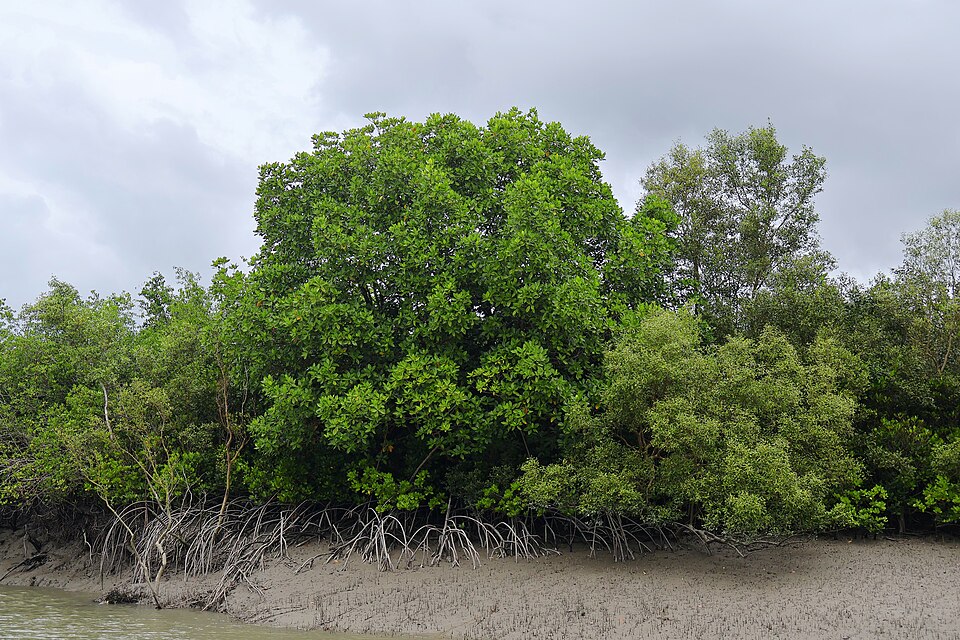
- Confusing 'tidal/littoral forest' with 'tropical evergreen forest' — mangroves form a distinct saline-tolerant category
- Assuming Sundarbans is a deciduous forest simply because it is in eastern India
Asked directly as 'Sundarbans is which forest type', or dressed up as a Champion-Seth classification match-list.
- practice — not a real PYQ
Which classification system is most commonly used to categorize Indian forest types, including littoral/tidal forest?
- (a)Champion & Seth
- (b)Koppen
- (c)Whittaker
- (d)Holdridge
Answer(a) Champion & Seth (1968) classification of Indian forests. - practice — not a real PYQ
The Sundarbans mangrove forest lies in the delta formed by which rivers?
- (a)Godavari-Krishna
- (b)Ganga-Brahmaputra-Meghna
- (c)Mahanadi-Brahmani
- (d)Indus-Sutlej
Answer(b) Ganga-Brahmaputra-Meghna delta.