
Which of the following diode is used in ultra-high speed switching electronic circuits?
- (a)Zener diode
- (b)Varactor diode
- (c)Tunnel diode
- (d)Schottky diode
Correct — C, Tunnel diode. Because of quantum tunneling across a very narrow, heavily-doped p-n junction, a tunnel diode (Esaki diode) responds in picoseconds and shows negative differential resistance, making it well suited to ultra-high-speed switching and microwave-frequency oscillator circuits.
- (a)Zener diode — Designed to operate in reverse breakdown for stable voltage regulation/reference — not a switching device.
- (b)Varactor diode — Used as a voltage-controlled variable capacitor in tuning circuits and oscillators, not for switching.
- (d)Schottky diode — Also switches quickly (it is a majority-carrier device with no minority-carrier storage delay) and is prized for low forward-voltage-drop rectification and RF applications — but the 'ultra-high-speed' (picosecond-range) switching credited here comes from the tunnel diode's quantum-tunneling mechanism.
A tunnel diode (Esaki diode) is a heavily-doped p-n junction diode, made so narrow that electrons can quantum-mechanically 'tunnel' straight across the depletion region without needing extra activation energy. This produces a region of negative differential resistance and an extremely fast response, making it useful in ultra-high-speed switching and microwave oscillator circuits.
The exam trap is matching each diode type to its one signature application: Zener → voltage regulation, Varactor → tuning/variable capacitance, Tunnel → ultra-high-speed switching/oscillation, Schottky → low-drop rectification. Several of these diodes 'switch fast' in some sense, so precision about which one earns the 'ultra-high-speed' label matters.
- Tunnel diode (Esaki diode) — heavily-doped p-n junction exhibiting negative resistance via quantum tunneling
- Used in ultra-high-speed switching and microwave oscillator circuits (response time in picoseconds)
- Invented by Leo Esaki, who shared the 1973 Nobel Prize in Physics for tunneling research
- Zener diode → voltage regulation; Varactor diode → variable capacitance/tuning
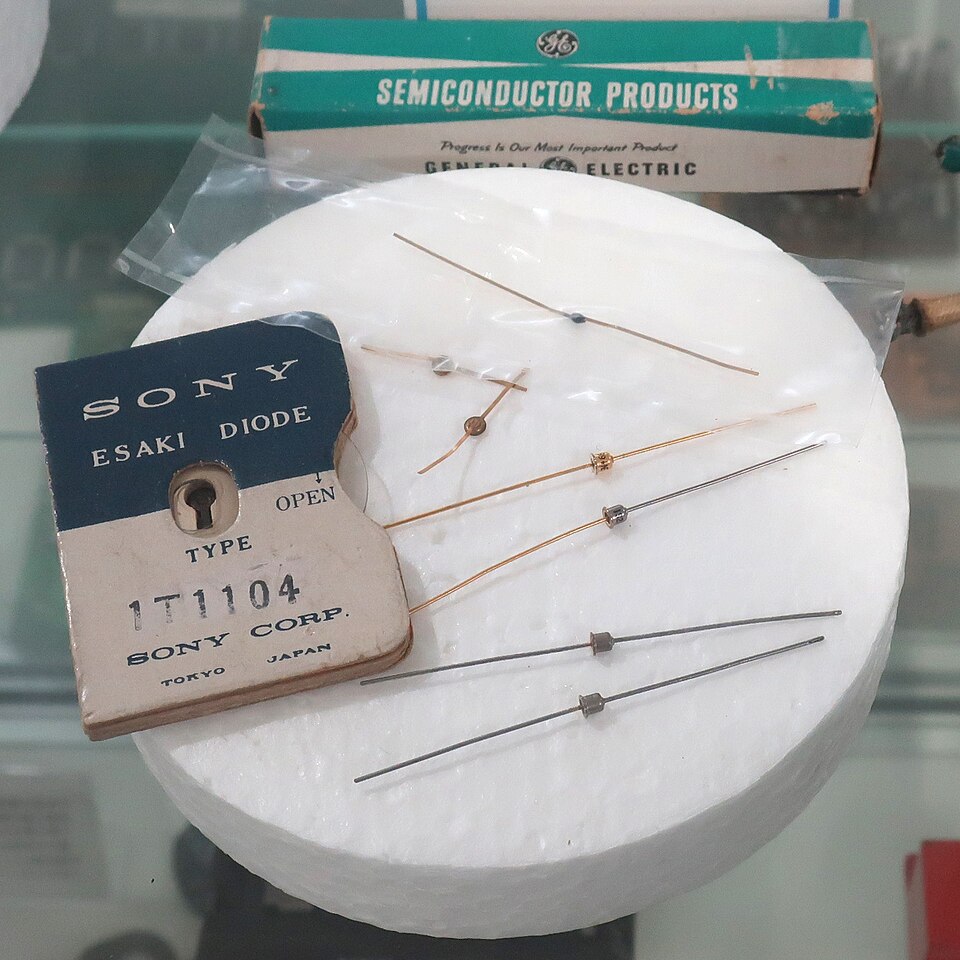
- Confusing Schottky (fast switching, low forward drop) with Tunnel (ultra-high-speed switching via quantum tunneling) — both are 'fast' but for different physical reasons
- Assuming the Zener diode has a switching application — it is built for voltage regulation
A classic 'diode type → principal application' matching MCQ; MPPSC/UPPSC electronics questions frequently test Zener vs Varactor vs Tunnel vs Schottky roles.
- practice — not a real PYQ
Which diode is primarily used for voltage regulation, operating in its reverse breakdown region?
- (a)Tunnel diode
- (b)Zener diode
- (c)Varactor diode
- (d)Schottky diode
Answer(b) Zener diode — designed to operate safely in reverse breakdown for a stable voltage reference. - practice — not a real PYQ
The tunnel diode was invented by which scientist, who later shared a Nobel Prize in Physics for related work?
- (a)William Shockley
- (b)Leo Esaki
- (c)John Bardeen
- (d)Walter Brattain
Answer(b) Leo Esaki — invented the tunnel diode (Esaki diode) and shared the 1973 Nobel Prize in Physics.