
To which period do the sites of Ellora and Elephanta belong?
- (a)Pratihara
- (b)Chalukyas
- (c)Rashtrakoot
- (d)Hoysalas
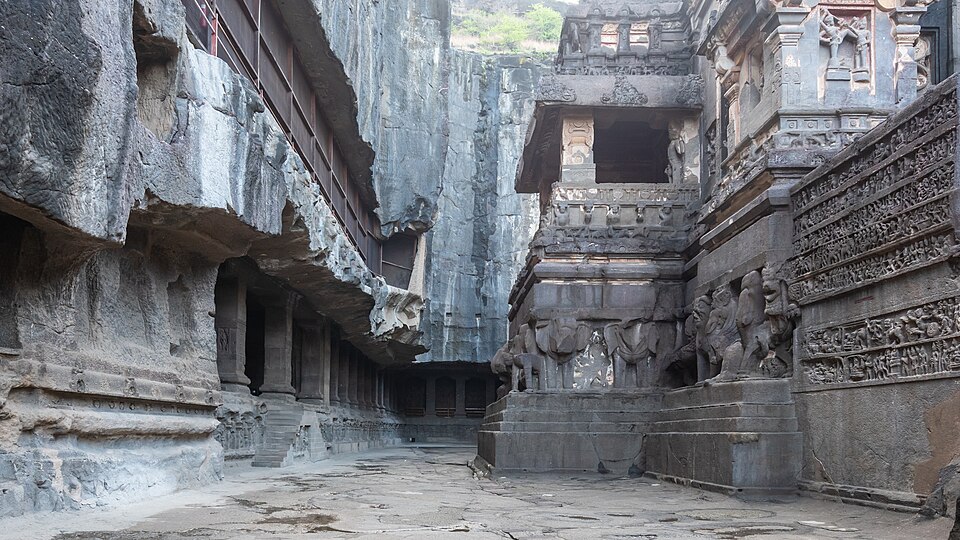
Correct — C, Rashtrakoot (Rashtrakuta). Ellora's most celebrated monument, the monolithic Kailasa temple, was carved out of a single rock under the Rashtrakuta king Krishna I in the 8th century CE — the peak achievement of Rashtrakuta rock-cut architecture. The nearby Elephanta caves, famous for their Sadashiva (Trimurti) sculpture, belong to the same broad era of western Deccan rock-cut cave activity, and both sites are conventionally grouped together under this period.
- (a)Pratihara — The Gurjara-Pratiharas were a north/western-Indian dynasty (centred around Kannauj) known for temples like those at Osian, not for the Ellora-Elephanta cave complexes.
- (b)Chalukyas — The Chalukyas (of Badami) are associated with early Deccan cave temples at Badami, Aihole, and Pattadakal — a related but distinct rock-cut tradition, not Ellora's Kailasa temple or Elephanta.
- (d)Hoysalas — The Hoysalas (12th-13th century, Karnataka) are known for star-shaped structural temples at Belur and Halebidu — free-standing built temples, not the earlier Ellora/Elephanta rock-cut caves.
Ellora (Maharashtra) has rock-cut caves of three faiths — Buddhist, Hindu, and Jain — carved over centuries. Its showpiece, the Kailasa temple, is a single monolithic structure excavated top-down from a hillside, sponsored by the Rashtrakuta king Krishna I. Elephanta Island, near Mumbai, has Shaiva rock-cut caves famed for the colossal Sadashiva (three-faced Shiva) sculpture, and is usually placed in the same broad rock-cut-architecture period.
MPPSC/UPSC typically test this as 'which dynasty patronised site X' — the trap is confusing the several Deccan/South-Indian dynasties (Chalukya, Rashtrakuta, Hoysala) that built rock-cut or structural temples in different sub-periods. Anchor on: Kailasa temple, Ellora = Krishna I, Rashtrakuta.
- Kailasa temple, Ellora — monolithic, carved top-down from a single rock
- Built under the Rashtrakuta king Krishna I, 8th century CE
- Ellora has caves of three faiths: Buddhist, Hindu, Jain
- Elephanta caves are famous for the Sadashiva (Trimurti) sculpture of Shiva
- Mixing up Chalukya (Badami-era caves) with Rashtrakuta (Ellora's Kailasa temple)
- Assuming Elephanta and Ellora belong to different periods — they are grouped together in standard accounts
Usually direct ('which dynasty/period does site X belong to'), or via 'who built the Kailasa temple' framing.
Where is the most famous Kailash temple located among the cave temples?
- (a) In the caves of Ajanta
- (b) In the caves of Ellora
- (c) In the caves of Elephanta
- (d) In the caves of Kanheri
Answer(b) In the caves of Ellora
Same MPPSC exam, a different year — tests the same Kailasa-temple/Ellora fact from a different angle (location vs. patronising dynasty).
- practice — not a real PYQ
The monolithic Kailasa temple at Ellora, carved from a single rock, was built under which dynasty?
- (a)Chalukya
- (b)Rashtrakuta
- (c)Pallava
- (d)Hoysala
Answer(b) Rashtrakuta — under king Krishna I, 8th century CE. - practice — not a real PYQ
The Elephanta Caves, near Mumbai, are famous for which sculpture?
- (a)Nataraja (dancing Shiva)
- (b)Sadashiva/Trimurti (three-faced Shiva)
- (c)Varaha avatar
- (d)Buddha in Dhyana mudra
Answer(b) Sadashiva/Trimurti — the colossal three-faced bust of Shiva is the Elephanta caves' signature sculpture.