
Which Indian State has recently radio-tagged an Indian Pangolin on the occasion of World Pangolin Day?
- (a)Kerala
- (b)Madhya Pradesh
- (c)Uttarakhand
- (d)Bihar
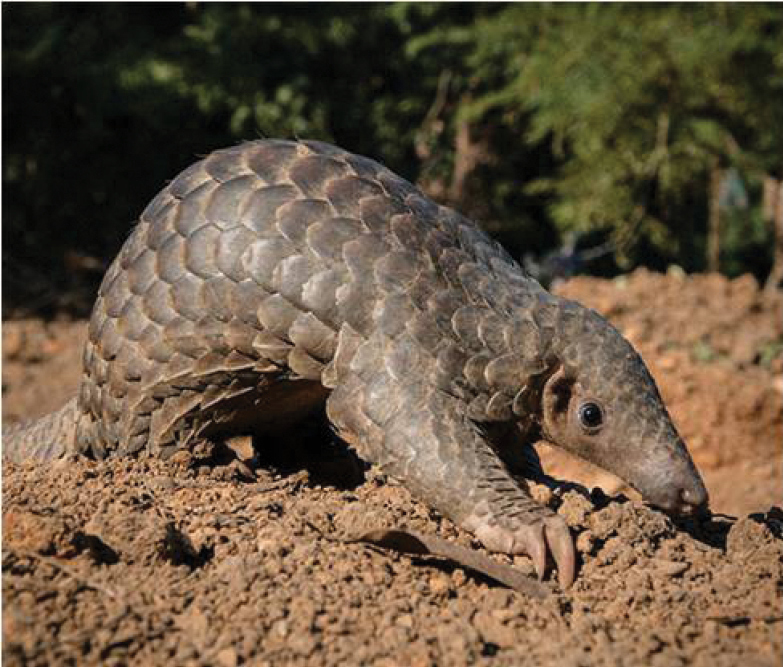
Correct — B, Madhya Pradesh. The Madhya Pradesh Forest Department, with the Wildlife Conservation Trust (WCT), radio-tagged an Indian Pangolin (Manis crassicaudata) at Satpura Tiger Reserve on World Pangolin Day (February 2020) — reported as India's first-ever radio-tagging of a pangolin, undertaken to track its post-release ranging behaviour and strengthen rescue-and-release conservation protocols.
- (a)Kerala — Not the state credited with this radio-tagging; the event took place at MP's Satpura Tiger Reserve.
- (c)Uttarakhand — Not the state credited with this radio-tagging.
- (d)Bihar — Not the state credited with this radio-tagging.
The Indian Pangolin (Manis crassicaudata) is a scaly, toothless, insectivorous mammal, listed as Endangered by the IUCN and given the highest legal protection (Schedule I) under India's Wildlife (Protection) Act, 1972. It is heavily poached for its keratin scales, trafficked for use in traditional medicine, making it one of the world's most illegally trafficked mammals.
MPPSC leans heavily on Madhya-Pradesh-specific current affairs — 'which state did X wildlife conservation first' questions about MP are common, and the answer is very often MP itself, so students should not assume such 'firsts' default to a state more famous for that habitat.
- Indian Pangolin (Manis crassicaudata) is a Schedule I species under the Wildlife (Protection) Act, 1972
- Radio-tagged at Satpura Tiger Reserve, Madhya Pradesh, on World Pangolin Day (2020) — reported as India's first such radio-tagging
- Conducted with the Wildlife Conservation Trust (WCT) to study post-release ranging behaviour
- World Pangolin Day is observed on the third Saturday of February each year
- Assuming a rare-species conservation 'first' automatically belongs to the state better known for that species' habitat elsewhere
- Confusing World Pangolin Day (third Saturday of February) with other wildlife observance days
MPPSC frequently tests Madhya-Pradesh-specific current affairs, especially wildlife conservation 'firsts' tied to its own tiger reserves and forest department initiatives.
Consider the following statements: 1. Toothless mammals such as pangolins are not found in India. 2. Gibbon is the only ape found in India. Which of these statements given above is/are correct?
- (a) 1 only
- (b) 2 only
- (c) Both 1 and 2
- (d) Neither 1 nor 2
Answer(b) 2 only — the Indian Pangolin (Manis crassicaudata) is found in India, so statement 1 is wrong; the Hoolock gibbon is India's only ape, so statement 2 is right.
A different specific fact (species presence vs a conservation event) but the same underlying subject — the Indian Pangolin's identity and occurrence in India.
- practice — not a real PYQ
The Indian Pangolin (Manis crassicaudata) is placed under which Schedule of the Wildlife (Protection) Act, 1972, giving it the highest degree of legal protection?
- (a)Schedule I
- (b)Schedule III
- (c)Schedule IV
- (d)Schedule V
Answer(a) Schedule I. - practice — not a real PYQ
World Pangolin Day is observed every year on:
- (a)The first Sunday of January
- (b)The third Saturday of February
- (c)World Wildlife Day, 3 March
- (d)International Biodiversity Day, 22 May
Answer(b) The third Saturday of February.