
Which of the following inscriptions is known as the first advertisement of the world?
- (a)Dashpur inscription
- (b)Sohgara inscription
- (c)Supia inscription
- (d)Eran inscription
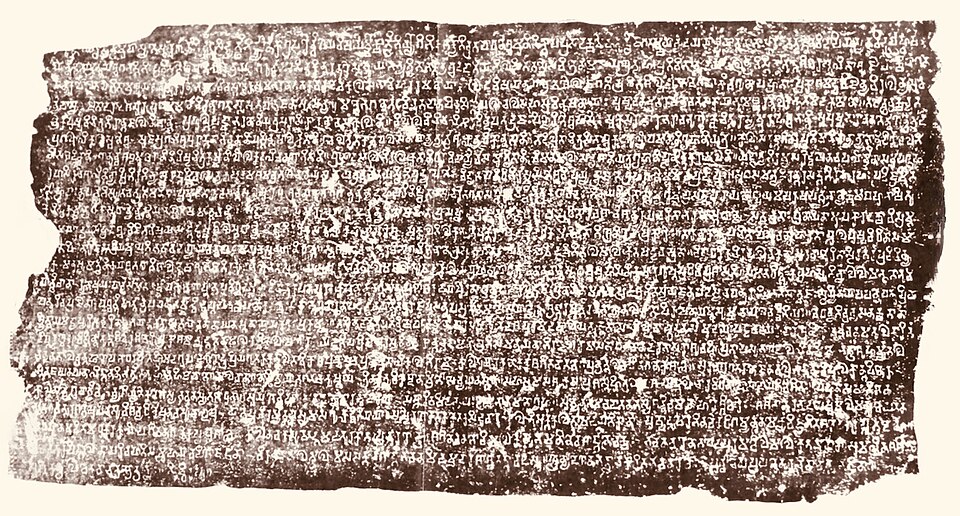
Correct — A, Dashpur inscription. The Dashpur (Mandsaur) inscription of the silk-weavers' guild — set up in the time of Kumaragupta and the local ruler Bandhuvarman, and later re-engraved in 473 CE — records how the guild built (and then restored) a Sun temple at Dashapura using its own accumulated wealth, and proudly proclaims the guild's skill and prosperity. Because it is essentially a public inscription praising the group's own craftsmanship and success, it is popularly cited as one of the earliest known 'advertisements' in the world.
- (b)Sohgara inscription — Wrong — the Sohgaura copper-plate inscription (Gorakhpur, UP; Mauryan-era) records famine-relief measures — grain storehouses (kosthagaras) for public distribution — not an advertisement.
- (c)Supia inscription — Wrong — the Supia (Shahdol, MP) pillar inscription is a Gupta-era dynastic record, not a self-promotional guild inscription.
- (d)Eran inscription — Wrong — the Eran inscriptions (Sagar, MP) record Gupta-era political events, including the earliest known epigraphic evidence of Sati; they are not advertisements.
The Dashpur/Mandsaur inscription is a stone record of a migrant silk-weavers' guild that settled in Dashapura (Mandsaur), prospered, and built a Sun temple there without seeking public donations — funding it entirely from the guild's own wealth. The inscription publicly celebrates the guild's craftsmanship and success, which is why exam sources describe it as the earliest known example of 'advertising' — a group broadcasting its own excellence in a public record.
MPPSC pairs this with three other MP-region inscriptions (Sohgara/Sohgaura, Supia, Eran) that are all genuine ancient records but serve very different purposes (famine relief, dynastic record, Sati evidence) — the trap is assuming 'ancient inscription' automatically means 'advertisement.'
- Dashpur/Mandsaur inscription: records the silk-weavers' guild's self-funded Sun temple at Dashapura
- Set up in the time of Kumaragupta and Bandhuvarman; the temple was later restored and the event re-inscribed (473 CE)
- Popularly cited as the world's/India's earliest known advertisement — a guild publicising its own prosperity and skill
- The inscription's poet was Vatsabhatti — a common MPPSC trap confuses him with the much-later playwright Bhavabhuti
- Sohgaura (UP), Supia and Eran (MP) inscriptions are ancient but serve different purposes (famine relief, dynastic/Sati records)
- Assuming any inscription praising a king or group counts as an 'advertisement' — the Dashpur inscription is cited for this specifically because it is guild self-promotion, not royal eulogy
- Mixing up Dashpur/Mandsaur (Malwa, MP) with Eran/Supia, which are separate MP sites with unrelated content
MPPSC has directly tested the Dashpur inscription's content again in 2024 (statement-based) — know it both as 'first advertisement' AND its factual details (Kumaragupta/Bandhuvarman, Vatsabhatti as poet, Paschimpur alias, silk-weavers).
Which statement is false regarding the Dashpur inscription of Kumaragupta and Bandhuvarman?
- (a) In this inscription, there is mention of the construction of Surya temple by a group of silk weavers.
- (b) This is the oldest example of advertisement tradition in Bharat.
- (c) In this inscription, Dashpur has been called Paschimpur also.
- (d) This inscription was composed by Bhavabhuti.
Answer(d) This inscription was composed by Bhavabhuti.
Same inscription (Dashpur/Mandsaur) tested again by MPPSC in 2024, confirming its 'oldest advertisement' identity while probing deeper factual details.
- practice — not a real PYQ
The Dashpur (Mandsaur) inscription of the silk-weavers' guild belongs to which ancient Indian dynasty?
- (a)Maurya
- (b)Gupta
- (c)Kushan
- (d)Chola
Answer(b) Gupta — the inscription belongs to the Gupta period, under Kumaragupta and the local ruler Bandhuvarman. - practice — not a real PYQ
The Sohgaura copper-plate inscription, one of India's earliest inscriptions, primarily records:
- (a)A guild's self-praise
- (b)Famine-relief grain storehouses
- (c)A king's military conquests
- (d)A Sati event
Answer(b) Famine-relief grain storehouses (kosthagaras) — a Mauryan-era administrative record.