UPSC Current Affairs

14 topicsGS-1: 2GS-2: 5GS-3: 7
0/14 done
GS-1History

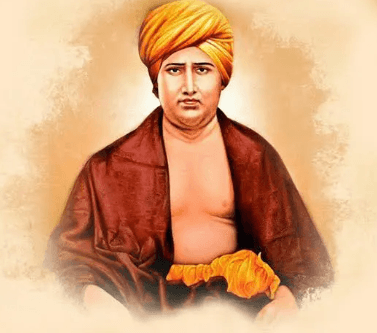
1.Maharshi Dayanand Saraswati Reform Legacy

Business Standard
Illustration for Maharshi Dayanand Saraswati Reform Legacy

What & Where

Reformer; Maharshi Dayanand Saraswati founded Arya Samaj (1875) to revive pristine Vedic dharma.

Geography; born Tankara, Kathiawar (now Morbi dist, Gujarat), itinerant ascetic across north-west India.

Demise; succumbed 30 Oct 1883 at Ajmer after alleged poisoning in Jodhpur court.

Quick Facts for MCQs

Reform Agenda

  • Vedas declared infallible source; rejected Puranic ritualism, animal sacrifice, superstition.
  • Equality championed; caste merit-based, advocated widow remarriage, opposed child marriage, defended individual dignity.
  • Public reasoning promoted through open debates, vernacular pamphlets, Samaj sessions.

Literary Output

  • Satyarth Prakash outlined 14-chapter critique of contemporary religions, social ills, governance norms.
  • Rigveda–Yajurveda commentaries offered rational, monotheistic Vedic interpretation accessible beyond priestly monopoly.
  • Sanskarvidhi re-codified sixteen samskaras, aligning household rites with Vedic injunctions.

Life Events

  • Childhood Shivaratri vigil incident triggered questioning of idol worship and pursuit of truth.
  • Years of peregrination included Himalayas, Punjab, Rajasthan before disciplined study under Virajananda.
  • Poisoning episode in Jodhpur signified fierce orthodox resistance; continued preaching till last breath.

Key Data Points

FeatureData-Point
Original nameMool Shankar
Birth date12 Feb 1824
Birth placeTankara, Kathiawar, Gujarat
GuruSwami Virajananda, Mathura
Organisation foundedArya Samaj, 10 Apr 1875, Bombay
Core sloganBack to the Vedas
Key treatiseSatyarth Prakash
Other worksSanskarvidhi; Rigvedadi Bhashya Bhumika
Publishing bodyParopakarini Sabha, Ajmer
Social stanceAnti-idol worship; anti-caste-by-birth; pro-women education
Death date30 Oct 1883
Death placeAjmer, Rajputana Agency

Related UPSC Prelims PYQs

GS1 2001PYQ 1

Consider the following statements:

GS1 2018PYQ 2

Which among the following events happened earliest?
GS-1Mapping

2.Bangladesh Geography and Elections

NDTV
Illustration for Bangladesh Geography and Elections

What & Where

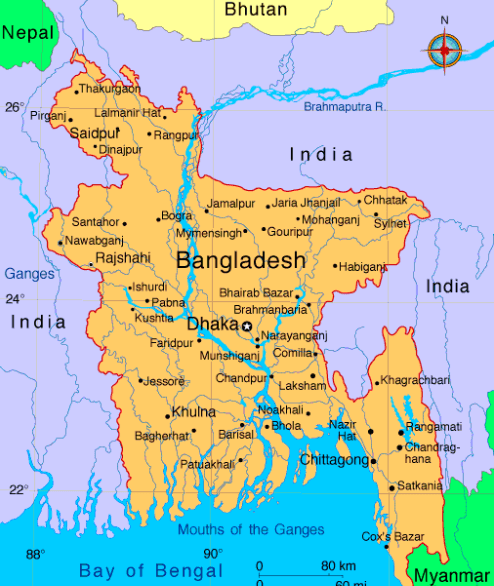
Bangladesh: deltaic South-Asian nation, carved from Pakistan in 1971 after Liberation War.

Lies in Ganges-Brahmaputra-Meghna delta; bordered by India (W,N,E), Myanmar (SE), Bay of Bengal (S).

2026 general election: BNP under Tarique Rahman toppled two-decade Awami League dominance with absolute majority.

Quick Facts for MCQs

Physical Geography

  • Deltaic terrain causes frequent flooding yet provides fertile alluvium.
  • Sundarbans hosts Bengal tigers; UNESCO World Heritage.
  • Rivers continually shift channels, altering borders and farmland.

Parliamentary Design

  • First-past-the-post voting for 300 constituencies ensures single-member representation.
  • 50 women seats allotted to parties proportionate to general-seat tally.
  • Five-year term; majority forms government.

Election 2026 Outcome

  • BNP majority ends Awami League’s nearly 20-year rule; power shift significant for regional politics.
  • Jamaat-e-Islami vote surge makes it principal opposition bloc.
  • Tarique Rahman poised to shape policy, alliance dynamics with India-Myanmar critical.

Key Data Points

FeatureData-Point
Independence year1971
Parliament typeUnicameral Jatiyo Sangshad
Total seats350
Direct FPTP seats300
Women-reserved seats50 (proportional)
2026 winnerBangladesh Nationalist Party
BNP seats won≈218
Second-largest partyJamaat-e-Islami
Main delta riversGanges (Padma) – Brahmaputra (Jamuna) – Meghna
Signature ecosystemSundarbans, world’s largest mangrove
Hilly terrain zoneChittagong Hill Tracts (SE)
Avg. elevation< 30 ft above sea level

Related UPSC Prelims PYQs

GS1 1996PYQ 1

Which one of the following countries has more or less evolved a two-party system?

GS-2Editorial

3.Reframing India’s Foreign Policy Vision

The Hindu
Illustration for Reframing India’s Foreign Policy Vision

What & Where

Concept shift: India moving from non-aligned Strategic Autonomy to Viksit Bharat 2047 interest-driven engagement

Core process: building endogenous tech, diversified trade, selective alliances over values-based multilateralism

Geography focus: Indo-Pacific technology chains, EU market access, neighbourhood stability

Quick Facts for MCQs

Multilateralism Erosion

  • Dysfunction: WTO, ISA, WHO see U.S. withdrawals, consensus bypass
  • Weaponization: Tariffs, sanctions deployed coercively against oil, tech choices
  • Capture: China dominates UN standards on digital infrastructure

Limits of Autonomy

  • Obsolescence: Cold-War neutrality untenable amid tech bifurcation Patriot vs S-400
  • Vulnerability: Import-heavy semiconductors weaken independent Indo-Pacific stance
  • Perception: U.S. labels India swing state needing incentives, not fixed partner

New Strategic Reality

  • Asymmetry: 19th-century-style might governs interim India-U.S. trade deal 2026
  • Tech-sovereignty: AI, cyber, space partnerships like NavIC-GLONASS define power
  • Competitive manufacturing: China Plus One benefits India yet rivals Vietnam, Mexico

Policy Reframe & Tools

  • Internal-build: PLI, Rare Earth Corridors, low external profile for capacity boost
  • Trade-diversify: Mega FTAs with EU (2026) and UK to cut U.S. reliance
  • Tech-alliances: BRICS CBDC links, quantum & space cooperation with Russia, others

Key Data Points

FeatureData-Point
WTO appellate paralysisU.S. rejection continued in 2025
U.S. tariff on Indian steel/aluminium50 % (2025)
India’s semiconductor import dependence≈ 90 % from East Asia (2025)
Electronics exports jumpDoubled to ₹4 lakh cr in 2025
India-EU FTA coverage99 % of India’s export trade (2026)
NavIC-GLONASS ground-station pactSigned 2025 with Russia
Bangladesh-Pakistan proposed defence pact2025; adds 2.5-front challenge
Rare Earth Corridors focusUnion Budget 2026-27
ISA, WHO U.S. exit period2025-26
China-led UN agency headsSeveral principal agencies captured

Related UPSC Prelims PYQs

CAPF_GAI, GS1 2020PYQ 1

यदि निकट भविष्य में दूसरा वैश्विक वित्तीय संकट होता है, तो निम्नलिखित में से कौन-सी कार्यवाही/नीति, भारत को, सबसे अधिक संभावना के साथ, कुछ सुरक्षा प्रदान कर सकती है?

CAPF_GAI, GS1 2024PYQ 2

Which of the following is NOT one of the pillars of India’s ‘Foreign Trade Policy-2023’?

GS-2Polity

4.Parliamentary Privilege Notice Rules

News on Air
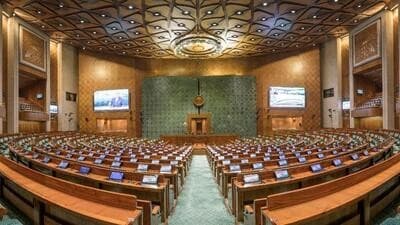
Illustration for Parliamentary Privilege Notice Rules

What & Where

Privilege Notice = MP’s written complaint over alleged breach of parliamentary privilege or contempt of House

Operates inside Lok Sabha & Rajya Sabha; Speaker/Chairman decides admissibility

Triggered by obstruction, misinformation, defamation, distorted records, or acts lowering House authority

Quick Facts for MCQs

Legal & Policy

  • Privilege powers derive from constitutional provisions, not ordinary statute
  • Houses act as judge, jury, executioner; courts barred from procedural review
  • Aims to secure unhindered legislative functioning and member independence

Procedural Steps

  • Notice submission → Presiding Officer admission → House debate or Committee referral
  • Committee gathers evidence, reports back for final House decision
  • No time limit fixed; action discretionary and case-specific

Penalties

  • Admonition/reprimand used for minor breaches; imprisonment rare, max till session end
  • Suspension or expulsion applicable only to offending members
  • Sanctions enforceable by House order, not subject to external appeal

Key Data Points

FeatureData-Point
Core Constitutional basisArticles 105, 194 (privileges); 122 (court non-interference)
Immunity clauseArt 105(2) protects speech/vote inside Parliament
InitiatorAny Member of Parliament
Submission modeWritten notice to Presiding Officer
First scrutinySpeaker (LS) / Chairman (RS)
Inquiry body optionCommittee of Privileges
Possible punishmentsAdmonition, reprimand, imprisonment, suspension, expulsion
Contempt scopeAny act diminishing authority or dignity of House
Current contextGovt to move notice against Leader of Opposition during Budget debate

Related UPSC Prelims PYQs

CDS_GK 2020PYQ 1

Which of the following statements with regard to the privileges of the Members of the Parliament are correct?

CDS_GK 2025PYQ 2

भारत की संसद के सदस्यों के लिए संसदीय विशेषाधिकार से संबंधित निम्नलिखित कथनों में से कौन-सा/कौन-से सही है/हैं?

GS-2Polity

5.Strengthening Workplace Sexual Harassment Safeguards

PIB

What & Where

Safeguarding women at work: nationwide legal-institutional framework preventing, prohibiting, redressing sexual harassment under Sexual Harassment Act 2013.

Core processes: Internal Committees in establishments, Local Committees for unorganised sector; digital complaints via revamped SHe-Box portal.

Geography: Applicable pan-India; administered by Ministry of Women & Child Development with district-level officers.

Quick Facts for MCQs

Legal & Policy

  • SH Act 2013 mandates ICs (≥10 staff) and district LCs for unorganised workers.
  • Company (Accounts) Rules require annual Board Report disclosure of POSH case numbers.
  • SC in Aureliano Fernandes (2023-24) held lax enforcement violates Article 21 dignity.

Tech & Schemes

  • SHe-Box 2024 revamp: single-window, multilingual e-complaint filing and tracking for all sectors.
  • ISTM POSH training modules hosted on iGOT Karmayogi for continuous official sensitisation.
  • Project Stree Manoraksha 2025 offers trauma-informed mental-health support to harassment survivors.

Social Concerns

  • Two-thirds cases unreported; retaliation fears acute in sports, domestic, agricultural sectors.
  • Only 8 % workforce fully grasps POSH procedures; rural awareness extremely low.
  • Several eastern districts’ LCs non-functional, limiting justice for unorganised women.

Economic Angle

  • Safe workplaces key to Viksit Bharat goal: 70 % female labour force participation.
  • 2025 tech-sector study: perceived POSH bias drives higher mid-career female attrition.
  • Repeat-offender licence cancellation proposed to align business incentives with safety compliance.

Key Data Points

FeatureData-Point
Net female payroll addition (Jul 2025)4.42 lakh
Unreported harassment incidents≈ ⅔ of total
NCRB workplace harassment cases/yr≈ 400
HR officials lacking full POSH know-how53 %
Employees aware of own POSH policy8 %
SHe-Box portal revamp year2024
Constitutional anchorsArticles 14, 15, 21
National Workplace Safety Pledge2026

Related UPSC Prelims PYQs

ESE_GS, GEO_GS 2025PYQ 1

Which of the following statements about the Sexual Harassment of Women at Workplace (Prevention, Prohibition and Redressal) Act, 2013 is/are correct?

ESE_GS, GEO_GS 2025PYQ 2

Which of the following features regarding ‘Shram Suvidha Portal’ are correct?

GS-2Infrastructure

6.Sawalkot Hydropower Project and IWT Dispute

Indian Express
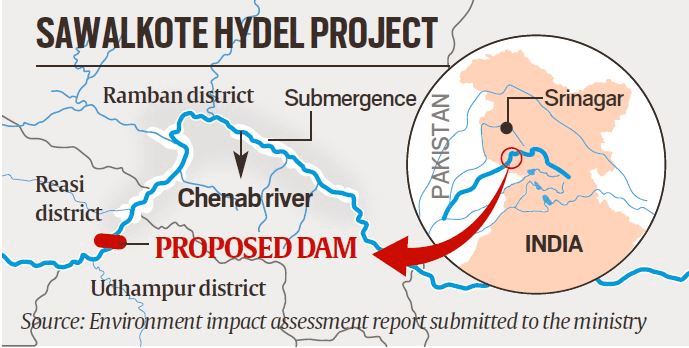
Illustration for Sawalkot Hydropower Project and IWT Dispute

What & Where

Project: Sawalkot hydroelectric scheme, run-of-river with concrete gravity dam and small reservoir on Chenab.

Capacity: 1,856 MW aiming to produce ~7,000 million units electricity yearly for northern grid.

Geography: Ramban district, Jammu & Kashmir; Chenab is a ‘Western River’ under the Indus Waters Treaty.

Quick Facts for MCQs

Legal & Policy

  • Treaty: Indus Waters Treaty 1960 grants Pakistan data rights; India placed treaty in abeyance as punitive step.
  • Consultation: Pakistan formally invoked treaty provisions seeking Sawalkot details and technical discussions.
  • Compliance: Islamabad urges full adherence, prefers dialogue and international legal mechanisms.

Strategic Significance

  • Control: Large project augments Indian leverage over Western Rivers amidst evolving treaty dynamics.
  • Power: Adds substantial base load; complements Baglihar, Dulhasti, Salal on Chenab corridor.
  • National priority: Tagged as Project of National Importance to accelerate approvals and funding.

Regional Projects

  • Chenab corridor: Existing 390 MW Dulhasti, 890 MW Baglihar, 690 MW Salal operate upstream/downstream.
  • Western cluster: Cumulative Chenab capacity with Sawalkot will surpass 3,800 MW on one river.
  • Geography: Plants span Kishtwar, Ramban, Reasi districts, strengthening regional energy security.

Key Data Points

FeatureData-Point
Main riverChenab
River category under IWTWestern River
State/UTJammu & Kashmir
DistrictRamban
Installed capacity1,856 MW
Project typeRun-of-river
Dam typeConcrete gravity
Annual energy≈7,000 MU
Initiated1984
Present statusProject of National Importance
Treaty citedIndus Waters Treaty, 1960
India’s stanceTreaty kept in abeyance post Pahalgam attack
Pakistan’s actionSought information & consultations

Related UPSC Prelims PYQs

CDS_GK, GS1 2025PYQ 1

Salal Power Project is situated on which one among the following rivers?

CDS_GK, GS1 2009PYQ 2

Consider the following statements :

GS-2Security

7.IAF Instructors Train RAF Pilots

Indian Express

What & Where

Deployment: three Indian Air Force Qualified Flight Instructors posted to RAF Valley, Wales, UK.

Mission: train Royal Air Force fast-jet pilots on Hawk T2 and Texan T1 aircraft for two years.

Context: outcome of 19th UK-India Air Staff Talks, reinforcing UK-India Vision 2035 defence roadmap.

Quick Facts for MCQs

Training Deployment

  • Three-member IAF team begins 2026 stint instructing RAF fast-jet trainees on Hawk T2, Texan T1.
  • First occasion Indian pilots formally embedded as flight instructors inside RAF training pipeline.
  • Precedent: single IAF officer posted to RAF College Cranwell earlier in 2026.

Bilateral Defence Framework

  • Initiative stems from 19th Air Staff Talks; strengthens Vision 2035 goal of deeper air-power cooperation.
  • Indian officers now instruct across all three UK service academies: Navy Dartmouth, Army Sandhurst, Air Cranwell.
  • Objective: elevate interoperability, mutual trust, long-term capability development.

Joint Exercises

  • Key UK-India drills: Cobra Warrior (air), Ajeya Warrior (army), Tarang Shakti (mega air exercise).
  • Repeated engagements sharpen combined tactics, techniques and procedures.
  • Exercise spectrum covers air combat, ground manoeuvre, large-force employment scenarios.

Key Data Points

FeatureData-Point
Host training baseRAF Valley, Wales
IAF instructors3 Qualified Flight Instructors
Training aircraftHawk T2; Texan T1
Tenure length2 years
Dialogue round19th UK-India Air Staff Talks
Strategic umbrellaUK-India Vision 2035
Earlier milestone1st IAF instructor at RAF College Cranwell, 2026
UK academies with Indian staffDartmouth, Sandhurst, Cranwell

Related UPSC Prelims PYQs

NDA_GAT 2021PYQ 1

'Exercise Desert Knight – 21' is a bilateral air exercise between the Indian Air Force and the Air Force of which one of the following countries?

GS-3Economy

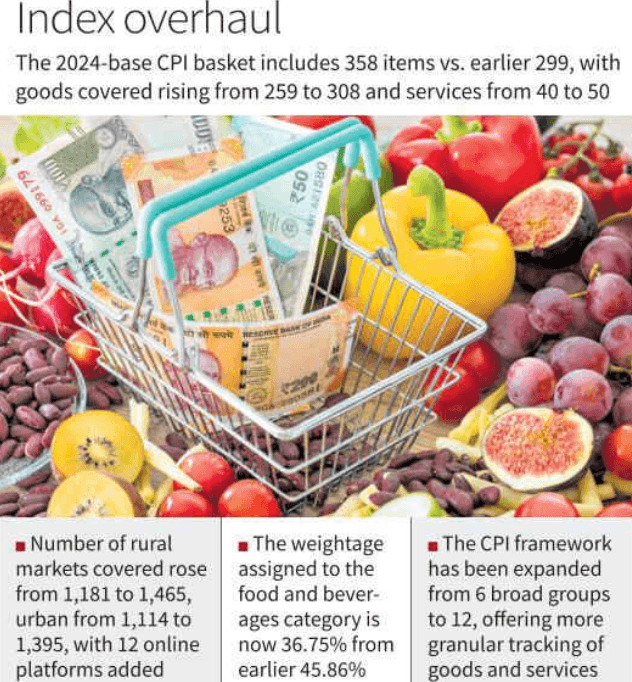
8.New CPI Base 2024 Methodology

PIB
Illustration for New CPI Base 2024 Methodology

What & Where

CPI (Base 2024=100) – India’s official retail‐inflation index, compiled monthly by NSO, MoSPI.

Covers rural + urban households nationwide; final All-India CPI weighted by respective consumption shares.

First data release: 12 Feb 2026; Jan 2026 inflation printed at 2.75 % YoY.

Quick Facts for MCQs

Methodology

  • Jevons index neutralises outlier market prices at item level.
  • Young/Modified Laspeyres aggregates item indices using fixed expenditure weights.
  • Combined CPI weight mirrors rural–urban consumption proportion.

Basket Expansion

  • Coverage upsized to 358 goods/services; stronger service share (education, health, OTT, transport).
  • Categories doubled from 6→12 aligning with UN COICOP 2018 classification.
  • Official admin prices used for fuel, rail, postal to enhance accuracy.

Tech & Data

  • Tablets replace paper schedules for faster, error-checked field entry.
  • E-commerce, digital subscription and airfare prices formally captured.
  • State-wise, rural-urban disaggregated indices published every month.

Key Data Points

FeatureData-Point
New base year2024 = 100
Previous base year2012 = 100
Publishing bodyMoSPI through NSO
Weight sourceHCES 2023-24
First release date12 Feb 2026
Jan 2026 CPI inflation2.75 %
Basket size358 items
Earlier basket size299 items
Broad groups now12 categories
Index formula (item)Jevons
Index formula (group)Young/Modified Laspeyres
Rural house rentIncluded first time
Digital collectionTablets + online prices

Related UPSC Prelims PYQs

GS1 2000PYQ 1

The new Gross Domestic Product (GDP) series released by the Central Statistical Organisation (CSO) in February 1999 is with reference to base price of

GS1 2001PYQ 2

The new series of Wholesale Price Index (WPI) released by the Government of India is with reference to the base prices of

GS-3S&T

9.Bodhan AI and Bharat EduAI Stack

The Hindu

What & Where

Bodhan AI – non-profit under Education Ministry; built at IIT Madras to create Bharat EduAI Stack.

Bharat EduAI Stack – open-source digital public infrastructure deploying AI tools across Indian education spectrum.

Geography: Nationwide rollout from kindergarten to research institutions in India.

Quick Facts for MCQs

Tech & Schemes

  • Infrastructure: Open-source DPI ensures vendor-neutral, modular AI deployment.
  • Interoperability: Stack designed for plug-and-play across schools, colleges, research labs.
  • Personalisation: AI tutors adapt content to individual learner profiles.

Governance & Implementation

  • Oversight: Ministry of Education steers; Bodhan AI executes.
  • Policy input: Aggregated learning data feeds evidence-based decisions.
  • Sovereignty: Indigenous stack avoids foreign platform dependence.

Education Impact

  • Equity: Targets affordable, accessible, high-quality learning nationwide.
  • Teacher support: AI modules offer training, grading, and content curation.
  • Parental tracking: Dashboards help parents monitor child progress.

Key Data Points

FeatureData-Point
Launch year2026
Parent ministryMinistry of Education
Developing instituteIIT Madras (AI Centre of Excellence for Education)
Entity typeNon-profit organisation
Core productBharat EduAI Stack
Key visionInclusive, interoperable, sovereign “AI for All”
Sample toolsAI tutors, teacher-training aids, admin systems
Data useLarge learning datasets for policy-making

Related UPSC Prelims PYQs

ESE_GS 2026PYQ 1

Which Ministry released the India AI Governance Guidelines in 2025?

GS-3Environment

10.Dal Lake In-Situ Conservation Plan

The Hindu

What & Where

Urban freshwater lake–wetland, famed “Jewel in the crown of Kashmir”.

Sited in Srinagar; part of tectonic–glacial Kashmir Valley lacustrine basin, linked to Jhelum River.

Four basins—Gagribal, Lokut Dal, Bod Dal, Nagin—within a 21 sq km wetland complex.

Quick Facts for MCQs

Legal & Policy

  • J&K govt drops relocation-centric ₹416 cr plan; adopts resident-inclusive, in-situ conservation.
  • Strategy shifts focus to ecosystem restoration without mass eviction.

Environmental Impact

  • Stressors: sewage, encroachment, eutrophication, declining water circulation.
  • Winter freezing alters nutrient cycling, shortens peak tourism window.

Economic Angle

  • Tourism backbone: houseboats, shikaras, Mughal-garden backdrop.
  • Supports floating agriculture and fisheries, anchoring local livelihoods.

Key Data Points

FeatureData-Point
Total lake area~18 sq km
Wetland complex size~21 sq km
Formation typeTectonic–glacial lacustrine
Main outflowControlled gates to Jhelum River
Surrounding Mughal gardensShalimar Bagh; Nishat Bagh
Floating gardens termRaad
Winter behaviourSurface often freezes
Shelved project cost₹416.72 crore
New approachIn-situ conservation with residents
Basin countFour
GS-3Environment

11.Arctic Warming Facilitates Invasive Plants

The Hindu
Illustration for Arctic Warming Facilitates Invasive Plants

What & Where

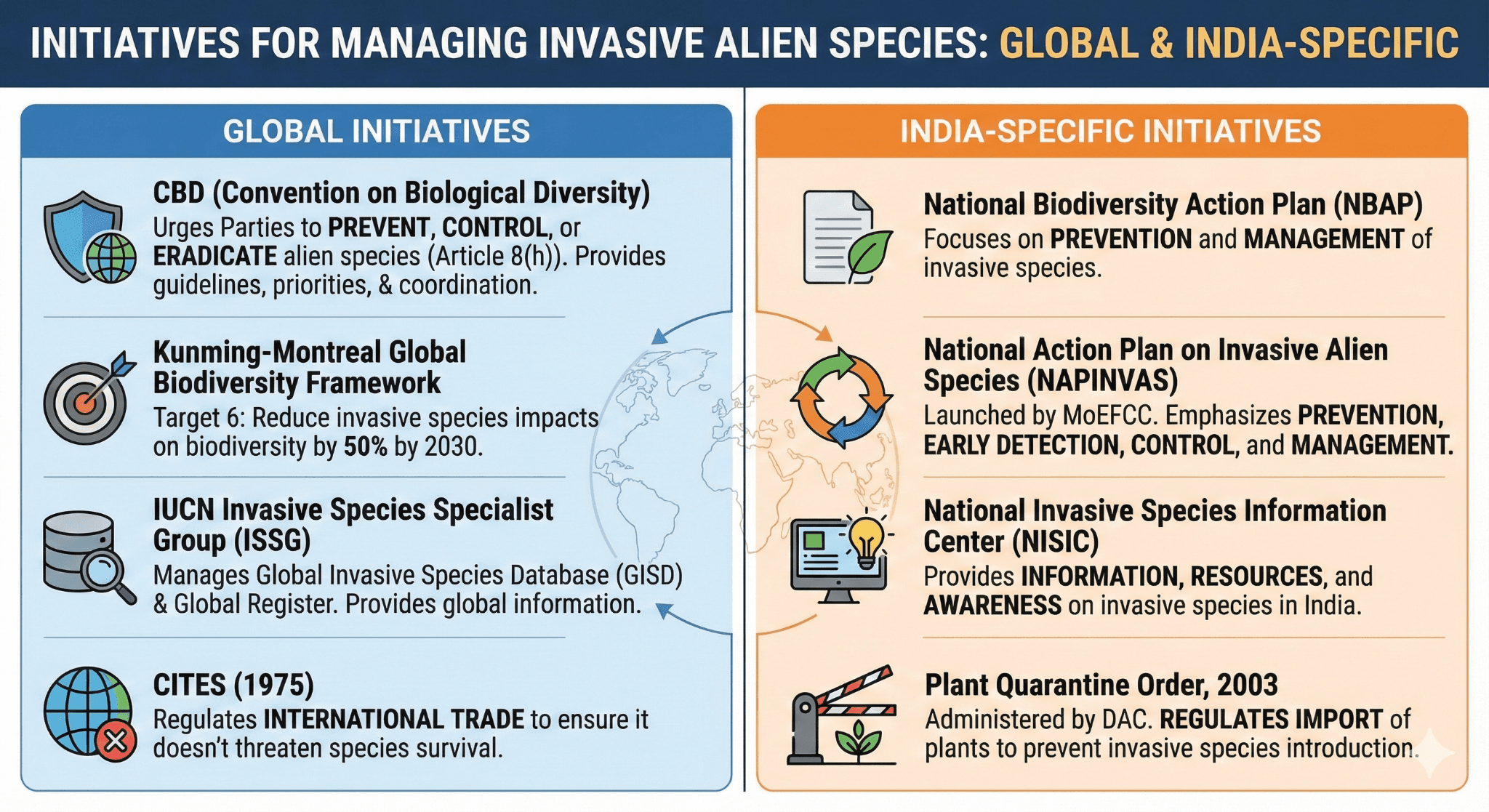
Invasive alien plant species = non-native flora establishing, spreading and disrupting local ecosystems.

Arctic tundra—mosses, lichens, dwarf shrubs—now exposed as warming erodes climatic barriers.

Key invasion hotspots: western Alaska, SW & SE Greenland, northern Iceland, Fennoscandia, Kanin–Pechora.

Quick Facts for MCQs

Drivers

  • Rapid Arctic warming lengthens growing season, softening permafrost, easing plant establishment.
  • Rising tourism, research bases, cargo routes boost propagule pressure via contaminated gear and freight.

Ecological Impact

  • Alien herbs/shrubs outcompete tundra moss-lichen matrix, altering nutrient cycles and snow insulation.
  • Threat cascades to fauna: Arctic fox, snowy owl, walrus lose habitat/food-web stability.

Numbers & Evidence

  • Svalbard already records common meadow-rue, once climatically excluded.
  • Model overlaps temperature projections with GBIF records to map future niches.

Indian Context

  • Open ecosystems lacking forest canopy show fastest invasive spread; canopy limits light-demanding exotics.
  • Management gaps persist despite National Biodiversity Act listing invasive control as priority.

Key Data Points

FeatureData-Point
Potential invaders modelled2,554 vascular plant spp. worldwide
Current Arctic alien taxa341; of which 188 naturalised
Hotspot count6 major regions
Chief Arctic introduction modesEscape from confinement; stowaway; seed contamination; vehicle transport
Major Indian invadersLantana camara, Chromolaena odorata, Prosopis juliflora
Indian area already invaded2,66,954 sq km natural habitats
Vulnerable Indian beltsShivalik–Terai, Duars, Aravallis, Dandakaranya, Nilgiris
Highly exposed ecosystemsDry grasslands, savannas, shola grasslands, Ganga–Brahmaputra wet plains
Climate driversShorter winters, longer growing seasons, increased human access
GS-3Security

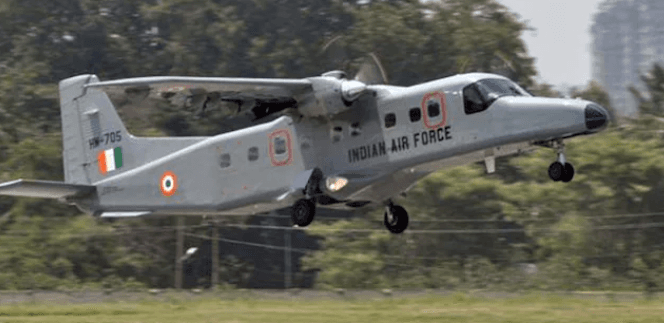
12.Dornier 228 Utility Aircraft Procurement

ANI
Illustration for Dornier 228 Utility Aircraft Procurement

What & Where

Dornier 228: twin-engine turboprop STOL utility aircraft for transport, patrol, SAR

Where: designed Germany 1980s, license-built by HAL Kanpur, now for Indian Coast Guard

Variants: 228-100/200, 228 NG glass-cockpit, HAL Maritime Patrol version

Quick Facts for MCQs

Security Dimension

  • Surveillance: boosts coastal watch, EEZ policing, anti-smuggling, SAR for Coast Guard
  • Mission roles: maritime patrol, border surveillance, real-time vessel tracking via datalink

Tech & Schemes

  • STOL: special wing allows operations from 800-m unpaved strips, key for island outposts
  • Avionics: NG variant sports glass cockpit, five-blade propeller, autopilot
  • Sensors: 360° radar and FLIR enable night all-weather detection

Economic Angle

  • Indigenisation: Buy (Indian) contract strengthens HAL domestic assembly line
  • Employment: cascades to MSME vendors, avionics and composite manufacturers
  • Self-reliance: aligns with Atmanirbhar Bharat defence procurement push

Key Data Points

FeatureData-Point
Contract value₹2,312 crore
Ordering agencyMinistry of Defence
Service userIndian Coast Guard
SupplierHindustan Aeronautics Ltd, Kanpur
Quantity8 Dornier 228
Procurement categoryBuy (Indian)
Passenger capacityUp to 19
Endurance5–6 hours
Engine modelTwin Garrett TPE331 turboprop
STOL abilityOperates from short, unpaved strips

Related UPSC Prelims PYQs

NDA_GAT 2022PYQ 1

With reference to India's defence, the terms ‘Surat’ and ‘Udaygiri’ refer to

GS-3Security

13.Ricin Toxin Bioterrorism Threat

Indian Express

What & Where

Ricin – naturally occurring type-II ribosome-inactivating protein extracted from castor beans (Ricinus communis).

India’s first alleged bioterror plot: Hyderabad doctor; probe shifted from Gujarat ATS to NIA for national-level investigation.

Security tag: Listed as Schedule 1 substance under the Chemical Weapons Convention, attracting highest global control.

Quick Facts for MCQs

Security Dimension

  • Agency: National Investigation Agency now leads probe, replacing Gujarat ATS.
  • Milestone: Officially first case labelled bioterrorism in India.
  • Compliance: Schedule 1 status mandates strict licensing, reporting and export bans.

Scientific Properties

  • Mechanism: Inhibits ribosomal 60S subunit, halting protein synthesis, destroying cells.
  • Toxicity: Minute inhaled, ingested or injected doses can be lethal; multi-route threat.
  • Countermeasure gap: No vaccine or antidote; only supportive care available.

Operational Challenges

  • Production: High-purity extraction from castor mash technically complex, limits scale.
  • Dissemination: Stable, respirable aerosol difficult to achieve for non-state actors.
  • History: Prior incidents confined to small-scale assassinations, never mass casualties.

Key Data Points

FeatureData-Point
Toxin classType-II ribosome-inactivating lectin
Source plantCastor bean (Ricinus communis)
Extraction solventIndustrial acetone
Antidote availabilityNone known
CWC listingSchedule 1 substance
Recorded use patternTargeted assassinations, no mass-casualty success
GS-3Security

14.Assam Rifles Induct Indigenous Dog Breeds

The Hindu

What & Where

Indigenous-canine shift: Assam Rifles replacing Belgian Malinois, German Shepherds, Labradors with Tangkhul Hui & Kombai breeds

Training hub: Assam Rifles Dog Training Centre, Jorhat (Assam); deployment across Northeast insurgency belt and Jammu & Kashmir

Timeline: full indigenous induction by 2027, foreign breeds completely phased out by 2050 under 2025 MHA directive

Quick Facts for MCQs

Security Dimension

  • Tracker dogs detect arms, explosives, narcotics supporting counter-insurgency in thick jungle terrain
  • Indigenous breeds expected higher stamina, lower acclimatisation issues enhancing patrol efficiency

Breeds & Veterinary

  • Tangkhul Hui carries strong disease resistance, traditional hunting lineage from Ukhrul district
  • Kombai offers agility, loyalty, complements Hui traits for mixed-team deployment

Policy & Timeline

  • MHA 2025 directive pushes all CAPFs toward Indian canine breeds preference
  • Assam Rifles roadmap: incremental intake till 2027, systematic foreign breed retirement culminating 2050

Key Data Points

FeatureData-Point
Implementing forceAssam Rifles (oldest CAPF)
Founded asCachar Levy, 1835
Administrative controlMinistry of Home Affairs
Operational controlMinistry of Defence
Main border guardedIndo-Myanmar, 1 640 km
Indigenous breeds chosenTangkhul Hui (Manipur) ; Kombai (Tamil Nadu)
Training facilityDog Training Centre, Jorhat (Assam)
Current foreign breedsBelgian Malinois, German Shepherd, Labrador
MHA canine order year2025
Phase-out deadline2050 (gradual), 2027 for full induction

Related UPSC Prelims PYQs

CAPF_GAI 2022PYQ 1

Which one of the following is the oldest Central Paramilitary Force in India?

Ready to practice?

Test your knowledge with our UPSC test series.

Start Free Trial