UPSC Current Affairs

13 topicsGS-1: 3GS-2: 4GS-3: 6
0/13 done
GS-2Polity

1.Kurmi Community Scheduled Tribe Demand (Scheduled Tribe Status)

Indian Express
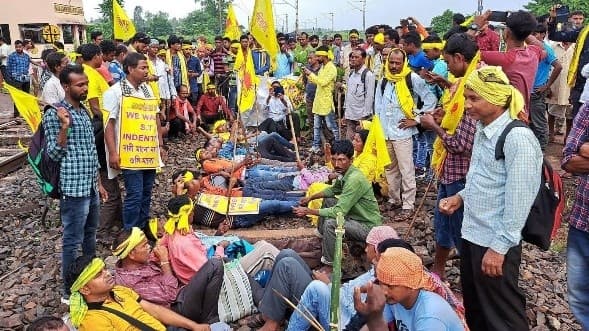
Illustration for Kurmi Community Scheduled Tribe Demand (Scheduled Tribe Status)

What & Where

Agrarian Kurmi/Kudmi community, presently OBC, now agitating for Scheduled Tribe tag and Sarna religion recognition.

Core belts: Junglemahal (WB), Chotanagpur (Jharkhand), Mayurbhanj zone (Odisha); smaller pockets in Purnia-Katihar-Araria (Bihar).

Also seek constitutional listing of Kurmali language in the Eighth Schedule.

Quick Facts for MCQs

Historical Status

  • 1931-Census: Enumerated as Scheduled Tribe across British provinces.
  • 1950-ST list: Name dropped without specific notification.
  • Gazette-Evidence: Bengal notices noted distinct inheritance customs, tribal traits.

Legal & Policy

  • OBC-Tag: Listed under Central/state OBC; land rights governed by CNT Act 1908.
  • ST-Criteria: Cites geographic isolation, totemic culture, endogamy to justify re-inclusion.
  • Language-Push: Kurmali inclusion in Eighth Schedule, alongside Sarna faith codification.

Freedom Struggle Role

  • Chuar-Rebellion: Led village resistance; figurehead Raghunath Mahato.
  • Indigo & Santhal uprisings: Kudmi peasants formed core fighting base.
  • Quit-India 1942: Leaders like Gopal Mahato organised Chotanagpur actions.

Key Data Points

FeatureData-Point
1931 classificationScheduled Tribe (Census)
Post-1950 statusOBC in most states
British Gazette years1913, 1931 “Notified Tribe”
Main religionSarna nature-worship
Legislation tagChotanagpur Tenancy Act 1908
Primary occupationFarming/market gardening
Key agitation demandST status + Kurmali in 8th Schedule
Core statesWB, Jharkhand, Odisha
GS-3Infrastructure

2.Mumbai–Ahmedabad Bullet Train Corridor (High-Speed Rail)

Indian Express
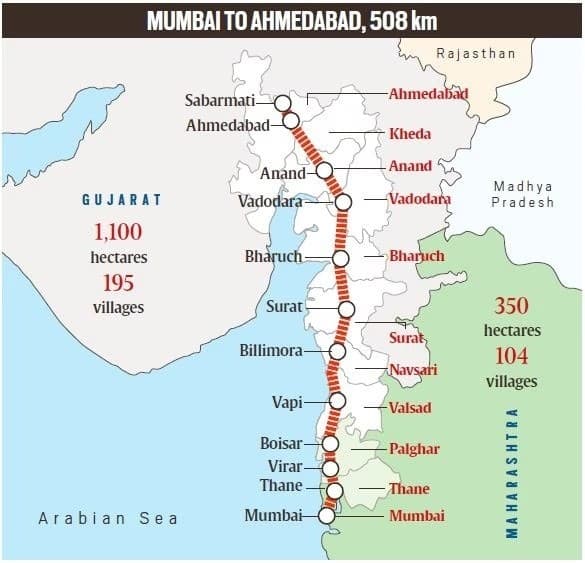
Illustration for Mumbai–Ahmedabad Bullet Train Corridor (High-Speed Rail)

What & Where

India’s first high-speed rail, 508 km Mumbai–Ahmedabad corridor across Maharashtra, Gujarat, Dadra & Nagar Haveli

Japanese Shinkansen technology, trains 320 kmph, travel time just over 2 h

Alignment largely elevated; includes 21 km tunnel with 7 km under-sea section under Thane creek

Quick Facts for MCQs

Infrastructure Highlights

  • TunnelUndersea: 7 km segment under Thane creek inside 21 km tunnel
  • ViaductDominance: Elevated track reduces level crossings, land acquisition
  • Bridges: 17 river and 9 steel bridges enable uninterrupted 320 kmph alignment

Tech & Schemes

  • RollingStock: Shinkansen E5/E10 series, automatic train control, no trackside signals
  • Financing: ~85 % outlay via JICA 0.1 % interest loan with 50-yr tenure
  • Gauge: Standard 1,435 mm differs from Indian 1,676 mm broad gauge

Economic Angle

  • TimeSaving: Cuts Mumbai–Ahmedabad journey to 2 h 7 min from ~7 h
  • Jobs: ~20,000 construction posts plus ancillary manufacturing demand
  • StationHubs: BKC, Thane, Surat, Vadodara planned as multimodal economic nodes

Key Data Points

FeatureData-Point
Implementing agencyNHSRCL
Total length508 km
Gujarat stretch348 km
Maharashtra stretch156 km
D&NH stretch4 km
Stations12
Operational speed320 kmph
Design speed350 kmph
Longest tunnel21 km (7 km undersea)
Latest breakthrough4.88 km Ghansoli–Shilphata

Related UPSC Prelims PYQs

ESE_GS, GS1 2024PYQ 1

Which of the following cities achieved the Guinness World Records by constructing Single Lane Bituminous Concrete Road and longest Double Decker Viaduct with Highway Flyover & Metro Rail?

ESE_GS, GS1 2004PYQ 2

Which among the following National Highway routes is the longest?

GS-1History

3.Kilnamandi Late Harappan Sarcophagus (Burial Practices)

Times of India
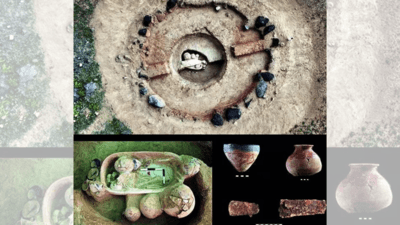
Illustration for Kilnamandi Late Harappan Sarcophagus (Burial Practices)

What & Where

Sarcophagus = terracotta coffin for burials containing charcoal, pottery, grave goods

Found at Kilnamandi village, Tiruvannamalai district, Tamil Nadu

AMS radiocarbon dated 1692 BCE, contemporaneous with Late Harappan phase

Quick Facts for MCQs

Archaeological Significance

  • Earliest-date 17th century BCE Tamil sarcophagus confirmed by AMS
  • Graffiti-link pre-Brahmi symbols show 90 percent Indus similarity
  • Iron-finds precede standard 1200 BCE south India Iron Age

Trade & Exchange

  • Carnelian-beads from Gujarat Maharashtra prove Late Harappan south-north trade
  • High-tin-bronze objects indicate metallurgical knowledge circulation
  • Trade-network challenges notion of peninsular isolation

Burial Customs

  • Sarcophagus-burial within stone enclosure alongside multiple urns
  • Graffiti-restricted to select coffins hint clan identity badges
  • Iron-spears 7–8 ft suggest martial or ceremonial role

Key Data Points

FeatureData-Point
Discovery siteKilnamandi, Tiruvannamalai, TN
Dating1692 BCE
Dating toolAMS radiocarbon
Cultural horizonLate Harappan
MaterialTerracotta sarcophagus
Graffiti-Indus overlap≈ 90 % similarity
Main graffiti motifsFork-like, semi-concentric U, wavering vertical lines
Key grave goodsEtched carnelian beads, iron tools, pottery, high-tin bronze
Carnelian sourceGujarat & Maharashtra
Iron spear length7–8 ft
Burial settingSlab-enclosed collective urns
Trade inferenceSouth–north exchange Tamil Nadu ↔ Harappan regions
GS-1Environment

4.Super Typhoon Ragasa Overview (Tropical Cyclone)

Economic Times

What & Where

Super Typhoon Ragasa (“Nando”): Category 5 cyclone packing 205 km/h winds, 250 km/h gusts, among Pacific’s strongest.

Originating over warm, low-shear western Pacific; now crossing Luzon Strait toward Babuyan Islands, then southern China.

Threat zone: Northern Luzon of the Philippines—7 000-island archipelago on the Pacific Ring of Fire.

Quick Facts for MCQs

Storm Characteristics

  • Category: Rare Category 5 intensity in current Pacific season
  • Conditions: Warm sea surface + low wind shear drove rapid intensification
  • Trajectory: West-northwest track threatens Luzon, later Guangdong–Hainan belt

Philippines Archipelago

  • Composition: 7 000+ islands bounded by South China, Sulu, Celebes seas, Philippine Sea
  • Ring-of-Fire: High seismicity plus frequent typhoons make compound disasters common
  • Hub: Manila operates as political, economic centre on Luzon’s west coast

Neighbouring Seas & Straits

  • North: Taiwan across 250 km-wide Luzon Strait
  • West: Vietnam separated by South China Sea
  • South: Malaysia Sabah & Indonesia across Sulu and Celebes seas

Volcanic Risk

  • Active peaks: Mayon, Taal repeatedly erupt, shaping disaster planning
  • Hazard: Eruptions, quakes elevate landslide/flood risk during typhoons
  • Relief: Steep mountains enhance orographic rainfall, flash-flood potential

Key Data Points

FeatureData-Point
Name (intl/local)Ragasa / Nando
Storm category5 (Super Typhoon)
Sustained wind205 km/h
Peak gust250 km/h
Origin basinWestern Pacific Ocean
Immediate targetBabuyan Islands, N Luzon
Forecast pathLuzon Strait → S China
Philippines capitalManila
Main island groupsLuzon, Visayas, Mindanao
Strait north of LuzonLuzon Strait
GS-3S&T

5.Isobutanol Diesel Biofuel Blend (Biofuel Blending)

The Hindu

What & Where

Isobutanol: four-carbon alcohol (C₄H₁₀O), clear, flammable, considered new bio-blendstock for diesel in India.

Produced via microbial fermentation of cane juice, molasses, grains; requires refinery retrofits for separation from ethanol.

Pilot blending project led by Automotive Research Association of India (ARAI); target up to 10 % diesel mix nationwide.

Quick Facts for MCQs

Production Process

  • Genetically engineered microbes ferment sugars, yield isobutanol alongside ethanol.
  • Requires sterile fermentation tanks, distillation columns retrofit in existing sugar mills.
  • Flexible: can switch between ethanol or isobutanol based on market demand.

Fuel Properties

  • Higher flash point and calorific value than ethanol; enhances diesel safety and mileage.
  • Uniform blending eliminates phase separation issues seen in ethanol–diesel mixes.
  • Can convert further to jet fuel, plastics, synthetic rubber intermediates.

Economic Angle

  • Utilises surplus ethanol capacity, supporting sugar sector revenues amid domestic glut.
  • Aims to curb crude-oil import bill, aiding India’s net-zero 2070 roadmap.
  • Minor infrastructure tweaks cheaper than building fresh biofuel plants.

Limitations

  • Low cetane necessitates ignition improvers for blends beyond 10 %.
  • Higher additive and retrofitting costs could raise pump prices.
  • Engine durability concerns emerge at high blend ratios without redesign.

Key Data Points

FeatureData-Point
Chemical formulaC₄H₁₀O
Carbon atoms4 (higher than ethanol’s 2)
Flash pointHigher than ethanol → safer storage
Energy density> ethanol; closer to diesel
Recommended blend ratio≤ 10 % with diesel
Cetane numberLow → may cause knocking
Miscibility with dieselGood; no extra surfactant needed
Co-solvent needBiodiesel improves full homogeneity
Key producer feedstocksSugarcane juice, molasses, cereal grains
Lead test agencyARAI, Pune
GS-3S&T

6.Evo Genomic AI Model (Genomic AI)

DD News

What & Where

Evo: large foundation AI model for microbial & viral genomics, dubbed “ChatGPT for DNA”.

Location: developed jointly at Stanford University and Arc Institute, California, USA.

Use-case: designs bacteriophages to combat drug-resistant bacterial infections.

Quick Facts for MCQs

Technical Features

  • Training: learnt 300 bn nucleotides, recognizes gene syntax and epistasis
  • Generative: proposes complete viral blueprints ready for synthesis via DNA printers
  • Validation: lab synthesis confirms infectivity, protein activity

Health Applications

  • Phage-therapy: designs viruses that selectively kill drug-resistant bacteria
  • Mutation-analysis: predicts disease-linked protein changes, guiding precision medicine
  • CRISPR: suggests new Cas9 variants for genome editing

R&D Impact

  • Speed: AI reduces wet-lab iteration cycles from years to weeks
  • Cost: automates design, slashing expenditure on trial-and-error screening
  • Scale: enables genome-scale engineering unreachable by manual methods

Access & Governance

  • Availability: model weights released for non-commercial academia, fostering collaborative science
  • Oversight: synthetic designs still require biosafety review and containment protocols
  • Dual-use risk: capability to create novel viruses flagged for security monitoring

Key Data Points

FeatureData-Point
Developer institutionsStanford University & Arc Institute
Model nicknameChatGPT for DNA
Primary objectiveDesign therapeutic bacteriophages
Training genomes80,000 microbial genomes
Training sequencesMillions of phage & plasmids
Total nucleotides≈ 300 billion
ResolutionSingle-nucleotide level
Context lengthExtended, captures long-distance gene interactions
Generative outputsViruses, proteins, genome-scale constructs
Access policyPublicly available for non-commercial academic research
GS-3S&T

7.India’s Semiconductor Design Push (Semiconductor Mission)

The Hindu
Illustration for India’s Semiconductor Design Push (Semiconductor Mission)

What & Where

Semicon India Mission: ₹76,000 cr push for domestic semiconductor fabs, assembly, display lines.

Targeted processes: front-end fabrication, OSAT/ATMP back-end, fab-less design, skill development.

Emerging hubs: Dholera (Gujarat), Bengaluru-Mysuru belt, Odisha electronics corridor.

Quick Facts for MCQs

Policy & Schemes

  • PLI/DLI/SPECS offset 9–10 % cost gap with East Asia.
  • DLI reimburses 50 % eligible R&D for fab-less firms.
  • C2S gives free EDA tool access to 100+ institutes.

Market Drivers

  • China+1 shift redirects manufacturing capacity toward India.
  • India is 2nd-largest smartphone maker; fastest-growing electronics market.
  • Strong demand for legacy 28 nm+ nodes in auto, IoT, energy devices.

Economic Angle

  • Electronics exports forecast to 5 × by 2026, narrowing trade deficit.
  • Semiconductor jobs carry 6.7 × employment multiplier across ecosystem.
  • New hubs in Gujarat, Karnataka, Odisha decentralise high-tech growth.

Challenges & Risks

  • Fab capex $10–15 bn; needs cheap power, ultra-pure water, solid logistics.
  • Only fraction of 8 lakh graduates are industry-ready; scaling specialised training crucial.
  • VC wary of long gestation; stable, predictable policy vital for investor confidence.

Key Data Points

FeatureData-Point
Global design share (India)20 %
Design engineers in India≈1.25 lakh
Chips designed per year≈3,000
Semicon India capital subsidy50 %
Programme outlay₹76,000 crore
Micron ATMP investment₹22,500 crore
Micron ops start2024
C2S engineers target85,000
Projected chip demand 2030$110 billion
Job multiplier6.7 ×

Related UPSC Prelims PYQs

ESE_GS 2026PYQ 1

Which state is home to India’s first Silicon Carbide (SiC) semiconductor manufacturing plant?

GS-3S&TQuick Bite

8.Supercomputers Versus Personal Computers (Supercomputing)

The Hindu
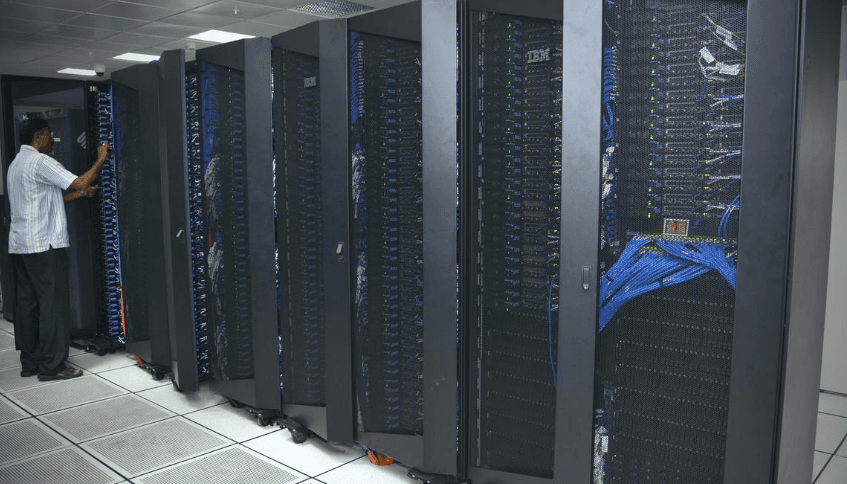
Illustration for Supercomputers Versus Personal Computers (Supercomputing)

What & Where

Supercomputer: ultra-high-performance system executing quintillions of calculations/second for science, weather, AI, nuclear modelling.

Exascale: ≥1 ExaFLOPS; Europe’s debut via Germany’s JUPITER at Forschungszentrum Jülich.

India: National Supercomputing Mission deploying PARAM & AIRAWAT lines across research institutes.

Quick Facts for MCQs

International Examples

  • Germany: JUPITER tops EU lists, focuses on energy-efficient exascale computing.
  • US, China already field multiple exascale systems, intensifying performance race.
  • European build emphasises sovereignty over critical HPC hardware & software.

Tech & Schemes

  • NSM aims 70+ petascale nodes, indigenous hardware, campus networks by C-DAC & IITs.
  • PARAM generations evolve from petascale to AI-centric AIRAWAT, boosting domestic R&D.
  • Indigenous interconnect Trinetra, RISC-V processors under design for future upgrades.

Architecture & Infrastructure

  • Clusters stitch thousands–millions CPUs/GPUs via InfiniBand or Omni-Path interconnects.
  • Parallel file systems supply petabyte storage, high I/O bandwidth for data-heavy models.
  • Power demand equals small town; liquid or immersion cooling prevents thermal runaway.

Key Data Points

FeatureData-Point
Normal PC speedBillions ops/s (GFLOPS)
Supercomputer speedQuintillions ops/s (ExaFLOPS)
First European exascaleJUPITER, Germany
Indian umbrella programmeNational Supercomputing Mission
Key Indian familiesPARAM, AIRAWAT
Cooling style supercomputersLiquid / immersion

Related UPSC Prelims PYQs

CAPF_GAI, GS1 2023PYQ 1

What are Airawat, Param Siddhi, Pratyus and Mihir?

CAPF_GAI, GS1 1997PYQ 2

The world’s fastest computer has been able to perform (as of Dec. 1996)

GS-2Security

9.Saudi–Pakistan Strategic Defence Pact (SMDA Agreement)

The Hindu

What & Where

SMDA; first formal Saudi-Pakistan defence pact; signed Sept 2025; converts decades-old informal military help into treaty commitment

Clause; “collective defence” obliges joint response to attacks; establishes permanent joint military committee and intel-sharing channels

Geography; links South Asia front (India–Pakistan) with Gulf security arc (Iran, Yemen Houthis, Israel)

Quick Facts for MCQs

Security Dimension

  • Pact; enables Saudi funding for Pakistan tech modernisation—drones, hypersonics, cyber—with Chinese & Turkish inputs
  • Impact; may dilute Riyadh–Delhi counter-terror synergy; complicates Indian attempts to isolate Pakistan globally
  • Risk; accelerates regional arms race forcing India to upscale AI, space, electronic warfare spending

Energy & Economy

  • Dependency; India imports major crude volumes from Saudi; pact adds geopolitical premium to supply security
  • Corridor; Saudi backing vital for India-Middle East-Europe Economic Corridor; divergence could slow project momentum
  • Remittances; Indian workers in KSA remit billions; political chill could affect flows and labour welfare

Diplomatic Options

  • Engagement; intensify economic projects—West Coast Refinery, renewables, fintech—to keep Riyadh ties Pakistan-neutral
  • Iran pivot; fast-track Chabahar & INSTC giving alternate access to Central Asia bypassing Pakistan
  • Diversify; deepen UAE, Qatar links and leverage I2U2 mini-lateral for balanced Gulf footprint

Key Data Points

FeatureData-Point
SignatoriesSaudi Arabia & Pakistan
Agreement nameStrategic Mutual Defense Agreement (SMDA)
Year signed2025
Core clauseCollective defence obligation
Saudi oil share in India imports≈17% (2023)
Indian diaspora in Saudi~2.6 million
India–Saudi trade rankIndia 2nd largest partner for Riyadh; Saudi 5th for India
Indian investment in KSAUSD 3 billion (Aug 2023)
GS-3SecurityQuick Bite

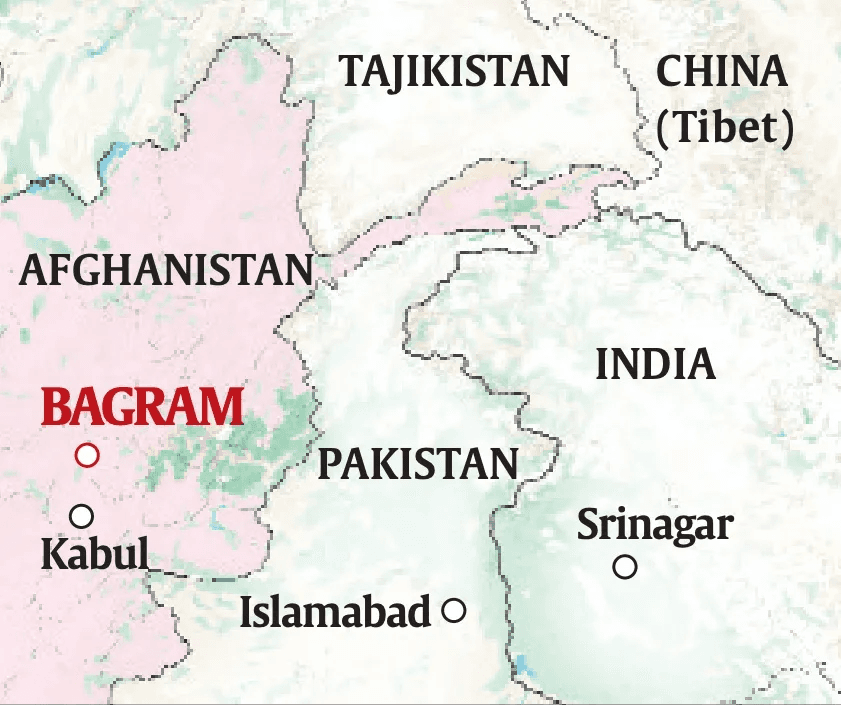
10.Bagram Air Base Significance (Afghan Base)

Indian Express
Illustration for Bagram Air Base Significance (Afghan Base)

What & Where

Airbase: Bagram Airfield, Afghanistan’s largest, 60 km north of Kabul in Parwan province

Function: Former US logistics-intelligence hub; now under Taliban control but sought by US

Geography: Commands Salang Tunnel and highways linking Kabul to north, south, west corridors

Quick Facts for MCQs

Historical Timeline

  • 1950s Soviet construction amid Cold War rivalry
  • 1979–89 hosted Soviet forces during Soviet–Afghan War
  • 2001–21 served as principal US command centre in War on Terror

Connectivity & Geography

  • Salang Tunnel links Kabul to Mazar-e-Sharif and northern cities
  • Parwan highways connect Kabul to Ghazni, Kandahar southward; Bamiyan westward
  • Location dominates central Afghan movement corridors and supply chains

Security Dimension

  • US President warns of consequences, hints at military action if base not returned
  • Base enables regional monitoring, including Chinese Lop Nur and Koko Nur nuclear sites
  • Growing China-Taliban ties elevate Bagram’s strategic relevance

Key Data Points

FeatureData-Point
Distance from Kabul~60 km north
ProvinceParwan
Built bySoviet Union, 1950s
Salang Tunnel length2.6 km
US main hub years2001–2021
Year vacated by US2021
Nearest Chinese nuclear siteLop Nur, ~2,000 km
Strategic tagAfghanistan’s largest military base
GS-2Scheme

11.LEADS 2025 Logistics Index (Logistics Performance)

PIB

What & Where

National index-survey benchmarking logistics performance across all Indian States & UTs

Released by DPIIT, Ministry of Commerce & Industry; current edition tagged “LEADS 2025”

Tracks infrastructure, services, efficiency, policy support and stakeholder perception in supply chains

Quick Facts for MCQs

Tech & Schemes

  • API integration enables section-wise speed analytics on major corridors
  • Interactive dashboard lets States benchmark, track, and download own performance data
  • Digital design aligns with PM GatiShakti, ULIP platforms

Economic Angle

  • Objective: cut logistics cost, improve multimodal efficiency, boost Make in India competitiveness
  • Gap identification guides State investment in roads, warehousing, multimodal hubs
  • Healthy competition among States expected to raise overall supply-chain productivity

Governance Tools

  • Tailored policy recommendations dispatched to each State/UT post-survey
  • Grievance redressal, single-window clearances part of evaluated facilitation measures
  • Industry perception surveys feed directly into annual ranking revisions

Key Data Points

FeatureData-Point
Launch occasionMake in India decade celebrations, New Delhi
Parent ministryCommerce & Industry
Implementing armDPIIT
Coverage36 States/UTs
Assessment pillarsInfrastructure, Services, Efficiency, Policy Support, Perception
Corridor sample5–7 key national road corridors
Key metricsJourney time, truck speed, waiting time
Data captureAPI-enabled real-time speed readings
Ranking bandsLeaders, Achievers, Aspirers
Output toolDigital dashboard for continuous monitoring

Related UPSC Prelims PYQs

CAPF_GAI 2024PYQ 1

Which of the following statements with regard to National Logistics Policy (NLP) is NOT correct?

GS-2Scheme

12.Mana Mitra WhatsApp Governance Platform (Digital Services)

Times of India
Illustration for Mana Mitra WhatsApp Governance Platform (Digital Services)

What & Where

WhatsApp-governance platform Mana Mitra, launched Jan 2025, delivers public services digitally via chat.

Single-window integrates 36 Andhra Pradesh departments, offering certificates, payments, hall tickets and more.

Access through WhatsApp 95523 00009; recognised by DARPG for all-India replication.

Quick Facts for MCQs

Tech & Schemes

  • Integration: Chatbot menu delivers income, caste certificates, hall tickets, tax payments instantly as PDFs.
  • Security: QR codes enable website cross-check; blockchain authentication being piloted for tamper-proof records.
  • Partnership: Meta MoU supplies encryption and scalable backend, ensuring uptime during lakh-plus simultaneous requests.

Governance Impact

  • Inclusion: Mobile-first design taps ~500 million Indian WhatsApp users, easing rural access without new apps.
  • Efficiency: Real-time dashboards monitor pendency, speed approvals, eliminate long queues and paperwork.
  • Transparency: Digital delivery curbs middlemen, echoing Minimum Government, Maximum Governance mantra.

Challenges & Risks

  • Connectivity: Tribal and remote belts face patchy internet, risking exclusion.
  • Cybersecurity: Phishing and spoofed accounts demand two-factor authentication plus user awareness drives.
  • Compliance: Must align with Digital Personal Data Protection Act 2023 for safe citizen data handling.

Future Roadmap

  • Upgrade: Phase-II introduces AI-powered, multilingual voice bots for predictive assistance.
  • Integration: Planned linkage with DigiLocker, UPI, CoWIN to craft unified national service hub.
  • Legislation: Proposed legal framework to institutionalise WhatsApp governance and fix accountability.

Key Data Points

FeatureData-Point
Launch month-yearJanuary 2025
Indian first?Yes, first WhatsApp-based governance model
State implementingAndhra Pradesh
Access number95523 00009
Departments onboard36
Services available738
Backend partnerMeta (MoU signed)
Verification toolQR-coded digital certificates
Tech under rolloutBlockchain authentication, AI chatbots
Central recognitionDARPG best-practice for nationwide scale
GS-1Editorial

13.Public Distribution System Reform (Food Security)

The Hindu

What & Where

Thali Index = cost of one balanced Indian meal (rice, roti, dal, veg, curd, salad); gauges affordability, not just calories.

Crisil 2025 study: 50 % rural & 20 % urban Indians lack money for two thalis/day; still 40 % & 10 % even with PDS.

Pan-India assessment uses 2023-24 Household Consumption Expenditure Survey; exposes nutrition gaps beyond official poverty lines.

Quick Facts for MCQs

Nutrition Gap

  • Pulses only affordable protein; poorest 5 % consume 50 % of richest 5 % levels.
  • Cereal equality masks micronutrient, protein, vitamin shortfalls across income classes.
  • Hidden hunger persists despite low “extreme poverty” headline.

PDS Limitations

  • Supply skewed to rice & wheat; protein-rich items excluded.
  • Universal cereal entitlements raise FCI procurement, storage and subsidy costs.
  • Inclusion errors: 80 % urban households receive subsidised grain irrespective of need.

Reform Proposals

  • Define region-specific “two-thali” nutrition norm for targeting.
  • Reallocate savings from trimmed cereal quotas to subsidised tur, moong, chana.
  • Employ Aadhaar-linked e-POS & HCES data for dynamic, leakage-free beneficiary lists.

Key Data Points

FeatureData-Point
Extreme poverty (World Bank, 2022-23)2.3 % of population
Rural food-deprived (pre-PDS)50 % households
Urban food-deprived (pre-PDS)20 % households
Rural deprived even after PDS40 %
Urban deprived even after PDS10 %
Top 10 % rural subsidy vs poorest 5 %88 % of latter’s subsidy
Free grain beneficiaries under NFSA80 crore persons
Pulse intake: poorest vs richest rural 5 %Half the quantity
Rangarajan poverty line (urban)₹1,407 per capita / month
Tendulkar shiftCalorie → broader outcomes (2009)

Related UPSC Prelims PYQs

GS1 2004PYQ 1

Which one of the following statements is NOT correct?

GS1 2018PYQ 2

राष्ट्रीय खाद्य सुरक्षा अधिनियम, 2013 के अधीन बनाए गए नियमों के संदर्भ में, निम्नलिखित कथनों पर विचार कीजिए :

Ready to practice?

Test your knowledge with our UPSC test series.

Start Free Trial