UPSC Current Affairs

16 topicsGS-1: 3GS-2: 1GS-3: 12
0/16 done
GS-2Polity

1.Supreme Court on Begging (Right to Dignity)

The Hindu

What & Where

Definition – SC says state-run beggars’ homes are constitutional trusts, not quasi-penal or charity shelters.

Process – Admission, care, rehabilitation must respect Article 21 dignity; children routed via Juvenile Justice Act 2015.

Geography – Begging regulated by states/UTs; most adopt Bombay Prevention of Begging Act 1959.

Quick Facts for MCQs

Legal & Policy

  • Competence – No central anti-begging statute; states free to frame or adopt 1959 Bombay Act.
  • Delhi HC & SC view – Criminalising poverty violates dignity; socio-economic solutions preferred.
  • BNS 2023 – Trafficking sections usable to crush organised begging rings.

Judicial Directives

  • Safety – Separate women/child units, counselling, education; kids shifted to child-care institutions, not beggars’ homes.
  • Health – 24-hour medical screening; dieticians to monitor nutrition.
  • Infrastructure – Biennial third-party audits, strict occupancy caps, mandatory vocational training.

Scheme & Statistics

  • SMILE components – medical aid, skill training, shelter linkage, 2026 “beggar-free” target.
  • Funding – Central grants routed via District Social Welfare officers; NGOs act as implementing partners.
  • Monitoring – Dashboard tracks admissions, rehabilitation, recidivism rates.

Social Concerns

  • Drivers – poverty, disability, disasters, caste stigma, organised trafficking.
  • Impacts – public health hazards, tourist discomfort, strain on urban services.
  • Rights – Arbitrary arrests under anti-begging laws termed human-rights violations by courts.

Key Data Points

FeatureData-Point
Landmark caseM.S. Patter v. State of NCT Delhi (2025)
Constitutional article invokedArticle 21 – right to life with dignity
List entry for vagrancy lawsConcurrent List, Entry 15
Dominant state lawBombay Prevention of Begging Act 1959
Delhi HC 2018 rulingHarsh Mander v. Union of India decriminalised begging
National schemeSMILE – launched 2022
Persons rehabilitated under SMILE970 (352 children) till 2024
Census 2011 beggar count4,13,670 nationwide
State with most beggarsWest Bengal
Child protection treaty citedUN Convention on the Rights of the Child

Related UPSC Prelims PYQs

NDA_GAT 2025PYQ 1

S1. In many countries, there are millions of people who are underprivileged and deprived
GS-3Economy

2.GST 2.0 Reform (Tax Rationalisation)

Indian Express

What & Where

Definition: GST 2.0, nationwide overhaul of 2017 Goods & Services Tax.

Geography: Implemented across India from 22 Sept 2025, tagged “GST Bachat Utsav”.

Core process: Merges multiple slabs into merit-standard-demerit rates, automates compliance.

Quick Facts for MCQs

Tax Structure

  • Rationalisation: Collapses earlier five slabs into broad 5 %, 18 %, 40 % plus a few special micro-rates.
  • Alignment: Similar goods placed in same slab to curb classification disputes.
  • Sin goods: Pan masala, tobacco, aerated drinks, luxury yachts taxed at 40 %.

Consumer Impact

  • Relief: Food staples, life-health insurance, salons shifted to 5 % slab.
  • Disposable-income boost: Lower rates expected to spur household consumption.
  • Exemptions: Select medicines, assistive devices remain zero-rated.

Compliance & Tech

  • Registration: End-to-end digital with e-KYC and risk flags.
  • Returns: Pre-filled GSTR-3B and automated ITC reconciliation.
  • Refunds: 90 % provisional payout within 7 days for IDS exporters.

Industry Implications

  • Cost reduction: Textiles, agri-machinery, construction materials move to 5 %.
  • Investment push: Simplified input credit lowers working-capital lock-in.
  • Litigation drop: Harmonised slabs expected to shrink classification appeals.

Key Data Points

FeatureData-Point
Launch date22 September 2025
New slab countThree: 5 %, 18 %, 40 %
Merit slab items516
Standard slab items640
Demerit slab rate40 %
0.25 % rate itemsRough diamonds, precious stones
1.5 % rate itemsCut & polished diamonds
Precious metals rate3 %
Brick options6 % (no ITC) / 12 % (with ITC)
Provisional refund share90 % in IDS cases

Related UPSC Prelims PYQs

CDS_GK, GS1 2017PYQ 1

वस्तु एवं सेवा कर (Goods and Services Tax/GST) के क्रियान्वयन हेतु निम्नलिखित संभावित लाभ क्या है/हैं ?

CDS_GK, GS1 2024PYQ 2

Which one of the following statements regarding GST is not correct?

GS-3Infrastructure

3.Sawalkote Hydropower Project (Chenab River Dam)

Indian Express
Illustration for Sawalkote Hydropower Project (Chenab River Dam)

What & Where

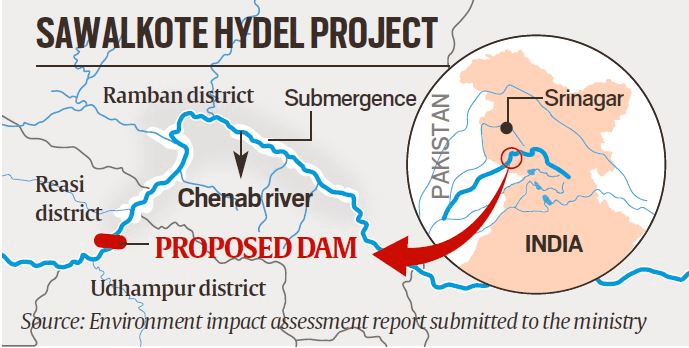
Sawalkote: 1,856 MW run-of-river hydroelectric project on Chenab River, Ramban district, Jammu & Kashmir

Infrastructure: concrete gravity dam with reservoir, notified as project of national importance (initiated 1984)

Output: expected ≈7,000 million units electricity annually, among India’s largest hydel schemes

Quick Facts for MCQs

Legal & Policy

  • IWT 1960 mediated by World Bank; grants Pakistan ~80 % flow of western rivers
  • Provision allows India non-consumptive western-river use: hydropower, navigation, limited irrigation
  • Treaty currently in abeyance, easing statutory clearances for Sawalkote

Security Dimension

  • Suspension after 2025 Pahalgam attack reclassified Chenab projects as strategic water-leverage assets
  • Project tagged national importance, bolstering upper-riparian bargaining power with Pakistan
  • Fast-tracking aids J&K energy security and deterrence posture

Energy & Infrastructure

  • Sawalkote augments Dulhasti, Baglihar, Salal, creating >3.8 GW Chenab hydel corridor
  • Run-of-river design minimizes large-scale submergence while exploiting steep gradient
  • Corridor expected to stabilize northern grid peak supply and reduce fossil dependence

Key Data Points

FeatureData-Point
Installed capacity1,856 MW
Main riverChenab
Project locationRamban, J&K
Project typeRun-of-river; concrete gravity dam
Initiation year1984
Annual generation≈7,000 MU
Treaty affectedIndus Waters Treaty 1960
IWT mediatorWorld Bank
Eastern rivers to IndiaRavi, Beas, Sutlej
Western rivers to PakistanIndus, Jhelum, Chenab
Other Chenab projectsDulhasti 390 MW; Baglihar 890 MW; Salal 690 MW
Fast-tracking triggerIWT suspension post Pahalgam attack 2025

Related UPSC Prelims PYQs

CDS_GK 2025PYQ 1

Salal Power Project is situated on which one among the following rivers?

CDS_GK 2021PYQ 2

The Luhri Hydro-Electric Power Project is being constructed on the river

GS-3EconomyQuick Bite

4.CAG State Debt Analysis (Fiscal Health)

Indian Express

What & Where

Public debt: states’ market borrowings + loans from Union, audited by CAG.

Golden-Rule process: borrow strictly for capital creation, not routine revenue outgo.

Scope: 28 Indian states, FY 2013-14 → 2022-23 fiscal performance.

Quick Facts for MCQs

Fiscal Metrics

  • Market loans share dominant, interest outgo rising share of revenue.
  • Centre loans proportionally growing after GST rollout.
  • Contingent liabilities via guarantees add off-budget pressure.

Drivers of Debt

  • GST reduced state tax autonomy; cesses cut divisible-pool share.
  • Revenue–expenditure mismatch: states do ≈⅔ spending but raise <⅓ revenue.
  • Higher market rates than Centre escalate servicing costs.

Risks & Impacts

  • Debt-trap possibility curtails social and infrastructure outlay.
  • Fiscal stress threatens cooperative federalism, widens regional inequality.
  • Inflation risk via elevated sub-national borrowing demand.

Corrective Measures

  • Enhance tax base, monetize assets, tap green/NSSF bonds for cheaper funds.
  • Prioritize capex, rationalize freebies, adopt performance budgeting with Fiscal Health Index.
  • Strengthen rainy-day funds; ensure timely GST compensation, Finance-Commission transfers.

Key Data Points

FeatureData-Point
FY23 total state debt₹59.60 lakh crore
10-yr growth multiple3.39 ×
Debt/GSDP FY14 vs FY2316.66 % → 22.96 %
Debt/GDP FY2322.17 %
Highest debt ratio statePunjab 40.35 %
Next two high statesNagaland 37.15 %, WB 33.70 %
Lowest debt ratio stateOdisha 8.45 %
Avg debt/revenue receipts≈150 % (191 % in FY21 peak)
Borrowing channelsSDLs, T-bills, RBI WMA, LIC, NABARD
Golden-Rule violators11 states; <25 % capex in AP, Punjab
Key Centre loans spikeGST-compensation, special capex aid

Related UPSC Prelims PYQs

CDS_GK, GS1 2018PYQ 1

Consider the following statements:

CDS_GK, GS1 2025PYQ 2

Which one of the following is a good statistic to evaluate where an economy stands in the financial cycle?

GS-1Mapping

5.Mapping Tirah Valley (Pakistan Valley)

New Indian Express

What & Where

Mountainous tribal region spanning Khyber & Orakzai districts, Khyber Pakhtunkhwa, Pakistan.

Squeezed between Khyber Pass and Khanki Valley, abutting Afghanistan border; traditional corridor South–Central Asia.

Known for fertile terraced valleys and recurrent insurgent activity resisting external control.

Quick Facts for MCQs

Physical Geography

  • Terraced agriculture; walnut & mulberry prominent cash trees.
  • High summer pastures enable seasonal transhumance.
  • Acts as link between Hindu Kush and Indus plains.

Security Dimension

  • Recent blast killed ≥23; valley recurrent militant sanctuary.
  • Terrain & border porosity hamper state control, aiding insurgent mobility.
  • Historically contested by Mughals, British, Pakistani forces.

Historical Context

  • 1897 Tirah Campaign showcased tribal resistance to British Raj.
  • Continuous uprisings illustrate long tradition of autonomy.
  • Strategic value retained from imperial era to present conflict.

Demography & Culture

  • Pashtun tribal code (Pashtunwali) governs local justice and conflict resolution.
  • Sikh merchant presence signals historic trade tolerance.
  • Hamsaya (client) groups depend on dominant tribes for protection.

Key Data Points

FeatureData-Point
ProvinceKhyber Pakhtunkhwa, Pakistan
DistrictsKhyber District, Orakzai District
Approx. area600–700 sq miles
Main sub-valleysMaidan, Rajgul, Waran, Bara, Mastura
Strategic passesSampagha, Tseri Kandao, Saran Sar
Dominant tribesAfridi, Orakzai (Pashtun)
Minority groupsSikh traders, Hamsaya communities
Historic battle1897 Tirah Campaign (British)
Soil typeFertile alluvial
Border proximityClose to Afghanistan–Pakistan Durand Line
GS-1Mapping

6.Barren Island Volcano (Active Volcano)

The Print
Illustration for Barren Island Volcano (Active Volcano)

What & Where

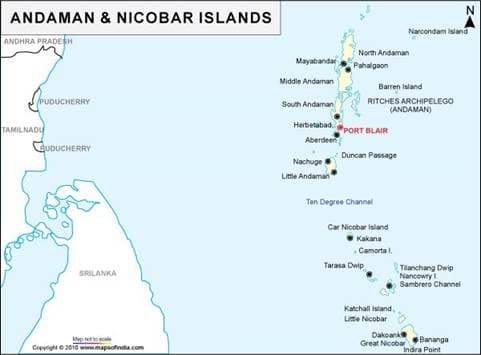
Barren Island: India & South Asia’s only confirmed active subaerial volcano, uninhabited, rugged cones.

Sits in Andaman Sea, ~138 km NE of Port Blair, Andaman & Nicobar UT.

Lies on Indian–Burmese plate subduction zone; 3 km² island, 354 m high, 2 km-wide caldera.

Quick Facts for MCQs

Geological Features

  • Stratovolcano; central caldera from collapsed cone, basaltic to andesitic flows.
  • Only active volcano between Sumatra & Myanmar, key to Andaman volcanic arc studies.
  • Low-intensity eruptions reshape island without large regional impact.

Eruption History

  • Long dormancy after 1787; renewed phases 1991, 2005-07, 2017, 2022, 2025.
  • 2025 events: mild lava effusion, ash plumes; no human settlement threatened.
  • Continuous monitoring refines models of Indian Ocean volcanism.

Ecology & Environment

  • Harsh, ash-laden terrain; limited flora, dwindling bird/fauna post-eruptions.
  • Offers natural laboratory for primary succession research.
  • Adjacent waters host rich marine biodiversity, largely unaffected by ash fall.

Strategic Dimension

  • Proximity to key Andaman Sea shipping lanes boosts India’s maritime situational awareness.
  • Geological uniqueness strengthens India’s scientific footprint in Indo-Pacific.
  • Access regulated; potential niche for controlled volcanology tourism.

Key Data Points

FeatureData-Point
Island area≈3 sq km
Peak elevation354 m AMSL
Caldera width≈2 km
Distance from Port Blair≈138 km NE
First recorded eruption1787
Latest eruptions13 & 20 Sep 2025
Volcanic Explosivity IndexVEI 2 (low)
Oldest lava flows≈1.6 million yrs
Oceanic crust age≈106 million yrs
Tectonic settingIndian–Burmese convergence

Related UPSC Prelims PYQs

CDS_GK 2020PYQ 1

Recently islands of Andaman and Nicobar were connected with mainland by Submarine Optical Fibre Cable. Which one of the following islands was not connected initially?

GS-3Environment

7.AI Nature Centre Betla Park (Eco-tourism Tech)

New Indian Express
Illustration for AI Nature Centre Betla Park (Eco-tourism Tech)

What & Where

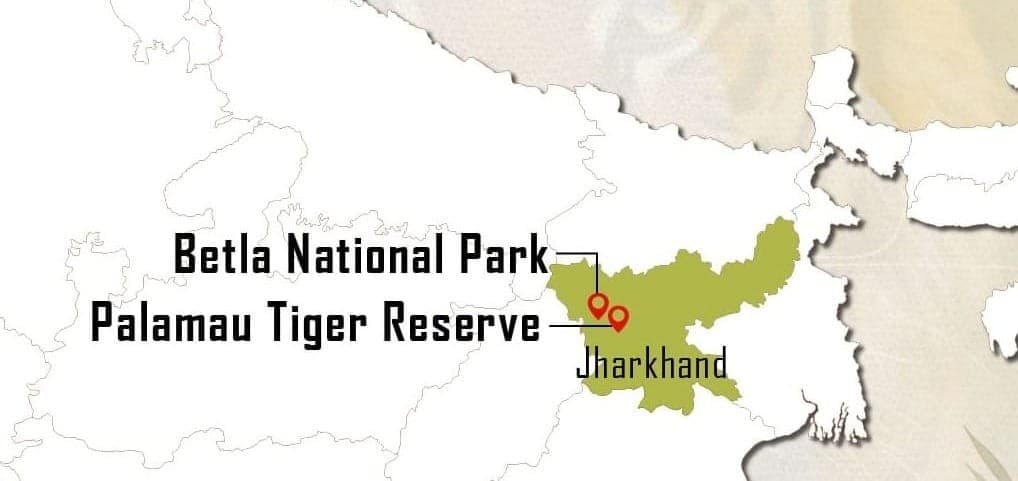
Centre — India’s first AI-enabled nature interpretation hub inside Betla National Park, Palamau Tiger Reserve (PTR), Jharkhand

Geography — Betla NP in Latehar district, Chotanagpur Plateau, ≈170 km west of Ranchi

Status — Forms core of PTR, one of the first nine Project Tiger reserves (1973)

Quick Facts for MCQs

Tech & Features

  • AI-assistants enable guided learning with real-time query responses
  • 3D holograms plus AR/VR recreate lifelike animal presence and movement
  • Immersive audio integrates waterfalls, bird calls, hunt sequences

Eco-tourism & Education

  • High-tech hub expected to boost year-round tourist inflow and revenue
  • Interactive modules raise visitor sensitivity to habitat conservation
  • Traditional elephant rides, jeep safaris continue alongside digital experience

Conservation & Research

  • Virtual observation tools let scientists study behaviour without field intrusion
  • Simulated datasets aid modelling of predator-prey and herd dynamics
  • Outreach content supports local tribal eco-tourism stewardship initiatives

Key Data Points

FeatureData-Point
DeveloperPTR authorities, Dy. Director Prajesh Kant Jena
First-of-its-kind1st AI-enabled nature experience centre in India
Core technologiesAI assistants, 3D holograms, AR/VR, immersive sound
Key simulationsFood-sharing, herd movement, predator-prey interactions
National Park notified1986
PTR total area1,129.93 sq km
Project Tiger batchAmong earliest nine reserves, 1973
Distance from Ranchi≈170 km
GS-3Environment

8.Polluted River Stretches Report (CPCB Findings)

The Hindu
Illustration for Polluted River Stretches Report (CPCB Findings)

What & Where

Polluted River Stretch (PRS): contiguous river segment with Biological Oxygen Demand (BOD) > 3 mg/L, hence unfit for bathing

Priority scale: P-1 >30 mg/L BOD (highest urgency) to P-5 ≤3 mg/L (least) guiding remediation

Highest PRS counts: Maharashtra 54, Kerala 31, Madhya Pradesh & Manipur 18 each, Karnataka 14

Quick Facts for MCQs

Scale & Trends

  • Reduction 2023: unfit sites down 1%, PRS down 5% versus 2022
  • Priority shift: P-4 stretches fell 37%, P-2 & P-3 counts rose, signalling partial improvement
  • Success metric: stretches migrating from P-1 toward P-5 on BOD scale

Drivers of Pollution

  • Ritualistic inputs: idol immersion, cremation release Plaster of Paris, toxic paints, floral waste
  • Industrial discharge: textiles, tanneries, chemicals add heavy metals to Ganga, Yamuna, Damodar
  • Agricultural runoff: fertilisers, pesticides, stubble ash cause eutrophication exemplified by Sutlej

Government Initiatives

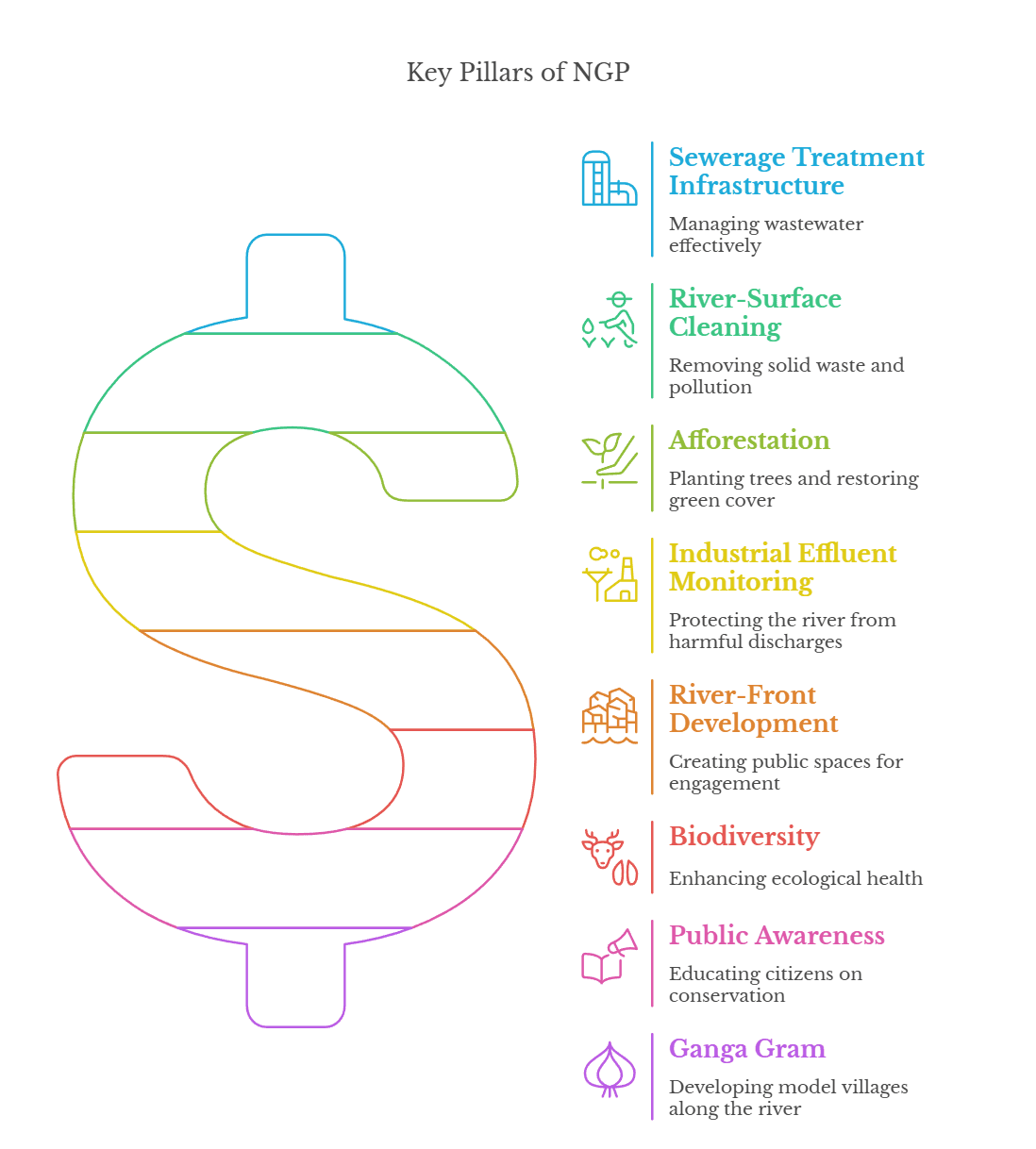
  • Namami Gange aggregates GAP, NRGBA, Clean Ganga Fund for basin-wide works
  • Bhuvan-Ganga GIS app crowdsources pollution hotspots, supports CPCB monitoring
  • Riverbank waste-disposal ban empowers SPCBs for on-ground enforcement

Recommended Actions

  • Enforcement: Water Act 1974 plus NGT fast-track penalties, expand sewage networks
  • Industrial control: mandatory Zero Liquid Discharge, real-time ETP monitoring, heavy fines
  • Digital tools: AI, IoT sensors, GIS drones enable continuous water-quality vigilance

Key Data Points

FeatureData-Point
Unfit bathing sites 2023807
Unfit bathing sites 2022815
Polluted River Stretches 2023296
PRS 2022311
Top PRS stateMaharashtra 54
States with most P-1 stretchesTamil Nadu, Uttar Pradesh, Uttarakhand – 5 each
Priority-4 stretches 2022→202372 → 45
BOD unfit threshold>3 mg/L

Related UPSC Prelims PYQs

GEO_GS, NDA_GAT 2020PYQ 1

The biological oxygen demand (BOD) of unpolluted river water is:

GEO_GS, NDA_GAT 2024PYQ 2

Which of the following statements regarding the given rivers is/are correct?

GS-3Species

9.Bonnet Macaque Ecology (Endemic Primate)

The Hindu
Illustration for Bonnet Macaque Ecology (Endemic Primate)

What & Where

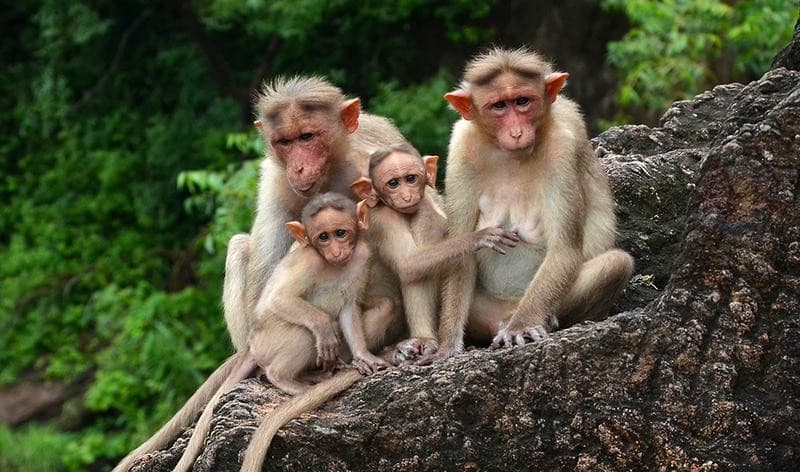
Definition: Bonnet macaque, arboreal–terrestrial Old-World monkey with signature hair whorl

Geography: Endemic southern India; Western Ghats, Deccan plains, urban fringes

Habitat range: Evergreen, dry-deciduous forests, plantations, village edges, city parks

Quick Facts for MCQs

Conservation Status

  • Listing: IUCN Least Concern due wide distribution yet local declines from habitat loss
  • Protection gap: Not in Schedule I of Wildlife (Protection) Act unlike lion-tailed macaque

Ecology & Behaviour

  • Dominance: Linear hierarchy; strong grooming alliances
  • Reproduction: Single infant; females birth ≈5 offspring before menopause (~27 yrs)
  • Tolerance: Adult males unusually permissive toward juveniles

Human Interaction

  • Conflict: Frequent crop raids, household incursions in semi-urban zones
  • Adaptation: Thrives on human food waste, increasing habituation
  • Mortality risk: Poisoning, electrocution, disease outbreaks near settlements

Recent Incident

  • Event: Nine macaques found dead Thiruvananthapuram, Kerala; cause under probe
  • Concerns: Possible poisoning or zoonotic disease trigger
  • Response: Forest-veterinary teams conducting necropsy, toxicology tests

Key Data Points

FeatureData-Point
IUCN statusLeast Concern
Distinct trait“Bonnet-shaped” scalp whorl
Adult weight♂ 6.7 kg; ♀ 3.9 kg
Body length35–60 cm (tail extra)
Breeding peakSept–Oct (annual)
Gestation≈24 weeks
Avg lifespan wild20–25 yrs
Troop typeMulti-male, multi-female ≈30 members
Female dispersalPhilopatric (stay natal)
Diet patternOmnivorous, crop-raiding, waste-scavenging
GS-3SpeciesQuick Bite

10.Himalayan Musk Deer (Endangered Cervid)

Down to Earth
Illustration for Himalayan Musk Deer (Endangered Cervid)

What & Where

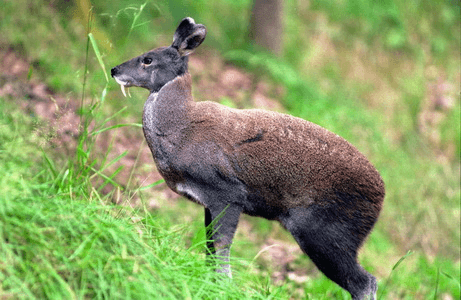
Himalayan musk deer hare-like antlerless deer producing valuable musk

Native to alpine zones 2,500–4,000 m across India, Nepal, Bhutan, China

Currently zero individuals in CZA-recognised Indian zoos

Quick Facts for MCQs

Captive Breeding & Policy

  • 1982 Himalayan Musk Project launched under MoEFCC for ex-situ conservation
  • Kedarnath centre grew from five to 28 deer, closed 2006, last animal to Darjeeling Zoo
  • CZA September 2025 inventory confirms no ongoing breeding programme

Behaviour & Adaptations

  • Solitary crepuscular deer mark territory using caudal gland secretions
  • Bounding escape gait enables jumps of 6 m over rocky slopes
  • Males carry abdominal musk sac; species lacks antlers

Threats & Conservation

  • High-value musk sac drives intensive poaching across Himalayan range
  • Global trade banned; listed Endangered on IUCN, Appendix I under CITES
  • Absence of founder stock stalls future Indian captive initiatives

Key Data Points

FeatureData-Point
IUCN statusEndangered
CITES listingAppendix I
Altitudinal range>2,500 m alpine belts
Indian range statesJ&K, Himachal, Uttarakhand, Sikkim, Arunachal
First breeding centreKedarnath WLS, 1982
Peak captive number28 deer (2006)
Current captive stockZero in CZA-recognised zoos
Activity periodDawn & dusk (crepuscular)
Maximum leapUp to 6 m

Related UPSC Prelims PYQs

CDS_GK, GS1 2012PYQ 1

Which one of the following groups of animals belongs to the category of endangered species?

CDS_GK, GS1 2024PYQ 2

हिमालयी हिमनदियों (ग्लेशियरों) और उनकी अवस्थिति के निम्नलिखित युग्मों में से कौन-सा/कौन-से सही सुमेलित है/हैं?

GS-3S&T

11.Phytosaur Fossil Discovery (Paleontological Find)

New Indian Express
Illustration for Phytosaur Fossil Discovery (Paleontological Find)

What & Where

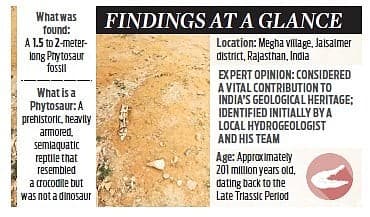
Phytosaurs – extinct, semi-aquatic crocodile-like reptiles (Order Phytosauria) thriving Late Triassic–Early Jurassic.

Latest suspected fossil: 6–7 ft spine in Megha village, Fatehgarh subdivision, Jaisalmer district, Rajasthan.

Region also yielded Akal & Thaiyat dinosaur remains plus shark and other marine fossils.

Quick Facts for MCQs

Morphological Diversity

  • Long-snouted forms specialised in piscivory.
  • Short-snouted variants targeted terrestrial vertebrates.
  • High-snouted morphs acted as broad generalist feeders.

Paleontological Hotspot

  • Jaisalmer desert exposes rich Late Triassic–Jurassic fossiliferous strata.
  • Holds confirmed dinosaur, shark, marine invertebrate and now possible phytosaur remains.
  • Discovery bolsters geo-heritage tourism and research funding prospects.

Evolutionary Insights

  • Demonstrates convergent evolution with crocodilians despite separate lineages.
  • Helps reconstruct Indian paleo-climate and biodiversity before Gondwana fragmentation.
  • Supports global stratigraphic correlation across Triassic–Jurassic transition.

Key Data Points

FeatureData-Point
Geologic spanLate Triassic to possibly Early Jurassic
Biological orderPhytosauria
Latest discovery siteMegha village, Fatehgarh, Jaisalmer (Rajasthan)
Visible fossil lengthAbout 6–7 ft
Snout typesLong-, short-, high-snouted
Reported continentsIndia, Europe, North & South America, Africa, Asia
GS-3S&T

12.Safeguarding Indian Satellites (Space Security)

The Hindu

What & Where

Bodyguard satellites: escort craft orbiting near Indian assets to detect, warn, or counter close-approach threats.

ISRO’s ₹27,000-cr plan: 52 surveillance satellites slated for launch 2026-30 across LEO, GEO and cislunar zones.

Key nodes: IS4OM & Project NETRA, Bengaluru; Aditya-L1, L1 point; national CERT-In cyber norms for space systems.

Quick Facts for MCQs

Tech & Schemes

  • IS4OM: real-time collision alerts enabling avoidance manoeuvres.
  • NETRA: network of radars, telescopes for domestic SSA capability.
  • Aditya-L1: monitors CMEs reducing electronics burnout risk.

Security Dimension

  • Satellites: backbone for NavIC, defence comms, surveillance hence strategic.
  • Bodyguard concept: proximity monitoring, hostile manoeuvre deterrence, physical repositioning.
  • Global trend: US, China, Russia testing escort or inspector craft.

Challenges

  • Technology: AI autonomy, fine-thrust manoeuvring, high-fidelity sensors still maturing domestically.
  • Finance: escort constellation demands sustained capital beyond current ₹27k crore allocation.
  • Geopolitics: deployment could spur space arms race, invite mistrust.

Legal & Policy

  • CERT-In 2025 guidelines: mandatory encryption, network segmentation for space assets.
  • IN-SPACe licensing: enforces safety standards on private launches.
  • India at IADC 2024: pledged no debris creation, supports responsible behaviour.

Key Data Points

FeatureData-Point
Programme outlay₹27,000 crore
Surveillance satellites planned52
Launch windowfrom 2026
IS4OM locationBengaluru
Project NETRA focusIndigenous Space Situational Awareness
Aditya-L1 goalSolar storm forecasting
CERT-In satellite cyber normsEffective 2025
Debris-free pledge target2030
Possible new assetBodyguard satellites
Main risk typesDebris, collisions, jamming, spoofing, cyber, solar storms

Related UPSC Prelims PYQs

CAPF_GAI, CDS_GK 2024PYQ 1

भारत का ‘मिशन शक्ति’ (DRDO) निम्नलिखित में से किससे संबंधित है?

CAPF_GAI, CDS_GK 2022PYQ 2

भारत की सुरक्षा के संदर्भ में, निम्नलिखित हेलीकॉप्टरों पर विचार कीजिए :

GS-3S&TQuick Bite

13.Arjuna 2025 PN7 (Quasi-Satellite)

The Hindu

What & Where

Quasi-satellite: Sun-orbiting body in 1:1 resonance with Earth, stays nearby yet not gravitationally bound to Earth.

2025 PN7: seventh known Earth quasi-satellite; detected 2025 by Pan-STARRS 1 telescope, Haleakalā, Hawaii.

Belongs to Arjuna asteroid class—objects with Earth-like, low-eccentricity, low-inclination orbits.

Quick Facts for MCQs

Orbital Dynamics

  • Resonance: completes one solar orbit in same time as Earth, maintaining near-constant angular position.
  • Remains Sun-orbiting; closest approach distances vary due to mild eccentricity and inclination.

Classification & Comparison

  • Arjuna asteroids: Earth-like orbits, occasionally become temporary mini-moons.
  • Mini-moon differs: gravitationally bound for weeks-months, unlike long-term quasi-satellite synchrony.

Scientific & Tech Significance

  • Natural laboratory for studying resonance, gravitational perturbations, near-Earth object dynamics.
  • Potential candidate for future rendezvous, resource extraction, redirection or planetary-defense technology demos.

Key Data Points

FeatureData-Point
Official designation2025 PN7
Discovery instrumentPan-STARRS 1 telescope, Hawaii
Object classArjuna asteroid
Orbital relationQuasi-satellite of Earth
Semi-major axis1.003 AU
Orbital period~1 Earth year (1:1 resonance)
Orbit shapeSlightly elliptical
Quasi-satellite tenure~128 years (2025-2153)
Earth quasi-satellites knownSeven (including 2025 PN7)
First Arjuna identified1991 VG
GS-3S&TQuick Bite

14.Extreme Nuclear Transients (Cosmic Explosions)

The Hindu

What & Where

Definition Extreme Nuclear Transients: ultra-energetic explosions from massive-star debris spiralling into supermassive black holes

Scale Seen in large galaxies hosting black holes ≥ 10⁸ M☉, far more powerful than gamma-ray bursts

Visibility Radio-bright for years, enabling detection over cosmological distances

Quick Facts for MCQs

Source & Mechanism

  • Tidal forces stretch-compress star, igniting nuclear reactions and ejecting relativistic debris
  • Accretion of debris around dormant black holes releases multi-band electromagnetic energy
  • Nuclear burning plus relativistic jets drive exceptional luminosity

Event Comparisons

  • GRB : millisecond–minute duration, lower total energy, linked to neutron-star mergers or collapsars
  • TDE : similar tidal origin but in smaller galaxies, less-massive black holes, shorter radio phase
  • FXT : supernova-based, brief X-ray flashes, far less energetic than ENTs

Scientific Value

  • Black-hole census : Reveals otherwise inactive supermassive black holes across universe
  • Extreme physics : Tests relativistic jet formation, nuclear combustion under extreme gravity
  • Cosmology : Bright beacons to probe early-universe intergalactic medium

Tech & Schemes

  • Rubin Observatory : Wide-field optical surveys to catch ENT onset
  • Roman Telescope : Infrared follow-up for host-galaxy properties and distance
  • Radio arrays : Long-baseline facilities track multi-year afterglow evolution

Key Data Points

FeatureData-Point
Peak power vs GRBEven higher electromagnetic output
Progenitor star mass≥ 3 M☉ torn apart
Central engineExtreme tidal forces near event horizon
Radio luminosity spanLasts several years
Future observatoriesVera C. Rubin & Nancy Grace Roman (2027)

Related UPSC Prelims PYQs

CAPF_GAI 2022PYQ 1

कभी-कभी समाचारों में प्रकाशित शब्द 'डीनेटरस A' निम्नलिखित में से किससे संबंधित है?

GS-3Security

15.CORE Security Programme (Civil-Military Synergy)

PIB

What & Where

CORE Programme – five-day professional engagement on national & regional security

Venue New Delhi, nodal organiser HQ Integrated Defence Staff (IDS)

Serves as civil–military forum for strategic review, leadership grooming

Quick Facts for MCQs

Security Dimension

  • Threat-spectrum includes regional instability, global power shifts, hybrid warfare
  • Programme promotes joint problem-solving for complex, multidomain contingencies
  • Encourages preparedness doctrine integrating military and civilian agencies

Tech & Warfare

  • Emphasis on technology-driven transformation of modern battlefields
  • Discussions cover cyber, space, AI tools altering offence-defence balance
  • Aims to align future leaders with rapid tech adoption cycles

Leadership Development

  • Cross-domain learning builds intellectual foundation for senior leadership cadre
  • Exposure to diverse ministries nurtures whole-of-government mindset
  • Balanced decision-making fostered through civil–military dialogue sessions

Key Data Points

FeatureData-Point
Nodal organiserHeadquarters Integrated Defence Staff
Launch cityNew Delhi
Duration5 days
Core aimStrengthen civil–military synergy against multidimensional threats
Key participantsSenior officers: Armed Forces; MoD, MEA, MHA
Main methodsLectures, discussions, expert interactions
Thematic focusRegional/global security, tech warfare, strategic communication, inter-agency synergy
Outcome soughtEnhanced strategic awareness & balanced decision-making
GS-1Editorial

16.Transgender Rights Participation (Gender Inclusion)

The Hindu
Illustration for Transgender Rights Participation (Gender Inclusion)

What & Where

Definition: Transgender persons legally recognised as “third gender” under NALSA v Union of India 2014.

Coverage: Rights under Articles 14, 15, 19, 21 span education, employment, housing, political participation.

Geography: National focus with pioneering steps in Tamil Nadu, Karnataka, Kerala.

Quick Facts for MCQs

Legal & Policy

  • Recognition: NALSA affirms self-identification; Supreme Court directs reservations in jobs, education.
  • Legislation: 2019 Act bans discrimination but mandates District Magistrate certificate, criticised as intrusive.
  • Advisory body: National Council for Transgender Persons (2020) guides Union ministries on policy.

Socio-Economic Indicators

  • Employment: NHRC finds 92 % denied jobs, ~50 % face workplace harassment.
  • Health cost: Transition surgeries priced ₹2–5 lakh, rarely insured, fuelling economic distress.
  • Safety: NCRB records higher violence; WHO notes elevated suicide risk among trans youth.

State Initiatives

  • Tamil Nadu: Aravanis Welfare Board 2008, monthly pensions, targeted schemes.
  • Kerala: Government funds gender-reassignment surgeries; inclusive policy framework.
  • Karnataka: 1 % horizontal reservation 2021 across education and government recruitment.

Political Representation

  • Current gap: No trans MP or Union minister; limited inclusion on statutory boards like censor board.
  • Trailblazers: Shabnam Mausi MLA 1998, Madhu Bai Kinnar Mayor 2015, Joyita Mondal Judge 2017.

Key Data Points

FeatureData-Point
NALSA judgment year2014
Transgender Act enactment2019
National Council created2020
Karnataka reservation1 % seats in education & jobs (2021)
NHRC 2017 job denial rate92 %
Typical gender-transition cost₹2–5 lakh in private hospitals

Ready to practice?

Test your knowledge with our UPSC test series.

Start Free Trial