UPSC Current Affairs

13 topicsGS-1: 3GS-2: 1GS-3: 9
0/13 done
GS-2Polity

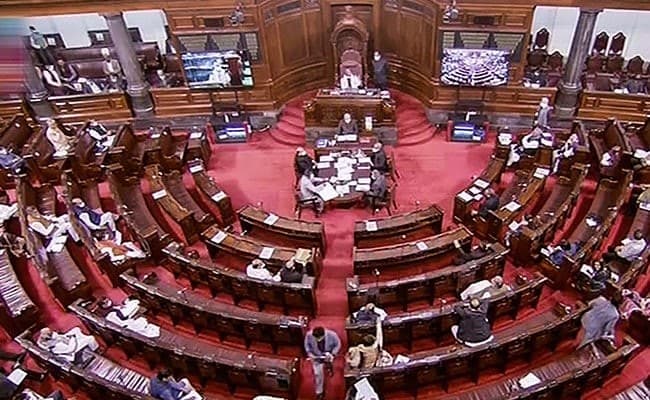
1.Rajya Sabha Biennial Election Schedule (Rajya Sabha)

News on Air
Illustration for Rajya Sabha Biennial Election Schedule (Rajya Sabha)

What & Where

Rajya Sabha biennial election fills seats of one-third members retiring every two years in Parliament’s Upper House

Applies across States & UTs; current schedule targets 6 seats Tamil Nadu, 2 seats Assam

Conducted by Election Commission via indirect proportional representation, single transferable vote

Quick Facts for MCQs

Membership & Tenure

  • Current composition 233 elected 12 nominated forming 245 occupied seats
  • Six-year tenure for each member; bye-elected member serves remaining term only
  • One-third seats vacate every second year triggering regular biennial polls

Election Method

  • Indirect STV proportional representation mirrors party strength in respective legislative assemblies
  • State MLAs elect state quota; Delhi Puducherry J&K colleges choose UT quota
  • Election Commission announces timeline, supervises polling and counting

Eligibility & Disqualification

  • Eligibility citizen of India 30+ years oath per Third Schedule plus any statutory conditions
  • Disqualification on office of profit insolvency unsound mind loss of citizenship
  • Anti-defection Tenth Schedule can unseat switching members

Key Data Points

FeatureData-Point
Maximum strength250
Present strength245
Elected members233
Nominated members12
Member term6 years
Retirement cycleOne-third every 2 years
Minimum age30 years
Election methodSTV, proportional, by MLAs/UT colleges
Bye-election tenureRemainder of predecessor term

Related UPSC Prelims PYQs

CDS_GK, NDA_GAT 2025PYQ 1

Which one of the following statements about the Parliament of India is correct ?

CDS_GK, NDA_GAT 2021PYQ 2

Which one of the following statements about the composition of the Parliament is not correct?
GS-3Economy

2.Policy Blueprint for Medium Enterprises (Medium Enterprises)

NITI
Illustration for Policy Blueprint for Medium Enterprises (Medium Enterprises)

What & Where

Definition: Medium Enterprises = investment ≤ ₹125 cr & turnover ≤ ₹500 cr (effective Apr 2025).

Location: India; tiny 0.3 % slice of 6.3 crore MSMEs.

Role: Manufacturing backbone with outsized export, R&D and job impact.

Quick Facts for MCQs

Economic Angle

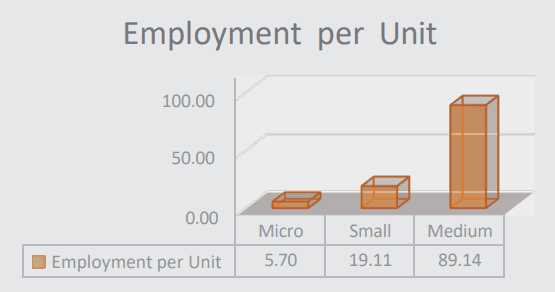
  • Contribution: High profitability; 89 jobs per unit; critical to manufacturing expansion.
  • Export engine: Provide 40 % of MSME exports, earning ₹50,562 cr forex annually.
  • Growth potential: 20 % unit rise may add ₹5.4 lakh cr exports and 12 lakh jobs.

Challenges

  • Awareness: Only 10 % access scheme portals; information remains fragmented.
  • Finance: Absent working-capital line forces reliance on personal savings.
  • Technology: 82 % lack AI, IoT, other Industry 4.0 tools; skills training misaligned.

Policy Prescriptions

  • Credit: ₹5 cr credit card plus turnover-linked working capital facility for medium units.
  • Tech push: Upgrade Technology Centres to SME 4.0 Competence Centres; add cluster testing labs.
  • Support stack: Three-tier R&D fund and AI-enabled Udyam sub-portal for schemes and compliance.

Key Data Points

FeatureData-Point
Share in MSME universe0.3 %
Share in MSME exports40 %
Avg jobs created/unit89
MSME GDP contribution29 % of GDP
Forex earned yearly~₹50,562 crore
Share in MSME R&D spend81 %
Units using govt portals10 %
Units without Industry 4.082 %
Proposed credit card limit₹5 crore
Extra gain from 20 % unit rise₹5.4 lakh cr exports; 12 lakh jobs

Related UPSC Prelims PYQs

CDS_GK, GS1 2023PYQ 1

Consider the following statements with reference to India:

CDS_GK, GS1 2022PYQ 2

सूक्ष्म, लघु और मध्यम उद्योगों (MSMEs) के बारे में निम्नलिखित कथनों पर विचार कीजिए:

GS-3Infrastructure

3.Northeast Region Emerging Growth Frontrunner (Northeast Infrastructure)

The Hindu

What & Where

Northeast Region (NER): eight-state belt from Sikkim to Arunachal; 5,484 km international borders; India’s Act East gateway.

Rising Northeast Investors Summit 2025: DoNER-led platform to woo capital, brand NER as ASEAN-BBN trade corridor.

“Ashta Lakshmis” vision: bio-economy, renewables, tourism, high-tech manufacturing positioning NER as national growth frontrunner.

Quick Facts for MCQs

Economic Potential

  • Renewable-rich; bamboo, tea, organics, sports talent aid diversified value chains.
  • Upcoming Assam semiconductor plant signals shift from resource to high-tech industry.
  • Border Economic Zones proposed to catalyse cross-border value addition.

Connectivity & Infrastructure

  • Trilateral Highway, Kaladan project, Sittwe & Chittagong ports integrate NER with Indo-Pacific shipping lanes.
  • Sela Tunnel, Bharatmala, UDAN extensions give all-weather road-air reach to remote valleys.
  • BharatNet 5G corridors planned for every state capital to spur digital commerce.

Social & Environmental Concerns

  • Insurgencies, ILP demands and 2023 Manipur ethnic clash deter investors and labour mobility.
  • Terrain-induced floods, landslides; 2022 Assam flood displaced millions, underlining climate vulnerability.
  • Proximity to Golden Triangle fuels narcotics trafficking, stressing health and policing systems.

Policy & Schemes

  • PM-DevINE, NEIDS, MOVCDNER, UNNATI, Bamboo Mission drive industrial, organic, and MSME ecosystems.
  • Swadesh Darshan 2.0, Dekho Apna Desh promote eco, spiritual and ethnic tourism circuits via homestays.
  • Lokur-style safeguards recommended for tribal land, education, healthcare, inclusive governance.

Key Data Points

FeatureData-Point
Investment intent at Summit 2025₹4.3 lakh crore
Share of India’s hydropower potential40 % (~62 GW)
Hydropower harnessed till now6.9 %
Assessed solar potential57,360 MW
Solar installed share17 %
Literacy rate (NER average)~80 %
International borders length5,484 km with 5 countries
MoRTH budget earmarked for NER10 %
NESIDS corpusUSD 1 billion
Expected India-ASEAN trade riseUSD 125 bn → 200 bn in decade

Related UPSC Prelims PYQs

CAPF_GAI 2022PYQ 1

As part of the Look/Act East Policy, which one of the following capitals of North-East Indian States is proposed to be connected with Bangladesh via rail route?

GS-1History

4.Madhubani and Gond Folk Paintings (Folk Paintings)

PIB
Illustration for Madhubani and Gond Folk Paintings (Folk Paintings)

What & Where

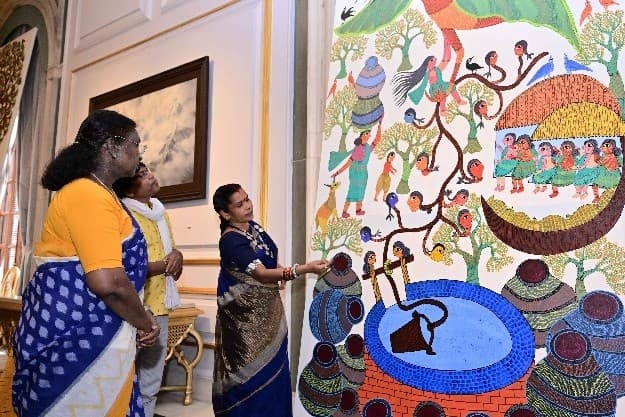
Madhubani (Mithila) painting from Bihar’s Mithila region; traditionally by rural women on walls, now on paper, cloth, canvas

Gond painting by Pardhan Gond tribes of Madhya Pradesh & neighbouring Central India; rooted in ritual storytelling on mud walls

Both art forms featured at Rashtrapati Bhavan’s Kala Utsav Artists-in-Residence programme

Quick Facts for MCQs

Materials & Techniques

  • Madhubani uses bamboo pens, natural dyes, cow-dung coated paper
  • Gond employs commercial acrylics yet retains dot-line texturing tradition
  • Bold outlines in Madhubani contrast with intricate infill of Gond

Iconography

  • Madhubani depicts Radha-Krishna, Shiva, local weddings, tulsi and banyan trees
  • Gond illustrates village folklore, animist deities, night creatures, interconnected nature scenes
  • Sun, moon, birds common across both highlighting cyclical life belief

Modern Adoption

  • Transition from hut walls to canvases spurred marketability and museum interest
  • International exhibitions and book collaborations expanded buyer base and cultural diplomacy

Cultural Significance

  • Both symbolise indigenous knowledge transfer through matrilineal and tribal oral traditions
  • Serve as economic lifeline for rural artisans via government and NGO craft initiatives

Key Data Points

FeatureData-Point
Madhubani alternate nameMithila painting
Madhubani key outlineBlack line using cow-dung + charcoal
Madhubani pigmentsPlant-based colours on cow-dung-treated base
Gond filling styleFine dots and lines creating rhythm
Gond core motifsMythical tales, flora-fauna harmony
Tribal group for GondPardhan Gond
Book popularising GondThe Night Life of Trees
Kala Utsav venueRashtrapati Bhavan

Related UPSC Prelims PYQs

CAPF_GAI, GS1 2022PYQ 1

Which one of the following was not a feature of the art of painting in India in the 19th century?

CAPF_GAI, GS1 1995PYQ 2

The Mughal School of Painting formed the spinal column of the various schools of Indian miniature art. Which one of the following painting styles was not affected by Mughal painting?

GS-1History

5.Charaka and Sushruta Ayurvedic Legacy (Ancient Ayurveda)

PIB
Illustration for Charaka and Sushruta Ayurvedic Legacy (Ancient Ayurveda)

What & Where

Statues of Charaka & Sushruta commissioned by Vice-President at Raj Bhavan, Goa

Charaka Samhita & Sushruta Samhita: cornerstones of Ayurveda, part of Great Trilogy with Astanga Hridaya

Geography of legacy: Kushan court (Charaka), ancient Kashi–Ujjain region (Sushruta under Vikramaditya)

Quick Facts for MCQs

Indian Literature

  • Charaka reorganised Agnivesha Samhita into eight Ashtanga Sthanas for broader pedagogical use
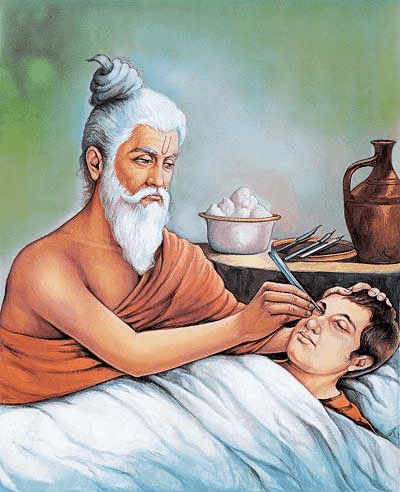
  • Sushruta Samhita earliest systematic treatise detailing instruments, anaesthesia, postoperative care

Medical Contributions

  • Charaka emphasised diagnosis via dosha balance; introduced concepts of immunity, digestion, genetics
  • Sushruta pioneered categorical classification of 125 surgical instruments, antiseptic use, fracture splints

Historical Context

  • Kanishka’s Kushan rule patronised Buddhist-linked medical scholarship, aiding Charaka’s dissemination
  • Gupta-era intellectual renaissance under Chandragupta II fostered Navratna circle including Dhanvantari, mentoring Sushruta

Key Data Points

FeatureData-Point
Era – Charaka2nd c BCE – 2nd c CE
Era – Sushruta7th–6th c BCE
CalledCharaka: Father of Medicine; Sushruta: Father of Surgery & Plastic Surgery
Royal linkCharaka: physician to Kanishka; Sushruta: disciple of Dhanvantari, Navratna of Vikramaditya
Core textCharaka Samhita (8 Ashtanga Sthanas); Sushruta Samhita
TrilogyCharaka Samhita, Sushruta Samhita, Astanga Hridaya
Precursor textAgnivesha Samhita, revised by Charaka
Later additionScholar Dhabala added 17 chapters to Charaka Samhita
Surgical featsSushruta documented 300+ procedures incl. rhinoplasty, caesarean
Special repairsOshtha Sandhan (lip), Karna Sandhan (ear)
Location of new statuesRaj Bhavan, Goa
Commissioned byVice-President of India, May 2025

Related UPSC Prelims PYQs

GS1, NDA_GAT 1996PYQ 1

Who among the following is known for his work on medicine during the Gupta period?

GS1, NDA_GAT 2022PYQ 2

When did Charaka Samhita originate?

GS-1Environment

6.South Africa Groundwater-Driven Land Uplift (Land Uplift Mechanism)

Down to Earth

What & Where

Land uplift: ~2 mm yr⁻¹ rise (2012-20) detected across drought-hit Western & Northern Cape, South Africa.

Cause: Water-mass unloading (surface + groundwater loss) triggers elastic rebound of upper crust.

Differs from subsidence; no pore collapse, purely loading–unloading mechanism.

Quick Facts for MCQs

Geophysical Process

  • Elastic rebound: crust uplifts where hydrological unloading greatest; may reverse after recharge.
  • Western Cape uplift spatially coincides with groundwater basins showing largest TWS deficits.
  • Similar rebound events recorded in California & Taiwan, indicating global relevance.

Measurement Tools

  • GNSS stations provide millimetre-scale vertical displacement data across South African network.
  • GRACE satellites convert gravity shifts to basin-scale water storage loss.
  • Hydrological models isolate precipitation-evapotranspiration trends to validate drought severity.

South Africa Geography

  • Great Escarpment forms high rim around interior Highveld plateau (1 200–1 800 m).
  • Orange River drains west to Atlantic; Limpopo flows northeast to Indian Ocean.
  • Table Mountain, Stormberg, Roggeveld ranges punctuate coastal and plateau margins.

Key Data Points

FeatureData-Point
Average uplift rate≈2 mm per year
Net rise 2012-2020~6 mm
Peak drought span2015-2018
Core study cityCape Town
Field sensors used74 GNSS-Trignet stations
Satellite proofGRACE Total Water Storage anomalies
Main driverLoss of surface & groundwater pressure
Subsidence mechanismPoro-elastic aquifer collapse
Executive capitalPretoria
Legislative capitalCape Town
Judicial capitalBloemfontein
Highest peakNjesuthi, 3 408 m (Drakensberg)
Atlantic-draining riverOrange–Vaal system
Enclave stateLesotho

Related UPSC Prelims PYQs

GEO_GS 2022PYQ 1

The process through which groundwater is brought up to the surface is called

GS-3Editorial

7.Strategies to Strengthen Urban Biodiversity (Urban Biodiversity)

The Hindu

What & Where

Definition: Urban biodiversity = all plant, animal, fungal, microbial life within man-made landscapes such as parks, roofs, wetlands.

Core elements: Green spaces, blue spaces, built-structure habitats, wildlife corridors linking fragmented patches.

Key Indian sites: Okhla Bird Sanctuary (Delhi), East Kolkata Wetlands, Pallikaranai marsh (Chennai), Mutha-Mula river stretch (Pune).

Quick Facts for MCQs

Ecological Services

  • Cooling: Urban forests, wetlands moderate heat, recharge groundwater, cut storm-water peaks.
  • Carbon: Trees sequester CO₂, filter particulates, boost air quality.
  • Health: Green vistas lower stress, promote recreation, support pollinators securing urban food chains.

Threats & Pressures

  • Sprawl: Chennai lost 2.6 km² forest (2021-23); Hyderabad 1.6 km².
  • Wetland encroachment: East Kolkata Ramsar site, Chennai marshes under dumping, only 15 % remain.
  • Pollution: Bellandur Lake foaming; Delhi air toxicity disrupts fauna physiology and communication.

Policy & Indices

  • Indexing: City Biodiversity Index piloted in Kochi, Gangtok, Nagpur for LBSAP drafting.
  • Legal push: Supreme Court halted Kancha Gachibowli tree felling, signalling enforceable urban eco-rights.
  • Planning: Mandatory biodiversity impact assessments, green corridors in master plans recommended.

Restoration Examples

  • Pallikaranai marsh upgraded to Reserved Forest & Ramsar after garbage-dump phase.
  • Guindy racecourse land conversion into lake to raise groundwater and avifaunal habitat.
  • Koyambedu pocket-park model regenerated 141 native plants, attracting diverse birds and butterflies.

Key Data Points

FeatureData-Point
Global urban population 2025≈50 %; projected 70 % by 2050
Avg. forest cover in Indian metros (FSI 2023)10.26 %
Highest & lowest city coverMumbai 25.43 %; Ahmedabad 3.27 %
Green belts impact in Frankfurt−3.5 °C temperature
Delhi heat island differential4–6 °C hotter than rural
Noise reduction by 10 m tree line5 dB
Ecosystem service value of trees (mega-cities)₹8 crore per sq km / yr
Surviving wetlands in Chennai15 % of original
City Biodiversity Index indicators23
UN-Habitat “3-30-300” rule3 trees view; 30 % canopy; park within 300 m
International Day for Biodiversity22 May (CBD text adopted 1992)
Kunming-Montreal GBF Target 12Urban green-blue integration

Related UPSC Prelims PYQs

GS1 2023PYQ 1

निम्नलिखित कथनों पर विचार कीजिए :

GS1 2014PYQ 2

The most important strategy for the conservation of biodiversity together with traditional human life is the establishment of

GS-3S&T

8.Personalised Base-Editing Gene Therapy (Gene Editing)

Indian Express
Illustration for Personalised Base-Editing Gene Therapy (Gene Editing)

What & Where

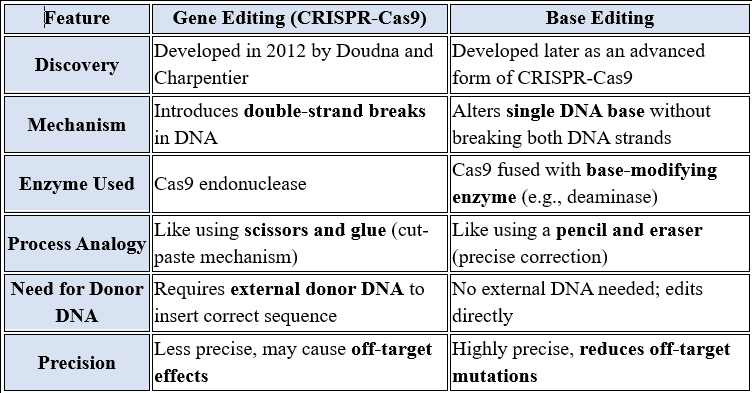
Custom gene therapy using CRISPR-Cas9–based “base editing” corrects single DNA base without double-strand break

First in-human use on 9-month US boy with carbamoyl-phosphate-synthetase-1 (CPS1) deficiency

Developed at University of Pennsylvania & Children’s Hospital of Philadelphia

Quick Facts for MCQs

Tech & Procedure

  • Diagnosis: whole-genome sequencing pinpoints mismatched base causing CPS1 enzyme loss
  • Programming: synthetic guide RNA directs Cas9-linked deaminase to faulty site
  • Action: converts erroneous base, leaves DNA backbone intact; analogy pencil-eraser vs scissor-glue

Significance

  • Precision-medicine milestone, showcases real-time custom therapy for ultra-rare disorders
  • Compact construct enables easier viral packaging, potential scale to thousands of monogenic diseases
  • Avoids double-strand breaks, lowering off-target chromosomal rearrangement risk

Limitations & Challenges

  • Cost prohibitive, bespoke design for each patient limits commercial scalability
  • Regulatory ambiguity in many countries, ethical panels yet to frame fast-track paths
  • Low pharma incentive, rare-disease market small without aggregated demand

Key Data Points

FeatureData-Point
Core technologyAdenine/Cytosine base editing (evolved CRISPR)
DNA changeSingle-base conversion, no foreign DNA insertion
Delivery vectorViral vector; fewer components than classic CRISPR
Developer institutionsUniv. of Pennsylvania, Children’s Hospital of Philadelphia
First patient age9 months (code-named KJ)
Target diseaseCPS1 deficiency, urea-cycle disorder
Enzyme comboGuide RNA + base-modifying enzyme fused with Cas9
Success tagWorld’s first customised base-editing therapy in humans
Approx. costHundreds of thousands of US dollars
Indian statusRegulatory pathway unclear, clinical use delayed

Related UPSC Prelims PYQs

GEO_GS, GS1 2025PYQ 1

Clustered Regularly Interspaced Short Palindromic Repeats are associated with

GEO_GS, GS1 2019PYQ 2

What is Cas9 protein that is often mentioned in news?

GS-3S&T

9.2025 Breakthrough Prize in Physics (Physics Awards)

PIB
Illustration for 2025 Breakthrough Prize in Physics (Physics Awards)

What & Where

Breakthrough Prize in Fundamental Physics: annual $3 mn global award nicknamed Oscars of Science

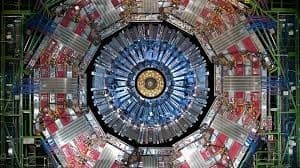
2025 edition jointly recognises CERN LHC experiments ATLAS, CMS, ALICE, LHCb using 2015-24 Run-2 data

CERN’s 27 km Large Hadron Collider lies beneath Franco-Swiss border near Geneva

Quick Facts for MCQs

Indian Contributions

  • Detector R&D, trigger electronics and upgrade hardware delivered by multiple Indian institutes
  • Data analysis, Grid computing nodes and manpower training supported under Worldwide LHC Computing Grid
  • Governance participation secured on CERN Council and experiment boards

Technology Specs

  • Dipole magnets bend beams; quadrupoles focus, all controlled from CERN Control Centre
  • Cryogenics employs superfluid helium keeping magnets colder than outer space
  • Four detectors placed at collision points record petabytes of data yearly

Scientific Outcomes

  • Higgs boson properties measured precisely, validating electroweak symmetry breaking
  • Quark–gluon plasma studies illuminate microsecond-old Universe conditions
  • CP-violation measurements in B mesons probe matter–antimatter asymmetry and beyond-Standard-Model physics

Key Data Points

FeatureData-Point
Prize year2025
Awarding bodyBreakthrough Prize Foundation
Prize purseUSD 3 million shared
Honoured experimentsATLAS, CMS, ALICE, LHCb
Researchers involved≈13,500
LHC tunnel length27 km
Operating temperature−271.3 °C (1.9 K)
Superconducting dipoles1,232
Beam particlesProtons or heavy ions
Indian partner labsTIFR, BARC, IITs, IISc, VECC, IUAC, IOP

Related UPSC Prelims PYQs

GS1 2013PYQ 1

The efforts to detect the existence of Higgs boson particle have become frequent news in the recent past. What is/are the importance/ importances of discovering this particle?

GS1 2009PYQ 2

In the year 2008, which one of the following conducted a complex scientific experiment in which sub-atomic particles were accelerated to nearly the speed of light ?

GS-3S&T

10.Spectral Function Detects Topological Invariants (Quantum Materials)

DD News
Illustration for Spectral Function Detects Topological Invariants (Quantum Materials)

What & Where

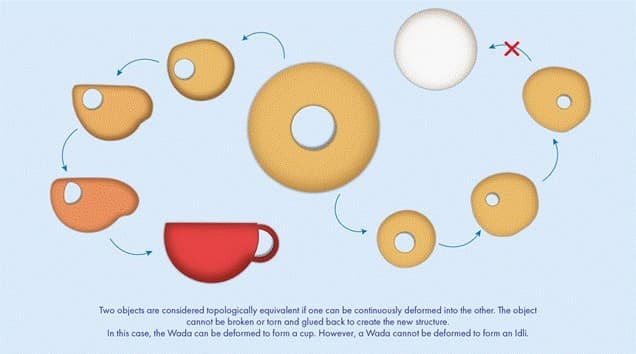
Spectral-function method detects topological invariants in quantum materials via momentum-space spectral function (SPSF) analysis.

Conceived at Raman Research Institute, Bengaluru; autonomous under Department of Science & Technology (DST).

Reveals 1D winding numbers and 2D Chern numbers by mapping electron energy–momentum distribution.

Quick Facts for MCQs

Tech & Schemes

  • Momentum-space spectral function offers high-resolution energy–momentum maps.
  • Non-invasive analysis avoids complex sample preparation.
  • Outpaces ARPES in speed and accessibility.

Quantum Insight

  • Topology metrics illuminate protected surface states and electron dynamics.
  • Universal method spans 1D chains and 2D layers.
  • Utilises density-of-states and dispersion-relation data.

Economic Angle

  • Supports quantum computing and energy-efficient, fault-tolerant electronics development.
  • Simplifies material classification, reducing laboratory costs.
  • Strengthens Indian leadership in condensed-matter research.

Key Data Points

FeatureData-Point
Core toolMomentum-space Spectral Function (SPSF)
Developing instituteRaman Research Institute, Bengaluru
Controlling departmentDST, Govt. of India
Detects invariantsWinding numbers (1D); Chern numbers (2D)
Technique natureNon-invasive, faster than ARPES
Standard comparatorAngle-Resolved Photoemission Spectroscopy
Material coverageBroad range of topological materials
Main benefitQuantum fingerprint without destructive probing
GS-3S&T

11.Bharat Forecasting System High-Resolution Weather Model (Numerical Weather Prediction)

Economic Times
Illustration for Bharat Forecasting System High-Resolution Weather Model (Numerical Weather Prediction)

What & Where

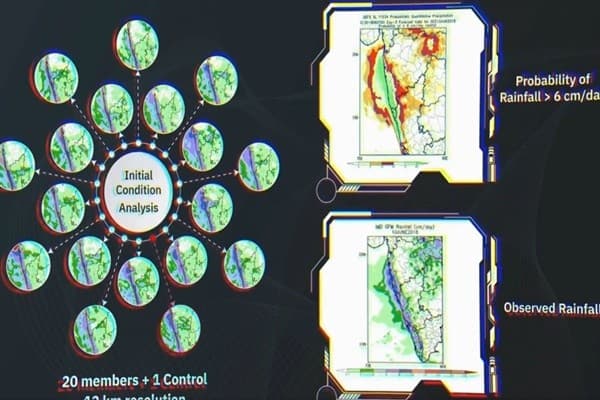
Definition: Bharat Forecasting System (BFS) – India’s ultra-high-resolution numerical weather prediction model.

Location scope: Tropics 30° S–30° N, delivers forecasts down to panchayat/village grids across India.

Platform: Runs on MoES supercomputer Arka at IITM-Pune.

Quick Facts for MCQs

Tech & Schemes

  • Processing: Arka crunches simulations within four hours enabling multiple daily runs.
  • Integration: Real-time radar, satellite, land and ocean data feed into BFS dynamic core.
  • Scalability: Grid can be refined further as computing capacity rises.

Disaster Management

  • Evacuation: 6 km grids sharpen cyclone, flood, thunderstorm alerts for district officials.
  • Heatwave: Early warnings aid urban health plans, reduce mortality.
  • Risk mapping: Panchayat-level intensity maps support NDMA contingency planning.

Agriculture & Water

  • Crop stage advice: Timely rainfall, drought, heat alerts sent via Agromet, Kisan portals.
  • Irrigation: Reservoir operations optimized through reliable short-range inflow forecasts.
  • Price stability: Reduced weather-led crop loss curbs food-inflation spikes.

Key Data Points

FeatureData-Point
Launch date26 May 2025
Parent ministryEarth Sciences
Developer hubIITM Pune
Lead scientistParthasarathi Mukhopadhyay
SupercomputerArka 11.77 PF, 33 PB
Horizontal resolution6 km × 6 km
Global rank in resolutionHighest; EU/UK/US = 9–14 km
Coverage band30° S to 30° N
Doppler radars used40+ (target 100)
Forecast horizonNowcast 2 hr; short-term up to few days
Run-time vs Pratyush60 % faster (∼4 hours)
Data storage33 Petabyte
Predecessor modelPratyush
GS-3S&T

12.ICMR Sickle Cell Stigma Scale (Sickle Cell Research)

The Hindu
Illustration for ICMR Sickle Cell Stigma Scale (Sickle Cell Research)

What & Where

Definition: ICMR-SCD Stigma Scale for India (ISSSI) quantifies stigma among sickle-cell patients and caregivers

Process: Two sub-tools (ISSSI-Pt, ISSSI-Cg) rating five stigma domains via validated psychometric items

Geography: Drafted in six SCD-endemic tribal districts across Odisha, Jharkhand, Chhattisgarh, Madhya Pradesh, Maharashtra

Quick Facts for MCQs

Tool Specifics

  • Multi-dimensional: captures cultural, linguistic, phenotypic nuances absent in African/American scales
  • Item source: community interviews, Delphi rounds, field-testing in six districts
  • Utility: baseline mapping, intervention monitoring, policy impact evaluation

Disease Snapshot

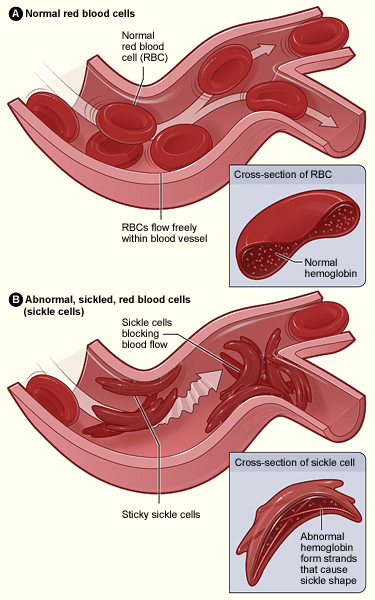
  • Etiology: autosomal recessive β-globin mutation making sickle-shaped RBCs, causing vaso-occlusion and anaemia
  • Therapy options: hydroxyurea, voxelotor, crizanlizumab, L-glutamine, transfusion, CRISPR-based gene/stem-cell transplant
  • Public-health weight: severe pain crises, organ damage, shortened lifespan, high tribal incidence

Government Initiatives

  • NHM 2013: dedicated SCD screening and management package
  • Stem-cell rules: 2017 guidelines permit only clinical-trial use; BMT allowed for SCD
  • Social security: RPwD reservations plus Anemia Mukt Bharat addressing haemoglobinopathies

Key Data Points

FeatureData-Point
DeveloperIndian Council of Medical Research
Sub-toolsISSSI-Pt (patients); ISSSI-Cg (caregivers)
Stigma domainsFamilial/reproductive, disclosure, illness burden, discrimination, healthcare
Validation statusPsychometrically robust for clinic, research, policy
India SCD rank2nd highest prevalence; 3rd in births globally
Estimated cases> 1 million Indians living with SCD
Tribal carrier range1 % – 40 %
High-burden beltOdisha, Jharkhand, Chhattisgarh, Madhya Pradesh, Maharashtra
National SCD missionSickle Cell Anaemia Elimination Mission 2023
Disability lawRPwD Act 2016 lists SCD for reservations
GS-3S&TQuick Bite

13.Jarosite Luminescent Martian Chronometer (Martian Mineral Dating)

The Hindu
Illustration for Jarosite Luminescent Martian Chronometer (Martian Mineral Dating)

What & Where

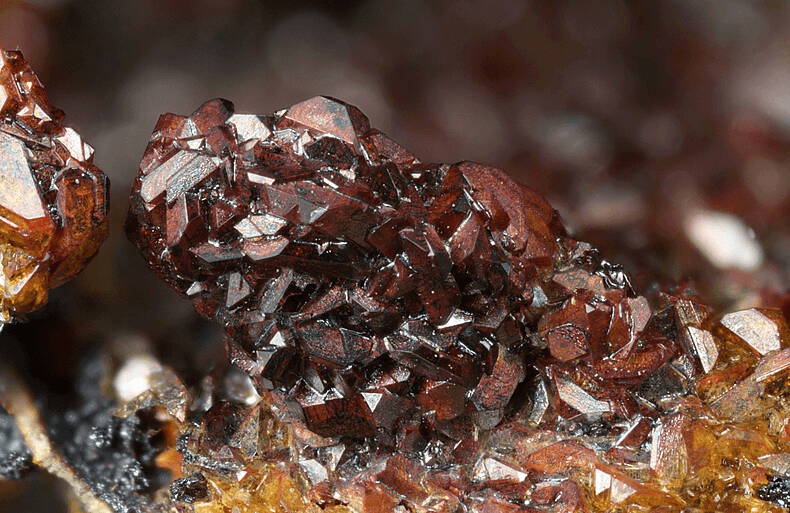
Jarosite, yellow-brown potassium-iron sulphate mineral, shows radiation-induced luminescence acting as natural geological clock

Formed in arid, acidic, sulphate-rich settings; on Earth (Kutch, acid mines, volcanic zones) and Mars (Meridiani Planum, Gale Crater)

Clock records dust storms, floods, volcanic events up to 25 000 years before present

Quick Facts for MCQs

Geological Dating

  • Luminescence intensity proportional to radiation dose accumulated since last heating or exposure
  • K-Ar method exploits decay of 40K to 40Ar within jarosite lattice
  • Mineral aids weathering chronology where organic carbon absent

Martian Events

  • Presence marks past water acidity and evaporation on Mars surface
  • Luminescent signal archives timing of dust storms, floods, volcanic ash deposition
  • Data enhance reconstruction of Red Planet climate cycles

Earth Occurrence

  • Forms in acid mine drainage, sulfur-rich fumaroles, evaporitic lakebeds
  • Indicates oxidative weathering of pyrite-bearing rocks
  • Valuable proxy for paleo-aridity studies in desert basins

Indian Angle

  • Kutch jarosite offers Mars-analog site for instrument calibration
  • Potential for cost-effective luminescence labs aiding planetary missions
  • Adds to India’s mineralogical diversity list useful for UPSC prelim trivia

Key Data Points

FeatureData-Point
Chemical classPotassium-iron sulphate hydroxide
Typical colourYellow-brown
Luminescence triggerNatural radiation exposure
Dating span≤ 25 000 years
Key dating techniquePotassium-Argon (K-Ar) radiometry
Indian locationKutch, Gujarat
Martian detection missionsNASA Opportunity, Curiosity
Preferred environmentArid, salty, acidic sediments

Ready to practice?

Test your knowledge with our UPSC test series.

Start Free Trial