UPSC Current Affairs

13 topicsGS-1: 2GS-2: 5GS-3: 6
0/13 done
GS-2Polity

2.Panchayat Devolution Index 2024 (Local Governance)

PIB

What & Where

Panchayat Devolution Index 2024: evidence-based ranking of PRI empowerment across all States & UTs.

Issued by Ministry of Panchayati Raj; benchmarks devolution under Article 243G.

Measures six pillars: Framework, Functions, Finances, Functionaries, Capacity-building, Accountability.

Quick Facts for MCQs

Index Highlights

  • Increase: 4-point jump in overall devolution between 2013-14 and 2021-22.
  • Digitalisation: e-gram swaraj & staffing drives boosted Functionaries pillar.
  • RGSA: flagship scheme credited for 10-point surge in Capacity scores.

State Rankings

  • Leadership: Karnataka tops overall; also best in Finances & Accountability.
  • Niche strength: Kerala excels in Framework; Tamil Nadu in Functions; Gujarat in Functionaries; Telangana in Capacity.
  • Laggards: Puducherry, Ladakh, DNH & DD occupy bottom slots.

Fiscal Picture

  • Dependence: 95 % PRI income sourced from Union + State grants.
  • Variation: Kerala, West Bengal exceed ₹57 lakh average revenue; Andhra Pradesh, Punjab under ₹6 lakh.
  • Expenditure: PRI revenue spending <0.6 % of state GSDP everywhere; Bihar merely 0.001 %.

Institutional Gaps

  • Function transfer: 29 Eleventh-Schedule subjects only partially devolved by most states.
  • Finance Commissions: Irregular SFC reports and delayed implementation erode fiscal autonomy.
  • Oversight: Low Gram Sabha turnout and scarce social audits weaken transparency.

Key Data Points

FeatureData-Point
Overall devolution 2013-1439.9 %
Overall devolution 2021-2243.9 %
Top ranked stateKarnataka
Second ranked stateKerala
Lowest UT scoreDNH & DD – 13.62
Functionaries index rise39.6 % → 50.9 %
Capacity index post-RGSA44 % → 54.6 %
PRI own-tax share1 % of revenue
Central grant share80 % of revenue
Avg central grant/Panchayat₹17 lakh

Related UPSC Prelims PYQs

CDS_GK, GS1 2023PYQ 1

Consider the following:

CDS_GK, GS1 2023PYQ 2

शिक्षा मंत्रालय द्वारा वर्ष 2020-2021 के लिए प्रकाशित प्रदर्शन ग्रेडिंग सूचकांक (PGI) में, निम्नलिखित में से किस राज्य/संघ राज्य-क्षेत्र का स्थान शीर्ष दस में शामिल नहीं है?

GS-3Economy

3.India Sovereign Green Bonds (Green Finance)

Indian Express

What & Where

Sovereign Green Bonds: Rupee sovereign debt raised solely for pre-approved green projects.

Implementing hub: Ministry of Finance; operational oversight by Dept. of Economic Affairs (DEA).

Geography: India; instrument supports national Net-Zero 2070 pathway.

Quick Facts for MCQs

Economic Angle

  • Demand: Recent auctions undersubscribed; weak appetite curbs price advantage.
  • Greenium: Yield gap with normal gilts nearly flat, limiting cheaper borrowing.
  • Liquidity: Sparse secondary trade deters large institutional investors.

Tech & Schemes

  • Rail: Financing three-phase electric locomotives, metro expansions for cleaner mobility.
  • Renewable: Supports solar, wind parks plus National Green Hydrogen Mission.
  • Forestry: Funds National Mission for a Green India afforestation targets.

Environmental Impact

  • Carbon-cut: Projects collectively lower transport & power-sector emissions.
  • Resilience: Green-tagged infrastructure designed to withstand climate stresses.

Key Data Points

FeatureData-Point
IssuerGovernment of India
Instrument TypeSovereign green bond (SGrB)
Supervising WingDepartment of Economic Affairs
Use-of-ProceedsEnergy, transport, afforestation, hydrogen
Sample ProjectsElectric locomotives, metro rail, solar/wind, Green India Mission
Investor BaseDomestic & foreign climate-focused funds
Interest Advantage“Greenium” small / almost absent currently
Secondary LiquidityLow; mostly held to maturity
Policy AnchorIndian Green Finance Framework
Net-Zero LinkAids 2070 carbon neutrality pledge

Related UPSC Prelims PYQs

CAPF_GAI, GS1 2025PYQ 1

The Union Budget for which of the following years announced the issue of Sovereign Green Bonds to reduce the carbon intensity of the economy?

CAPF_GAI, GS1 2022PYQ 2

भारतीय अर्थव्यवस्था के संदर्भ में, 'मुद्रास्फीति-संलग्न बांड (Inflation-Indexed Bonds — IIBs)' के क्या लाभ हैं?

GS-1History

4.Early Iron Age Tamil Civilization (Tamil Archaeology)

The Hindu
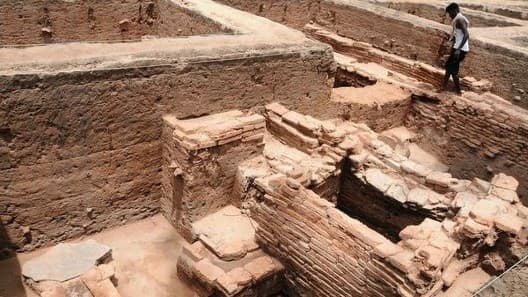
Illustration for Early Iron Age Tamil Civilization (Tamil Archaeology)

What & Where

Tamil Civilization — continuous riverine culture along Thamirabarani, Vaigai, Noyyal in present-day Tamil Nadu.

Recent radiometric dates push regional Iron Age start to early 4th millennium BCE, among world’s earliest.

Sites show urban planning, metallurgy, long-distance trade well before classical Sangam Age.

Quick Facts for MCQs

Chronology

  • Pre-Iron activity Pallavaram Paleolithic > Adichanallur Neolithic-Chalcolithic > early Iron Age Mayiladumparai.
  • Continuous habitation evidenced through Sangam and medieval Chola layers.
  • Radiometric advances revise South Asian metallurgy timeline by ~1000 years.

Archaeological Finds

  • Artefacts: iron tools, gold diadems, microliths, copper bracelets, glass beads, terracotta sarcophagi.
  • Epigraphy: Tamil-Brahmi potsherds at Keeladi, Adichanallur, Mayiladumparai.
  • Bio-remains: paddy grains at Sivagalai, human skeletons in urn burials.

Trade & Urbanism

  • Industry: weaving at Keeladi, shell-bangles at Korkai, carnelian beads Kodumanal.
  • Maritime links: Korkai port connecting to Gangetic plains and possibly overseas.
  • Urban layout: streets, brick structures, fortifications traceable from Keeladi to Porpanaikottai.

Key Data Points

FeatureData-Point
Report cited“Antiquity of Iron: Recent Radiometric Dates from Tamil Nadu”
Earliest iron evidencec. 3200 BCE (first quarter 4th millennium BCE)
Key riversThamirabarani, Vaigai, Noyyal
Sivagalai C-14 range3345 – 2953 BCE; paddy 1155 BCE
Mayiladumparai iron artefactsc. 4200 years old
Adichanallur burials3rd millennium BCE; gold diadems
Keeladi phase6th cent BCE; Tamil-Brahmi script
Korkai statusPandya capital; shell-bangle industry, Gangetic trade (c. 785 BCE)
Kodumanal specialtyCarnelian bead production; 2000 yrs BP
Pallavaram recordPaleolithic hand-axes found 1863

Related UPSC Prelims PYQs

CDS_GK 2023PYQ 1

दक्षिण भारत के निम्नलिखित किस राजवंश ने अपने दस्तावेज पहले प्राकृत में और बाद में संस्कृत में जारी किए ?

GS-1Mapping

5.Gulf of Eilat Geography (Places in News)

The Hindu

What & Where

Gulf of Eilat / Aqaba: northern arm of Red Sea, east of Sinai Peninsula, west of Arabian Peninsula.

Linear, 1,850 m-deep rift basin forming southern end of Dead Sea Transform fault.

Hosts world’s northernmost coral reefs along Egypt, Israel, Jordan, Saudi Arabia coasts.

Quick Facts for MCQs

Environmental Impact

  • Coral hiatus: Growth ceased ~3 millennia during late Holocene global cooling.
  • Recovery: Reefs recolonised naturally from deeper refugia after temperature rebound.
  • Resilience: High-latitude corals show greater thermal tolerance than many tropical reefs.

Tectonic Context

  • Dead Sea Transform: Left-lateral strike-slip fault dictates gulf’s narrow, elongated morphology.
  • Fault dynamics create steep submarine slopes and abrupt depth near coastline.
  • Region’s seismicity periodically reshapes coastal and benthic landscapes.

Border Geography

  • Four-nation coastline causes overlapping EEZ claims within 24 km-wide mouth.
  • Northern tip houses critical ports: Israel’s Eilat, Jordan’s Aqaba.
  • Egypt accesses gulf via Taba; Saudi Arabia via Haql on eastern shore.

Key Data Points

FeatureData-Point
Alternate nameGulf of Aqaba
Coastal countriesEgypt, Israel, Jordan, Saudi Arabia
Maximum depth~1,850 m
Depth v/s Gulf of SuezSignificantly deeper
Key northern citiesTaba, Eilat, Aqaba
Geological settingDead Sea Transform (strike-slip)
Coral event3,000-yr growth shutdown, later recovery
GS-3SpeciesQuick Bite

6.Konda Veduru Bamboo Godavari (Bamboo Species)

The Hindu

What & Where

Konda Veduru bamboo (Dendrocalamus strictus), nicknamed “Green Gold”, is a fast-growing, multipurpose bamboo variety.

Native to Eastern Ghats; densest in Godavari river valley across Andhra Pradesh, Telangana, Odisha, Chhattisgarh.

Bamboo shoots form staple diet of Konda Reddi PVTG women-harvest and process them.

Quick Facts for MCQs

Nutritional Value

  • Rich-profile bamboo shoots supply essential proteins, amino acids, vitamins, iron.
  • Seasonal harvest ensures micronutrient security for remote hill households.

Cultural Practices

  • Folk Hinduism worship of village and household deities integrates bamboo rituals.
  • Love and exchange marriages socially sanctioned by Kula Panchayat.

Socio-Economic Structure

  • Patriarchal lineage dictates inheritance; residence remains patrilocal.
  • Shifting cultivation plus bamboo trade underpin subsistence economy of Konda Reddis.

Key Data Points

FeatureData-Point
Scientific nameDendrocalamus strictus
Local nameKonda Veduru bamboo / Green Gold
Native rangeEastern Ghats, Godavari valley
Consuming tribeKonda Reddi (PVTG), Andhra Pradesh
Key nutrientsProteins, amino acids, vitamins, iron
Primary harvestersWomen of the tribe
Family typePatriarchal, patrilocal
Local governanceKula Panchayat, hereditary headman
Accepted marriagesLove, exchange
Main livelihoodShifting cultivation
GS-3S&T

7.mRNA Cancer Vaccine Technology (Cancer Vaccine)

The Hindu
Illustration for mRNA Cancer Vaccine Technology (Cancer Vaccine)

What & Where

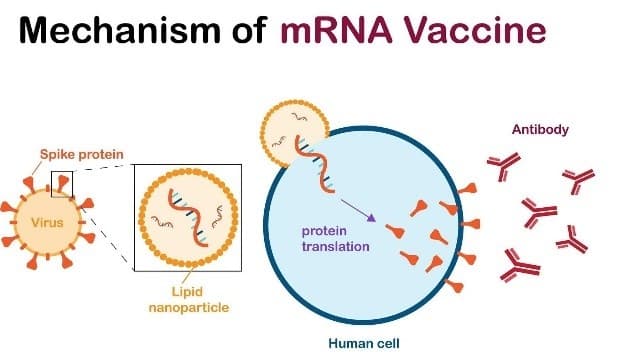
Definition: mRNA cancer vaccine delivers genetic code, makes cells express tumour antigens, triggers immune attack on cancer

Geography: First national rollout announced by Russia; free to patients from early 2025

Nature: Therapeutic, personalised per patient’s tumour profile; not a preventive shot

Quick Facts for MCQs

Mechanism

  • Instruction: mRNA codes for tumour-specific proteins; host ribosomes translate, present antigens via MHC
  • Immunity: Activates cytotoxic T-cells to seek and destroy malignant cells
  • Flexibility: mRNA sequence easily tweaked to new cancer mutations

Comparative Advantage

  • Precision: Targets only cancer cells, limiting collateral tissue damage
  • Speed: Lab synthesis of mRNA faster than developing protein or cell-based therapies
  • Multi-antigen: Can package several tumour signals in one formulation

International Examples

  • United Kingdom: NHS Cancer Vaccine Launch Pad accelerating personalised trials since 2023
  • United States: CureVac CVGBM showed potent response in glioblastoma study 2023
  • Wider horizon: Platform adaptable to numerous cancer types across jurisdictions

Significance

  • Breakthrough: Marks new era in immuno-oncology moving towards precision medicine
  • Versatility: Same platform may extend to infectious diseases, autoimmune conditions
  • Policy: Free Russian access positions mRNA oncology within public-health coverage

Key Data Points

FeatureData-Point
Technology baseMessenger-RNA platform
Developer countryRussia
Planned cost to patientFree of charge
Availability targetEarly 2025
Action typeTreats existing cancers
Antigen rangeMultiple tumour markers possible
Side-effect profileSpares healthy tissue; lower than chemotherapy
PersonalisationTailored to individual tumour neo-antigens
Comparable COVID-19 differenceCOVID shot targets single antigen
Global peersUK Cancer Vaccine Launch Pad; CureVac CVGBM (USA)

Related UPSC Prelims PYQs

GEO_GS, GS1 2022PYQ 1

In the context of vaccines manufactured to prevent COVID-19 pandemic, consider the following statements :

GEO_GS, GS1 2022PYQ 2

Covaxin, a COVID-19 vaccine manufactured in India, is

GS-3S&T

8.DNA Nanorafts Artificial Cells (Synthetic Biology)

BL
Illustration for DNA Nanorafts Artificial Cells (Synthetic Biology)

What & Where

DNA Nanorafts = flat, self-assembled DNA tiles programmable to reshape lipid membranes

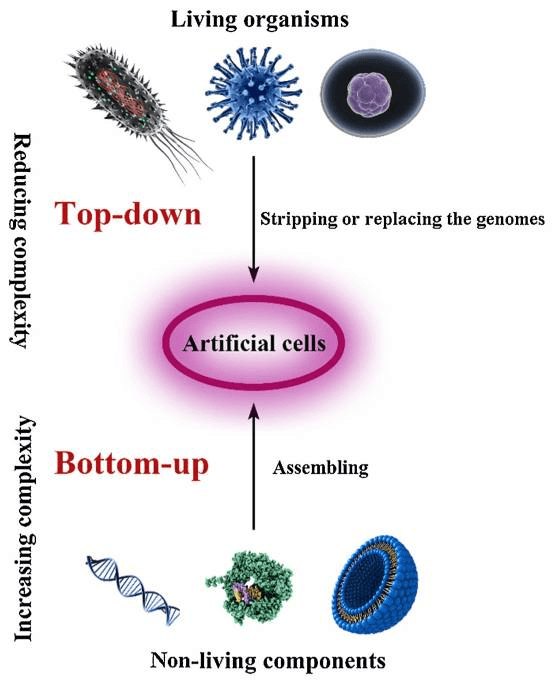
Operate on Giant Unilamellar Vesicles (GUVs) serving as bottom-up artificial cell models

Technique reported in Nature Materials, Feb 2025 by an international synthetic-biology team

Quick Facts for MCQs

Mechanism

  • Attachment: cholesterol-tagged nanorafts dock on GUV lipid bilayer
  • Actuation: unlocking strands increase raft area, bending or porating membrane
  • Reset: locking strands zip tiles, restoring original geometry

Functions & Applications

  • Cell-shaping: enables mimicking of motility, division, communication cues
  • Gatekeeping: temporary channels permit controlled cargo inflow or efflux
  • Medicine: programmable vesicles envisioned for on-site drug release, biosensing

Synthetic Cell Approaches

  • Top-down: genome-minimised cells eg JCVI-syn3.0 retain essential life genes
  • Bottom-up: chemical assembly of lipid vesicles plus functional modules eg DNA nanorafts
  • Goal: decipher life principles and craft therapeutic bio-machines

Key Data Points

FeatureData-Point
Building blockDNA strands arranged as nano-rafts
Model membraneGiant Unilamellar Vesicle (GUV)
Expansion trigger“Unlocking” complementary DNA strand
Reversal agent“Locking” strand with higher affinity
StabiliserLocked Nucleic Acid (LNA) bracing
Key actionsCell shaping; gated molecular transport
Channel natureReversible, non-protein nanopores
Creation routeBottom-up synthetic biology
Potential fieldsDrug delivery, biosensors, artificial organs
GS-2Editorial

9.India Mediates Global North-South (Global Governance)

The Hindu
Illustration for India Mediates Global North-South (Global Governance)

What & Where

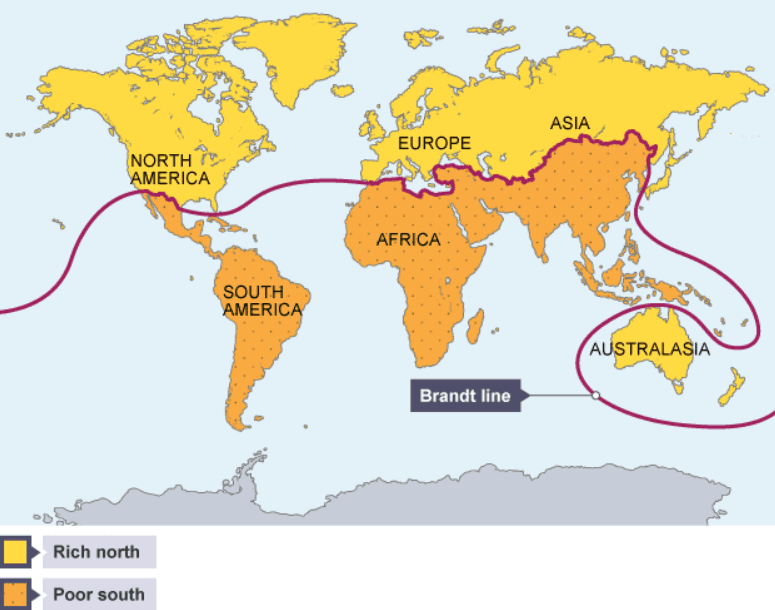
Global South – developing Asia, Africa, Latin America; seeks fair finance, tech and representation.

Global North – industrialised West plus Japan, Australia; dominates capital, supply chains, multilateral rules.

India acting bridge via Global Development Compact, Voice of Global South Summit, AU entry into G20.

Quick Facts for MCQs

Foreign Policy Tools

  • Vaccine Maitri shipped millions of doses to 100+ partners.
  • WIPO treaty advocacy protects traditional knowledge from biopiracy.
  • UNSC, IMF, World Bank reform demands amplify developing-country voice.

Development Initiatives

  • Global Development Compact offers non-conditional financing model.
  • AAGC planned as sustainable BRI alternative with Japan.
  • Mission LiFE promotes low-carbon lifestyle across Global South.

Challenges

  • Chinese BRI loans outscale Indian credit lines, influencing elites.
  • Project execution lags; bureaucratic clearances prolong timelines.
  • Big-Brother perception surfaces in neighbourhood; “India Out” Maldives case.

Reform Proposals

  • Create India International Development Agency to coordinate grants, LoCs.
  • Launch Global South Development Fund for green, digital infrastructure.
  • Use RuPay & UPI export to deepen financial connectivity in partner states.

Key Data Points

FeatureData-Point
Non-Aligned Movement launch1961, Belgrade
G-77 establishment1964, UN headquarters
Stockholm Conference climate principleCBDR idea backed by India, 1972
Voice of Global South SummitVirtual, Jan 2023, 125 nations
African Union joins G20New Delhi Summit, Sept 2023
International Solar Alliance birthParis COP-21, 2015
Loss & Damage Fund agreedCOP-27, 2022; India supporter
Quad membersIndia, US, Japan, Australia
Kaladan project delay~20 years, Myanmar
Asia-Africa Growth Corridor statusSlow progress versus BRI

Related UPSC Prelims PYQs

CAPF_GAI, CDS_GK 2023PYQ 1

निम्नलिखित में से भारत की G20 प्राथमिकताएँ क्या हैं?

CAPF_GAI, CDS_GK 2022PYQ 2

समृद्धि के लिए हिंद-प्रशांत आर्थिक ढाँचा (Indo-Pacific Economic Framework for Prosperity) का गठन करते समय, सदस्य देशों ने चार स्तंभों पर भावी समझौता-वार्ता के लिए सामूहिक परिचर्चा शुरू की है। उन स्तंभों में, निम्नलिखित में से कौन-सा नहीं है ?

GS-2MiscQuick Bite

10.Anti-Migrant Backlash in Tunisia (Migration Issues)

The Hindu

What & Where

Tunisia – northernmost African state, Mediterranean frontage; sandwiched between Algeria (W) and Libya (SE).

2023: President Kais Saied termed sub-Saharan migrants a “demographic threat”, fuelling anti-migrant violence.

UNHCR, under Tunisian pressure, suspended new asylum claims, heightening migrant vulnerability.

Quick Facts for MCQs

Social Concerns

  • Attacks: Surge in racially motivated assaults after 2023 presidential statement.
  • Migrant status: Asylum pathway blocked; sub-Saharans face detention, eviction, wage theft.
  • Demography narrative: Political use of “replacement” fear to rally domestic support.

Security Dimension

  • Extremism: ISIS affiliate active, exploiting social tensions for recruitment.
  • Border monitoring: Mediterranean route now shifts pressure onto EU-Tunisia cooperation.

Economic Angle

  • Employment: Chronic joblessness worsens public hostility toward perceived labour competitors.
  • Fiscal strain: Limited welfare budget hampers support for both citizens and migrants.

International Relations

  • Multilateral ties: Despite AU membership, Tunisian stance strains relations with sub-Saharan states.
  • UNHCR friction: Agency forced to pause asylum processing, citing governmental obstruction.

Key Data Points

FeatureData-Point
CapitalTunis
CoastlineMediterranean Sea
Land neighboursAlgeria, Libya
Dominant ethnicityArab 98 %
Income group (World Bank)Lower-middle-income
Labour issueHigh youth & women unemployment
Terror outfit aliasISIS branch: Ajnad al-Khilafah
Key membershipsUN, OIC, AU, NAM, G-77

Related UPSC Prelims PYQs

CAPF_GAI 2020PYQ 1

Which one of the following is NOT a Mediterranean country ?

GS-3Security

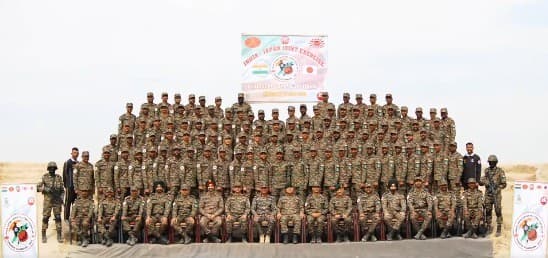
11.Exercise Dharma Guardian 2025 (Military Exercise)

DD News
Illustration for Exercise Dharma Guardian 2025 (Military Exercise)

What & Where

Exercise Dharma Guardian: biennial India-Japan army drill, 6th edition slated at Mount Fuji, Honshu.

Core training: joint urban-warfare & counter-terror operations conducted under UN peacekeeping guidelines.

Mount Fuji: 3,776 m active stratovolcano ~100 km SW of Tokyo; UNESCO World Heritage cultural site.

Quick Facts for MCQs

Security Dimension

  • Training: live-fire, room-intervention, hostage-rescue modules for dense urban terrain.
  • Objective: improve interoperability, tactical synergy, joint mission planning.
  • Result: greater readiness for UN peace support & humanitarian tasks.

Geographical Highlight

  • Mount Fuji: snow-capped about five months annually, iconic symmetrical cone.
  • Location: southern Honshu between Yamanashi & Shizuoka prefectures, near Pacific coast.
  • Sacred heritage: among Japan’s Three Holy Mountains (Tate, Haku, Fuji).

Bilateral Relations

  • Exercise reinforces Special Strategic & Global Partnership and 2+2 defence dialogue.
  • Complements ACSA allowing logistics support, joint maritime patrols, info-sharing.
  • Adds to series with Shinyuu Maitri (air), JIMEX (naval) for tri-service engagement.

Key Data Points

FeatureData-Point
Edition (2024)6th
Exercise typeBilateral army drill
FrequencyBiennial
Host locationMount Fuji, Japan
Participating forcesIndian Army & JGSDF
Primary focusUrban warfare & counter-terrorism
Mount Fuji height3,776.24 m
Volcano statusActive stratovolcano
UNESCO listing year2013

Related UPSC Prelims PYQs

CAPF_GAI, CDS_GK 2023PYQ 1

Exercise Ajeya Warrior is a biennial training event between the Indian Army and the army of:

CAPF_GAI, CDS_GK 2023PYQ 2

The eighth edition of the Exercise Garuda Shakti, a bilateral military-to-military exercise, was conducted recently between the special forces of India and

GS-3Security

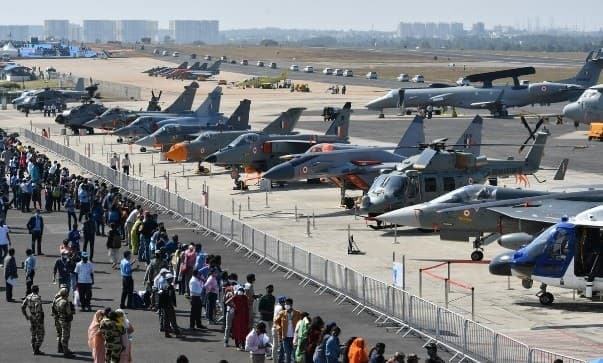
12.Aero India 2025 Airshow (Defense Exhibition)

The Hindu
Illustration for Aero India 2025 Airshow (Defense Exhibition)

What & Where

Aero India = Asia’s largest biennial aerospace & defence exhibition-cum-airshow, public + B2B.

Hosted at Air Force Station, Yelahanka, Bengaluru, since 1996 rebrand (1993 debut as Avia India).

Showcases fighter jets, helicopters, UAVs, radars; platform for global defence partnerships.

Quick Facts for MCQs

Origins & Evolution

  • Genesis: Began 1993 promoting Indian aerospace potential, gained global stature post-1996 rebrand.
  • Continuity: Conducted every odd-numbered year barring force-majeure interruptions.
  • Growth: Visitor, exhibitor counts multiplied, positioning Bengaluru as aerospace hub.

Organisers & Partners

  • Lead: Defence Exhibition Organisation under MoD oversees planning, marketing, protocols.
  • Support: HAL provides static displays, logistics; DRDO showcases R&D; IAF manages flight safety.
  • State role: Karnataka facilitates infrastructure, security, tourism tie-ins.

Economic & Industrial Angle

  • Investment: MoUs and JV announcements often exceed USD 5 billion per edition.
  • Supply-chain: MSME vendor meets bridge Tier-1 OEMs with Indian component makers.
  • Tourism: Hotel, transport, hospitality revenues spike across Bengaluru metropolitan area.

Technologies Showcased

  • Indigenous: Tejas Mk-1A, Light Combat Helicopter, Astra BVR missile highlight self-reliance.
  • Emerging: AI-driven ISR drones, unmanned wingman concepts, quantum-secure comms exhibited.
  • Demonstration: Surya Kiran & Sarang teams perform precision aerobatics, brandishing IAF prowess.

Key Data Points

FeatureData-Point
First edition nameAvia India (1993)
Rebranded year1996 as Aero India
Event frequencyBiennial (every two years)
2025 edition theme“The Runway to a Billion Opportunities”
Permanent venueIAF Station Yelahanka, Bengaluru
Nodal ministryMinistry of Defence
Key Indian supportersHAL, DRDO, Indian Air Force
Region rankAsia’s largest airshow
Core aimsMake in India, Atmanirbhar Bharat push
Typical displaysLive aerial demos, defence tech exhibitions
Past deal focusMMRCA procurement platform
Foreign participationGlobal defence ministers, OEM CEOs
GS-2Scheme

13.PM Dhan-Dhaanya Krishi Yojana (Agriculture Scheme)

Indian Express

What & Where

PM Dhan-Dhaanya Krishi Yojana: centrally sponsored agri-development mission, Union Budget 2025

Coverage: 100 low-productivity districts across India, identified via DFS & NABARD data

Scope: crop productivity, diversification, irrigation, storage, credit access

Quick Facts for MCQs

Legal & Policy

  • Centrally sponsored scheme, execution via state action plans
  • Relies on convergence; no separate Act or standalone budget line
  • DFS-NABARD datasets form official basis for district notification

Economic Angle

  • Productivity boost aims higher land utilisation, income uplift
  • Expanded credit flow expected to reduce informal borrowing
  • Improved post-harvest storage to cut wastage, stabilise prices

Tech & Schemes

  • Irrigation push emphasises micro-irrigation and energy-efficient pumps
  • Diversification component links with National Mission on Oilseeds, Pulses
  • Storage infra dovetails with Agri-Infra Fund subsidies

Key Data Points

FeatureData-Point
Launch year2025-26 (Budget 2025)
Nodal ministryAgriculture & Farmers’ Welfare
Core implementersCentre + States with NABARD, FIs
Districts covered100 identified low-productivity
Target farmers1.7 crore small & marginal
Fund flow modelConvergence of existing agri/allied schemes
Key pillarsProductivity, diversification, irrigation, storage, credit
Storage scalePanchayat & block-level godowns
Credit focusBoth short-term & long-term loans
Selection metricsCropping intensity, credit flow weakness

Related UPSC Prelims PYQs

CAPF_GAI, ESE_GS 2025PYQ 1

Which one of the following Yojanas replaces two schemes – National Agricultural Insurance Scheme (NAIS), 1999 as well as the Modified National Agricultural Insurance Scheme (MNAIS), 2010 – by incorporating the best features of all these schemes while removing the previous shortcomings and weaknesses?

CAPF_GAI, ESE_GS 2025PYQ 2

Which one among the following schemes focuses on developing modern infrastructure and optimizing supply chain from farm to retail in Indian agriculture sector?

Ready to practice?

Test your knowledge with our UPSC test series.

Start Free Trial