
Which one among the following statements regarding gypsum is not correct?
- (a)On heating gypsum at 373 K, it loses water molecules and becomes CaSO4·H2O.
- (b)On mixing with water, plaster of Paris changes to gypsum.
- (c)Plaster of Paris is used for supporting fractured bones.
- (d)Although gypsum possesses water of crystallization, it is not a liquid at room temperature.
Correct — A, On heating gypsum at 373 K, it loses water molecules and becomes CaSO4·H2O. The question asks which statement is not correct, and this is the one. Gypsum is calcium sulphate dihydrate, CaSO4·2H2O; heating it to 373 K, which is 100 degrees Celsius, drives off three-quarters of that water and leaves calcium sulphate hemihydrate, written CaSO4·1/2H2O — plaster of Paris. The half is the whole point of the formula, because two formula units of calcium sulphate share a single water molecule between them. As printed, the option gives a full water molecule per formula unit, which is not the compound that forms, so the statement is false. The remaining three are all true.
- (b)On mixing with water, plaster of Paris changes to gypsum. — This is correct, and it is the reaction that makes the material useful. Plaster of Paris takes back the water it lost and sets as a hard mass of gypsum crystals, which is why the powder has to be kept in a moisture-proof container.
- (c)Plaster of Paris is used for supporting fractured bones. — Correct. The same setting reaction is used to make an orthopaedic cast, and also for casts, moulds, ornamental work and smooth wall finishes.
- (d)Although gypsum possesses water of crystallization, it is not a liquid at room temperature. — Correct, if awkwardly phrased. Water of crystallisation is water held in a fixed proportion within the crystal lattice; it does not make the solid wet or liquid. Blue copper sulphate crystals and washing soda are dry solids for the same reason.
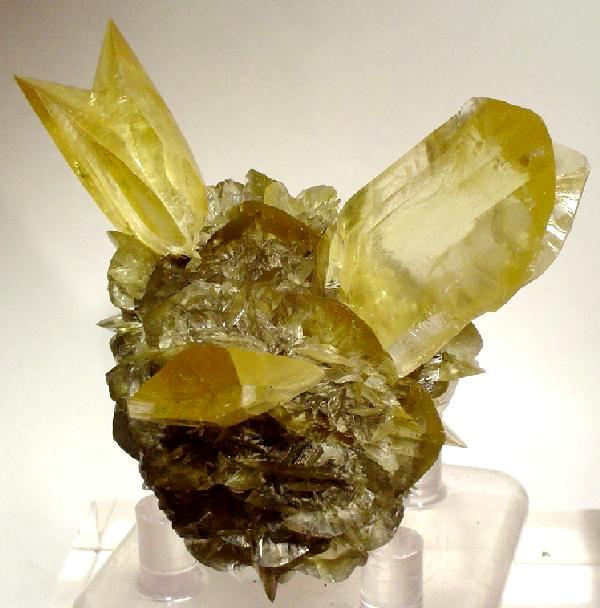
Gypsum is calcium sulphate dihydrate, CaSO4·2H2O, and it is a hydrated salt — a crystal that carries a fixed number of water molecules built into its lattice. Heated to about 373 K it loses most of that water and becomes the hemihydrate, plaster of Paris, CaSO4·1/2H2O. Add water back and the hemihydrate rehydrates to gypsum and sets hard. Heating further, past about 473 K, drives off the rest and gives dead burnt plaster, anhydrous calcium sulphate, which will no longer set.
The half-water in the hemihydrate is one of the small pieces of notation that school chemistry deliberately dwells on, because a fraction inside a formula looks wrong until it is explained: it means two CaSO4 units share one H2O between them. An option that quietly changes that half into a whole is therefore a very natural thing for an examiner to plant, and it is worth checking every printed formula in a chemistry item character by character before deciding which statement is false. Note that this card differs from the answer we hold on file for this question; the reasoning is set out in full above and the paper's own wording is what decides it.
- Gypsum is CaSO4·2H2O; plaster of Paris is CaSO4·1/2H2O.
- The conversion happens on heating gypsum to about 373 K (100 degrees Celsius).
- In the hemihydrate, two formula units of calcium sulphate share one molecule of water.
- Adding water to plaster of Paris turns it back into gypsum, which is why it sets hard.
- Heating beyond about 473 K gives dead burnt plaster, anhydrous CaSO4, which has lost the ability to set.
- Skimming past a printed formula — the difference between one water and half a water is the entire item here.
- Assuming a hydrated salt must feel damp; water of crystallisation is locked in the lattice.
- Mixing up the two heating stages: 373 K gives plaster of Paris, higher temperatures give dead burnt plaster.
A not-correct item in which the false statement is created by altering a formula rather than by making an obviously wrong claim, so it rewards careful reading of chemical notation.
Which one of the following is the chemical formula of Plaster of Paris?
- (a) CaSO₄·½ H₂O
- (b) CaSO₄·2 H₂O
- (c) CaSO₄·5 H₂O
- (d) CaSO₄·4 H₂O
Answer(a) CaSO₄·½ H₂O
The formula that decides this question, asked directly and answered from an official key. Half a water molecule per formula unit is the accepted value, not one.
Which one of the following is the number of water molecules that share with two formula unit CaSO₄ in plaster of Paris ?
- (a) One
- (b) Two
- (c) Five
- (d) Ten
Answer(a) One
Explains what the fraction means: one water molecule is shared between two units of calcium sulphate, which is why the formula is written with a half.
Which one of the following is the chemical formula of gypsum?
- (a) CaSO₄·2H₂O
- (b) Ca₂SiO₄
- (c) 2CaSO₄·H₂O
- (d) CaSO₄
Answer(a) CaSO₄·2H₂O
The starting material, keyed. Note that its option (c) writes the same hemihydrate the other way round, as two calcium sulphates to one water — an equivalent form of the fraction.
- practice — not a real PYQ
What is the chemical formula of plaster of Paris?
- (a)CaSO4·2H2O
- (b)CaSO4·1/2H2O
- (c)CaSO4
- (d)CaCO3
Answer(b) CaSO4·1/2H2O — the calcium sulphate hemihydrate obtained by heating gypsum to about 373 K.
- practice — not a real PYQ
Which one of the following happens when plaster of Paris is mixed with water?
- (a)It dissolves completely to give a clear solution
- (b)It sets into a hard mass of gypsum
- (c)It decomposes to calcium oxide and sulphur dioxide
- (d)It gives off hydrogen gas
Answer(b) It sets into a hard mass of gypsum — the hemihydrate takes water back and crystallises as the dihydrate.