
Plants adapted to grow in deserts and other dry habitats are called
- (a)xerophytes
- (b)mesophytes
- (c)hydrophytes
- (d)halophytes
Correct — A, xerophytes. Plants are grouped by the water regime they are built for, and the prefix carries the meaning: xero- is dry, so xerophytes are the plants of deserts and other arid habitats. Their adaptations all point one way, towards losing less water and holding more — thick waxy cuticles, leaves reduced to spines or shed altogether, sunken stomata that open at night, deep or widely spread root systems, and in succulents a fleshy water-storing stem that also does the photosynthesis.
- (b)mesophytes — Meso- means middle. Mesophytes are the plants of ordinary moderately watered land — most crops, most trees of a temperate or monsoon climate — and they have neither drought armour nor aquatic buoyancy tissue.
- (c)hydrophytes — Hydro- is water. Hydrophytes live in or on water; lotus, water hyacinth and Hydrilla have air-filled aerenchyma, thin or absent cuticles and often no need of a strong root system.
- (d)halophytes — Halo- is salt. Halophytes tolerate saline soil — mangroves such as Rhizophora and Avicennia are the standard example, with salt-excreting glands and stilt or breathing roots. Salinity does impose physiological drought, but the term names the salt, not the dryness.
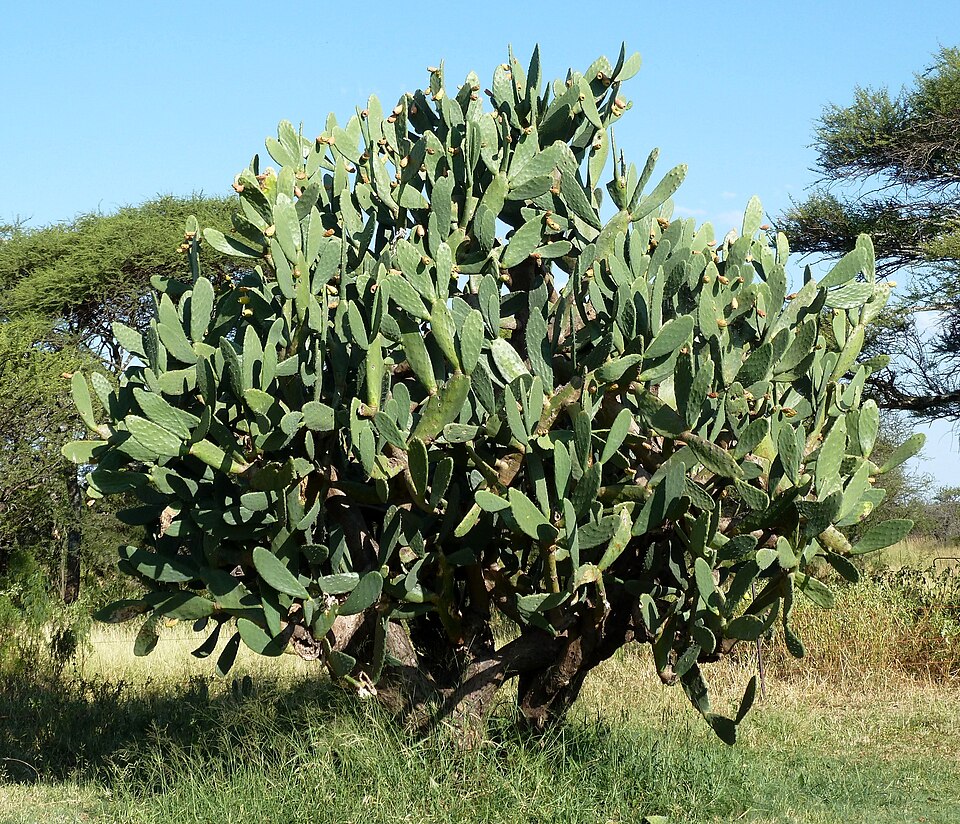
Ecological classification of plants by water availability gives four familiar groups. Hydrophytes grow in water; mesophytes grow in ordinarily moist soil; xerophytes grow where water is scarce; halophytes grow in saline habitats. Xerophytes achieve drought survival by three broad routes — escaping the dry season as seed, evading it by storing water in succulent tissue, or enduring it with sclerophyllous leaves, thick cuticle and deep roots. The cactus family shows the second route clearly, with the stem taking over photosynthesis while the leaves have become spines.
The whole item turns on four Greek prefixes, and reading them is faster and more reliable than recalling examples. It is worth noticing why halophytes are a genuinely tempting distractor rather than a filler: salty soil lowers the water potential outside the root, so a mangrove faces a water-uptake problem much like a desert plant's and shows several of the same features. The stem, though, says 'deserts and other dry habitats', which names the water regime and not the salt.
- Xerophytes are plants adapted to arid habitats; hydrophytes to water, mesophytes to ordinary moist soil, halophytes to saline soil.
- Common xerophytic adaptations include a thick waxy cuticle, sunken stomata, reduced or spiny leaves and deep root systems.
- In a cactus the stem is green and photosynthetic while the leaves are modified into spines.
- Many desert plants keep their stomata shut by day and fix carbon dioxide at night through crassulacean acid metabolism.
- Mangroves are halophytes and show pneumatophores and stilt roots as their signature adaptations.
- Choosing halophyte because salt-affected soils also cause water stress; the prefix names salt, not drought.
- Assuming a desert plant must have no leaves at all — many xerophytes keep small, hard, thick-cuticled leaves.
- Confusing mesophyte with hydrophyte; meso- means intermediate, not moist-loving.
A vocabulary item built entirely on Greek prefixes, so knowing xero-, hydro-, meso- and halo- answers it and several like it.
Which of the following leaf modifications occur(s) in the desert areas to inhibit water loss? 1. Hard and waxy leaves 2. Tiny leaves 3. Thorns instead of leaves Select the correct answer using the code given below:
- (a) 2 and 3 only
- (b) 2 only
- (c) 3 only
- (d) 1, 2 and 3
Answer(d) 1, 2 and 3
The same plants from the other side. That item lists the leaf modifications a desert plant shows; this one asks for the name given to plants that show them.
Which of the following leaf modifications occurs/occur in desert areas to inhibit water loss? 1. Hard and waxy leaves 2. Tiny leaves or no leaves 3. Thorns instead of leaves Select the correct answer using the codes given below.
- (a) 1 and 2 only
- (b) 2 only
- (c) 1 and 3 only
- (d) 1, 2 and 3
Answer(d) 1, 2 and 3
The 2018 question is almost a reprint of this 2013 one, which is a useful reminder that this small corner of plant ecology is asked repeatedly and is worth learning once, properly.
- practice — not a real PYQ
Plants such as lotus and Hydrilla, which grow in water, are called
- (a)xerophytes
- (b)hydrophytes
- (c)halophytes
- (d)epiphytes
Answer(b) hydrophytes — air-filled aerenchyma keeps them buoyant and supplies oxygen to submerged parts.
- practice — not a real PYQ
Which one of the following is a characteristic adaptation of a xerophyte?
- (a)Large thin leaves with a thin cuticle
- (b)Aerenchyma tissue in the stem
- (c)Sunken stomata and a thick waxy cuticle
- (d)Salt-excreting glands on the leaves
Answer(c) Sunken stomata and a thick waxy cuticle — both cut the rate at which water is lost from the leaf surface.