
Consider the following statements about Barchans : 1. These landforms are found in Thar desert in India. 2. The windward side has concave slope with maximum height at the centre. 3. Two ends of the barchan are called horns. Which of the statements given above is/are correct ?
- (a)1 and 2 only
- (b)2 and 3 only
- (c)1 and 3 only
- (d)3 only
Correct — C, 1 and 3 only. A barchan is the crescent-shaped dune that forms where a wind blows steadily from one direction across a firm surface carrying a limited supply of sand, and barchans occur in the Thar, so statement 1 stands. Statement 3 is the standard vocabulary — the two trailing tips of the crescent are called horns, and they point downwind. Statement 2 inverts the dune's own profile. The windward slope of a barchan is the gentle one, and it is convex; sand is pushed up it grain by grain until it spills over the crest. The steep face is on the lee side, where sand avalanches down at the angle of repose of about 30 to 34 degrees, and it is that slip face which is concave. The stem attaches 'concave' to the windward side, so the second statement fails and only the first and third survive.
- (a)1 and 2 only — Pairs a true statement with the false one. The windward slope of a barchan is gentle and convex, not concave; the concavity belongs to the lee-side slip face.
- (b)2 and 3 only — Again carries statement 2, which reverses the dune's cross-section.
- (d)3 only — Drops statement 1 for no reason. Barchans are well recorded in the Thar, particularly in the western Rajasthan sand tracts.
A barchan is the simplest and most mobile of dune forms. It needs three things at once: a steady wind from a single quarter, a sand supply too small to cover the ground completely, and a firm surface for the dune to migrate over. Sand climbs the gentle windward back by saltation, reaches the crest, and avalanches down the steep lee face, so the whole dune creeps downwind while keeping its shape. The tips at either end move faster than the bulky centre because there is less sand to shift, which is what draws the crescent out into horns.
Every wrong option in this item depends on the same reversal, so the profile is worth fixing in the mind once. Gentle and convex on the side facing the wind; steep and concave on the sheltered side; horns trailing downwind. If the wind is variable rather than constant, you get seifs or longitudinal dunes instead; if the sand supply is abundant enough to bury the ground, barchans merge into transverse ridges. In India the classic sites are the western Rajasthan sand tracts, and the dunes there migrate fast enough to be a real problem for roads, canals and farmland.
- A barchan has a gentle convex windward slope and a steep concave lee slope, with the slip face standing near the angle of repose of dry sand, about 30 to 34 degrees.
- The two horns of a barchan point downwind, because the thinner tips migrate faster than the thick central body.
- Barchans require a one-directional wind, a limited sand supply and a firm underlying surface.
- Barchans occur in the Thar desert of western Rajasthan and are also common in the Sahara, the Namib and the deserts of Central Asia.
- Where the wind shifts direction, longitudinal or seif dunes form instead; where sand is abundant, transverse dunes form.
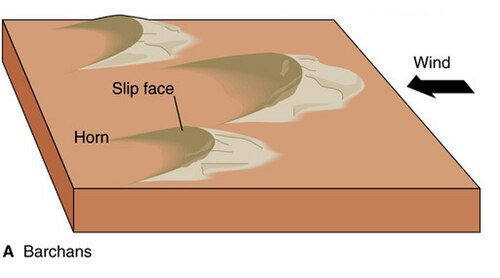
- Reversing the profile and putting the steep face on the windward side.
- Assuming the horns point into the wind; they trail behind it.
- Treating every crescent dune as a barchan when the same word is being used for a barchanoid ridge.
As a three-statement item in which the true statements are definitional and the false one flips a single geometric attribute of the dune.
Which of the following statements regarding Barchan is/are correct? 1. It is a crescent-shaped mound of sand, which is deposited by the wind blowing constantly from one direction in a desert. 2. The windward side has a convex steep slope with maximum height at the centre. 3. Two ends of Barchan are called horns and point opposite to the direction the wind blows. Select the answer using the code given below:
- (a) 1 only
- (b) 1 and 2 only
- (c) 2 and 3 only
- (d) 1, 2 and 3
Answer(a) 1 only
The same dune, tested twice with the same trick and one extra twist. That paper also plants a false claim about the windward slope, and additionally reverses the direction the horns point, so only the definition survives there while here the horns statement is printed correctly.
- practice — not a real PYQ
The horns of a barchan dune
- (a)point into the prevailing wind
- (b)point downwind
- (c)point vertically upward
- (d)point at right angles to the wind
Answer(b) point downwind — the thinner tips migrate faster than the heavier centre of the dune.
- practice — not a real PYQ
Longitudinal or seif dunes form mainly where
- (a)the wind blows steadily from one direction
- (b)the wind direction shifts between two or more quarters
- (c)there is no wind at all
- (d)the ground is permanently waterlogged
Answer(b) the wind direction shifts between two or more quarters — a single steady wind gives barchans instead.