
Trans-Siberian Railway from St. Petersburg to Vladivostok does not run across :
- (a)Altai range
- (b)Caucasus mountains
- (c)Ural mountains
- (d)Ob and Yenisei rivers
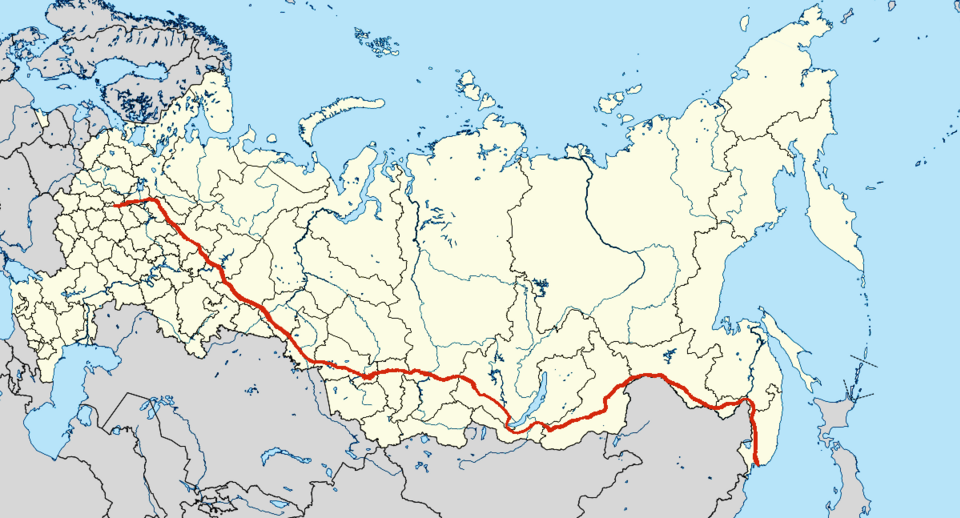
Correct — B, Caucasus mountains. The Trans-Siberian line runs west to east across the northern half of Eurasia. It leaves European Russia, climbs over the Urals near Yekaterinburg, crosses the West Siberian Plain — bridging the Ob at Novosibirsk and the Yenisei at Krasnoyarsk — skirts the southern shore of Lake Baikal, and continues through Chita and Khabarovsk to Vladivostok on the Pacific. The Caucasus is nowhere near that path. It lies far to the south-west, on the isthmus between the Black Sea and the Caspian, and forms Russia's frontier with Georgia and Azerbaijan. Nothing on a Moscow-to-Pacific journey goes anywhere near it.
- (a)Altai range — The Altai lies in southern Siberia, in the same belt of country the railway crosses, and the line runs along its northern approaches through Novosibirsk and Krasnoyarsk. Whatever one decides about how closely the track touches the range itself, the Altai is a Siberian feature on the railway's own side of the country — which the Caucasus is not.
- (c)Ural mountains — The Urals are crossed, and the crossing is the most celebrated point on the whole route; an obelisk marking the boundary of Europe and Asia stands beside the line near Yekaterinburg.
- (d)Ob and Yenisei rivers — Both rivers are bridged. The Ob is crossed at Novosibirsk, a city that exists because the railway needed a bridge there, and the Yenisei at Krasnoyarsk.
The Trans-Siberian Railway is the longest continuous railway line in the world, about 9,289 km from Moscow to Vladivostok, built between 1891 and 1916 and spanning eight time zones. It opened Siberia to settlement and resource extraction and remains the spine of Russian east-west movement. Two branch routes leave it in the east: the Trans-Mongolian, which turns south at Ulan-Ude for Ulaanbaatar and Beijing, and the Trans-Manchurian.
A 'does not run across' item is answered from a rough mental map, not from a station list. Sort the four options by where they sit in Russia. The Urals run north-south through the middle of the country and are the conventional divide between European and Asian Russia. The Ob and the Yenisei are the great north-flowing Siberian rivers. The Altai is in southern Siberia on the Mongolian and Kazakh borders. Only the Caucasus sits outside Siberia altogether, in the far south-west between two seas, and that alone settles the question.
- The Trans-Siberian Railway runs about 9,289 km from Moscow to Vladivostok and crosses eight time zones; construction ran from 1891 to 1916.
- It crosses the Urals near Yekaterinburg, the Ob at Novosibirsk, the Yenisei at Krasnoyarsk and the Amur at Khabarovsk.
- The Caucasus range lies between the Black Sea and the Caspian Sea; Mount Elbrus, at 5,642 m, is its highest peak.
- The Ob, the Yenisei and the Lena all drain northward to the Arctic Ocean, which is why their lower courses stay frozen after the headwaters thaw and cause spring flooding.
- The line runs along the southern shore of Lake Baikal, the deepest lake on Earth.
- Assuming that any large Russian mountain range must lie somewhere on a line that long.
- Mixing up the Caucasus and the Urals when asked which range divides Europe from Asia.
- Forgetting that Siberian rivers run north, not east, so a west-to-east railway must bridge them rather than follow them.
As a negative-form question — which feature the line does not cross — so the work is elimination on a mental map rather than recall of the route.
No directly related past PYQ was found.
- practice — not a real PYQ
The eastern terminus of the Trans-Siberian Railway is
- (a)Irkutsk
- (b)Khabarovsk
- (c)Vladivostok
- (d)Magadan
Answer(c) Vladivostok — Russia's principal Pacific port, at the far end of the line from Moscow.
- practice — not a real PYQ
The Ob, the Yenisei and the Lena all drain into
- (a)the Arctic Ocean
- (b)the Pacific Ocean
- (c)the Caspian Sea
- (d)the Sea of Okhotsk
Answer(a) the Arctic Ocean — all three are north-flowing rivers of Siberia.