
Cinnabar is an ore of
- (a)mercury
- (b)zinc
- (c)copper
- (d)lead
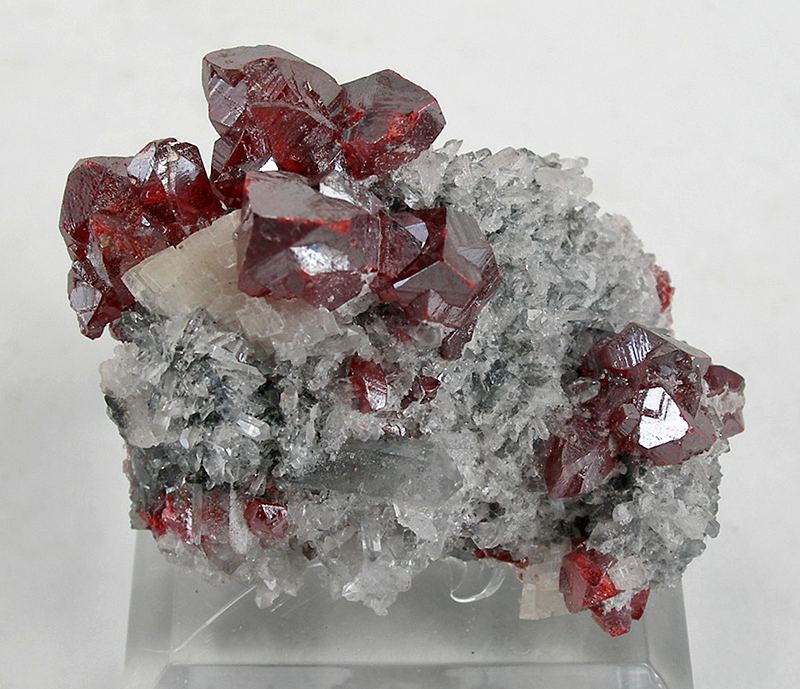
Correct — A, mercury. Cinnabar is mercury(II) sulphide, HgS, a brilliant red mineral and the chief ore from which mercury has been won since antiquity. The metal is obtained by roasting the ore in air — HgS + O₂ gives Hg + SO₂ — after which the mercury vapour is condensed. The same mineral, ground fine, is the pigment vermilion.
- (b)zinc — Zinc comes from zinc blende (sphalerite, ZnS) and calamine (ZnCO₃). Zinc blende is also a sulphide, which is what makes this the most plausible wrong answer.
- (c)copper — Copper's principal ores are copper pyrites (chalcopyrite, CuFeS₂) and malachite. Cinnabar contains no copper.
- (d)lead — Lead comes from galena, PbS — another sulphide, but a grey metallic-looking one, quite unlike cinnabar's red.
Ore names are a fixed vocabulary in this syllabus, and cinnabar belongs to mercury. Most of the heavy metals of the p-block and late d-block occur as sulphides, so the discriminator is not the sulphide ending but the specific mineral name.
Every wrong option is a metal whose common ore is also a sulphide, which is exactly why the item works. Fix the pairs by name rather than by chemistry: cinnabar to mercury, galena to lead, zinc blende to zinc, copper pyrites to copper. Mercury is worth remembering for a second reason — it is the only metal that is liquid at ordinary room temperature.
- Cinnabar is HgS, mercury(II) sulphide, and is the source of the pigment vermilion.
- Roasting the ore in air gives the free metal directly: HgS + O₂ → Hg + SO₂.
- Other sulphide ores worth pairing: galena PbS (lead), zinc blende ZnS (zinc), copper pyrites CuFeS₂ (copper), iron pyrites FeS₂.
- Mercury is liquid at room temperature and is used in thermometers, barometers and fluorescent lamps; its compounds are cumulative poisons, as the Minamata episode in Japan showed.
- Choosing zinc or lead because their ores are sulphides too.
- Confusing cinnabar with cassiterite, the tin ore, on the strength of the similar-sounding name.
- Assuming a red mineral must be an iron ore.
Asked as a direct ore-to-metal pairing, or inside a matching list of four ores against four metals.
Cinnabar is an ore of which one of the following?
- (a) Copper
- (b) Zinc
- (c) Mercury
- (d) Manganese
Answer(c) Mercury
The identical pairing asked a year earlier, with manganese swapped in for lead among the distractors. Ore names recur across these papers almost unchanged, so the list is worth learning as a list.
- practice — not a real PYQ
Galena is an ore of
- (a)zinc
- (b)lead
- (c)tin
- (d)mercury
Answer(b) lead — galena is lead sulphide, PbS, the principal lead ore.
- practice — not a real PYQ
Which one of the following metals is liquid at ordinary room temperature?
- (a)Sodium
- (b)Mercury
- (c)Lead
- (d)Zinc
Answer(b) Mercury — its melting point is about −39 °C, which is why it is used in thermometers and barometers.