
Borax is prepared from
- (a)calcium carbonate
- (b)magnesium carbonate
- (c)potassium carbonate
- (d)sodium carbonate
Correct — D, sodium carbonate. Borax is sodium tetraborate decahydrate, Na₂B₄O₇·10H₂O, so whatever it is made from has to supply the sodium. The classical route boils powdered colemanite, a calcium borate ore, with a solution of sodium carbonate: the carbonate hands over its sodium, borax crystallises from the cooled liquor and insoluble calcium carbonate is filtered off. No other carbonate on this list carries sodium, and without sodium the product would be some other borate entirely.
- (a)calcium carbonate — Calcium is on the wrong side of this preparation. Calcium borate is the ore that goes in; calcium carbonate is the waste that comes out, not a source of borax.
- (b)magnesium carbonate — Magnesium would give a magnesium borate. Borax is defined by its sodium, which magnesium carbonate cannot supply.
- (c)potassium carbonate — Potassium sits directly below sodium and behaves similarly, but the product would be a potassium borate. The name borax is reserved for the sodium salt.
Reading the formula is the whole method here. Na₂B₄O₇·10H₂O contains sodium, boron and oxygen, so the boron must come from a borate ore and the sodium from a sodium compound. The only sodium compound offered is sodium carbonate.
Much of the world's borax is not manufactured at all but mined as tincal, the natural mineral that crystallises in dried-up lake beds; Tibet supplied it to the Arab world along the Silk Road centuries before any chemical route existed. The examiner's word 'prepared' points at the chemical route instead, and there the carbonate is the reagent that matters.
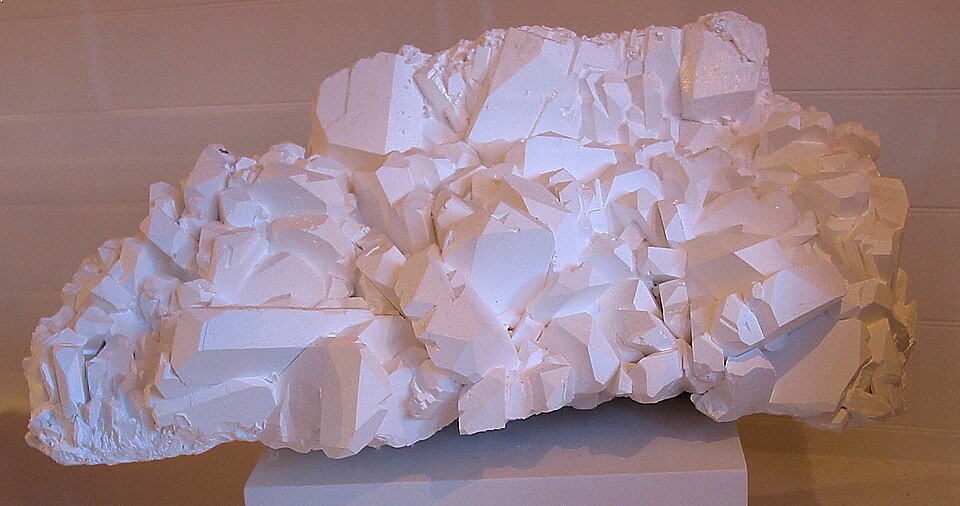
- Borax is sodium tetraborate decahydrate, Na₂B₄O₇·10H₂O; the natural mineral is called tincal.
- Colemanite, a calcium borate, boiled with sodium carbonate solution yields borax and calcium carbonate.
- Heated strongly, borax swells, loses its water and fuses to a clear glassy bead — the basis of the borax bead test for coloured metal salts.
- It is used as a flux in soldering and welding, in heat-resistant borosilicate glass and glazes, in detergents and as a laboratory buffer.
- Picking calcium carbonate because colemanite is a calcium mineral, which confuses the raw material with the reagent.
- Assuming potassium carbonate works because potassium is in the same group as sodium.
- Mixing up borax with boric acid, which is H₃BO₃ and carries no metal at all.
Asked as the source or preparation of borax, or through its formula, its bead test or its role as a flux.
Which among the following is the correct composition of Borax?
- (a) Sodium, Boron, Magnesium and Hydrogen
- (b) Sodium, Boron, Oxygen and Hydrogen
- (c) Potassium, Boron, Oxygen and Hydrogen
- (d) Sodium, Boron, Nitrogen and Hydrogen
Answer(b) Sodium, Boron, Oxygen and Hydrogen
The same compound approached from the other end — that paper asks which elements borax contains, this one asks which reagent supplies them. Both turn on the sodium, and both offer a potassium version as the trap.
- practice — not a real PYQ
The chemical formula of borax is
- (a)H₃BO₃
- (b)Na₂B₄O₇·10H₂O
- (c)Na₂CO₃·10H₂O
- (d)CaB₆O₁₁·5H₂O
Answer(b) Na₂B₄O₇·10H₂O — H₃BO₃ is boric acid, Na₂CO₃·10H₂O is washing soda and the last formula is colemanite.
- practice — not a real PYQ
Borax is used as a flux in soldering because on heating it
- (a)melts the metal being joined
- (b)dissolves metal oxides and gives a clean surface
- (c)prevents the solder from melting
- (d)raises the melting point of the joint
Answer(b) dissolves metal oxides and gives a clean surface — molten borax takes up the oxide film so the solder can wet the metal.