
White gold is an alloy of
- (a)gold, nickel and palladium
- (b)gold, cobalt and palladium
- (c)gold, titanium and platinum
- (d)gold, magnesium and palladium
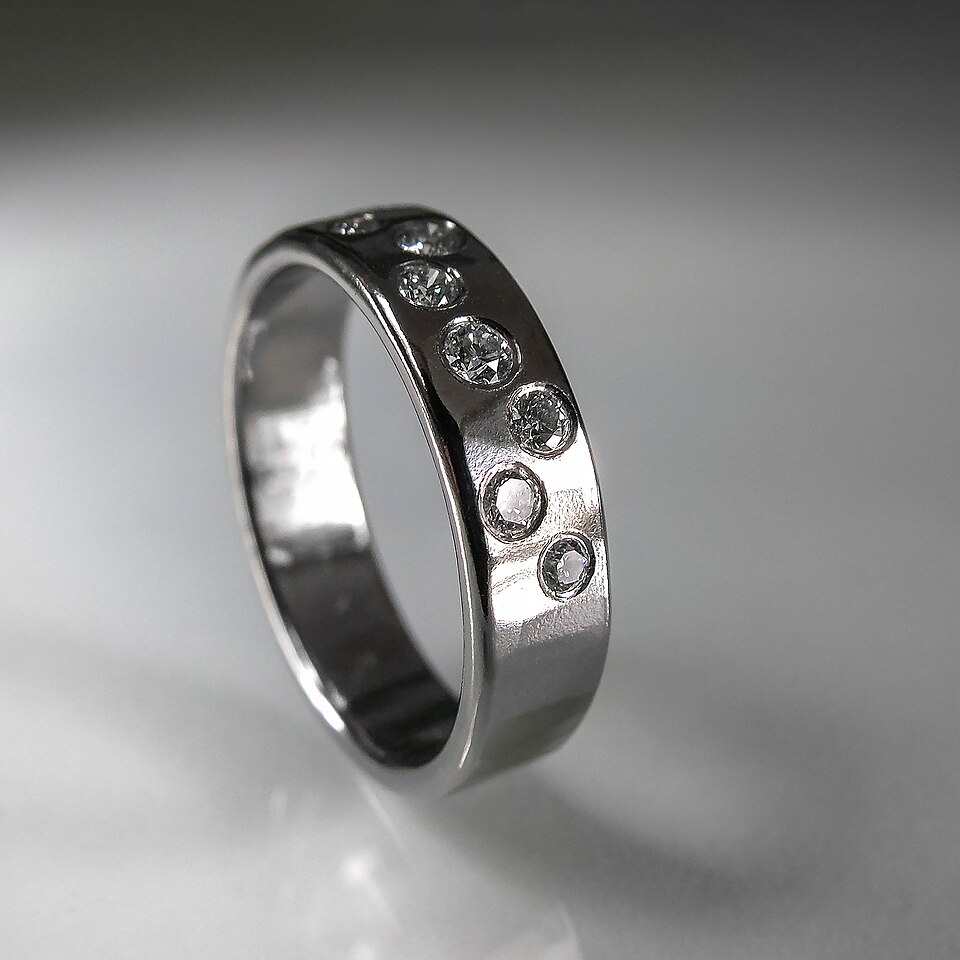
Correct — A, gold, nickel and palladium. White gold is not an element but a family of alloys in which pure gold — which is always yellow — is diluted with one or more white metals until the yellow is masked. The metals used for that job are nickel, palladium, silver and platinum, and the nickel-palladium combination named in this option is the standard jewellery formulation. Purity is still measured in carats, so an 18-carat white gold is 75 per cent gold by weight with the remaining quarter made up of the white metals.
- (b)gold, cobalt and palladium — Palladium belongs, but cobalt does not whiten gold — cobalt-bearing gold alloys are used to produce dark and black finishes, the opposite effect.
- (c)gold, titanium and platinum — Platinum is a genuine white-gold metal, but titanium is not alloyed into jewellery gold for this purpose; titanium is used on its own for rings, not as a whitener.
- (d)gold, magnesium and palladium — Magnesium is a light, reactive metal with no role in precious-metal alloys. Pairing it with palladium does not rescue the option.
Alloying changes colour as well as hardness. Gold is soft and yellow; adding copper pulls it towards red, adding silver towards green, and adding a white metal such as nickel or palladium bleaches the yellow out altogether. The carat figure records only how much gold is present, not what the rest of the alloy is.
Three of the four options pair gold with a plausible-sounding metal plus palladium, so palladium alone will not decide the question — the second metal does. Nickel-based white gold is cheaper and harder, palladium-based is more expensive and hypoallergenic; nickel can provoke contact allergy, which is why European rules cap how much of it may be released from jewellery. Many white gold pieces also carry a thin rhodium plating to give a brighter finish.
- White gold is gold alloyed with at least one white metal — usually nickel, palladium, silver or platinum.
- Purity is still expressed in carats: 24 carat is pure gold, 22 carat is about 91.6 per cent and 18 carat is 75 per cent.
- Copper-rich gold alloys give rose and red gold; silver-rich ones give a greenish tint.
- Rhodium plating is often applied over white gold for a bright, hard finish, and wears off with use.
- Treating white gold as a distinct element or a naturally occurring variety of gold.
- Assuming any metal paired with palladium will do, when the second metal is the discriminator.
- Confusing white gold with german silver, which contains no gold at all.
Asked as a straight composition question, or through a matching list of alloys against their constituent metals.
Standard 18-carat gold sold in the market contains
- (a) 82 parts gold and 18 parts other metals
- (b) 15 parts gold and 82 parts other metals
- (c) 18 parts gold and 6 parts other metals
- (d) 9 parts gold and 15 parts other metals
Answer(c) 18 parts gold and 6 parts other metals
The companion fact — the carat scale measures how much gold is in the alloy, while the CAPF item asks what the remaining fraction is made of. Together they describe a piece of white gold completely.
- practice — not a real PYQ
German silver is an alloy of
- (a)silver, copper and zinc
- (b)copper, zinc and nickel
- (c)silver, nickel and tin
- (d)copper, tin and lead
Answer(b) copper, zinc and nickel — despite the name, german silver contains no silver.
- practice — not a real PYQ
An 18-carat gold ornament contains gold to the extent of about
- (a)58 per cent
- (b)75 per cent
- (c)83 per cent
- (d)92 per cent
Answer(b) 75 per cent — 18 parts gold in 24, which is why 22-carat works out near 91.6 per cent.