
In which city was the G20 Summit 2023 held in India ?
- (a)Mumbai
- (b)New Delhi
- (c)Hyderabad
- (d)Bangalore
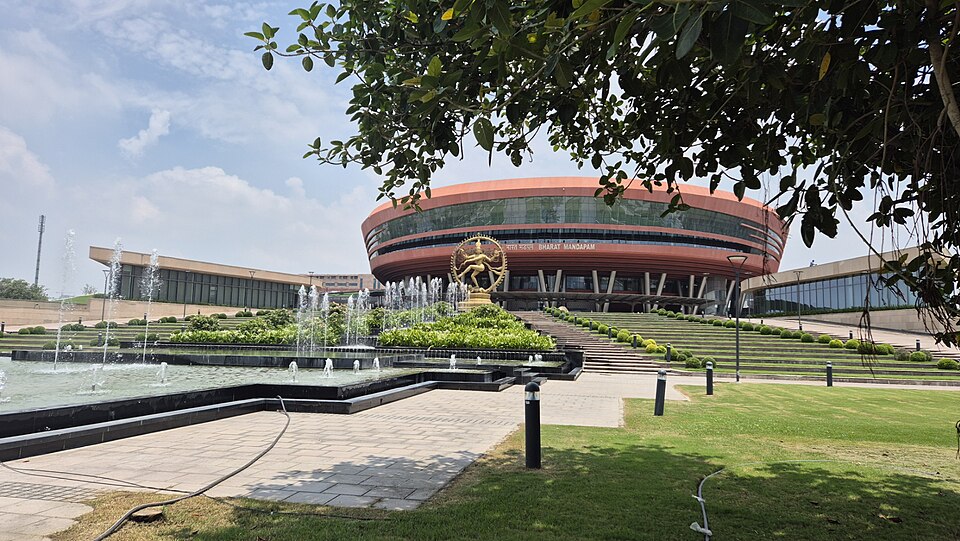
Correct — B, New Delhi. India held the G20 presidency through 2023, and the eighteenth G20 Heads of State and Government Summit — the leaders' summit that crowns each presidency — met in New Delhi on 9 and 10 September 2023, at the newly built Bharat Mandapam within the redeveloped Pragati Maidan complex. Two outcomes from those two days are the ones examiners return to. First, the African Union was admitted as a permanent member of the G20, the grouping's first enlargement since it was founded, taking its membership to twenty-one and giving a fifty-five-country continental bloc a seat alongside the European Union. Second, the New Delhi Leaders' Declaration was adopted by consensus — an outcome widely regarded as difficult, since the Bali summit of the previous year had shown how far apart the members were on the war in Ukraine, and a G20 declaration requires unanimity or it is not issued at all. The summit also launched the India–Middle East–Europe Economic Corridor and the Global Biofuels Alliance. The other three cities on the paper are not wrong by accident. India's presidency was deliberately spread across the country, with more than two hundred meetings of ministers, working groups and engagement groups held in some sixty cities, and Mumbai, Hyderabad and Bengaluru all hosted such meetings. What none of them hosted was the leaders' summit, which is what the stem means by 'the G20 Summit'. India handed the presidency to Brazil at the end of 2023.
- (a)Mumbai — A genuine venue of the presidency but not of the summit. Mumbai, as India's financial capital, hosted meetings in the finance track during 2023, and its selection for such meetings is exactly why the option is plausible. The Leaders' Summit itself, the only event a stem calls 'the G20 Summit', was in New Delhi.
- (c)Hyderabad — Another of the roughly sixty Indian cities that hosted G20 working-group and ministerial meetings during the presidency. Spreading the calendar across the country was a deliberate feature of India's approach, and it is what makes this question harder than it looks — several cities can truthfully say they hosted G20 events in 2023.
- (d)Bangalore — Bengaluru hosted G20 meetings in 2023, including in the finance track, as India's technology capital. The distinction the question turns on is between a sherpa or ministerial meeting and the Leaders' Summit, and only one city in each presidency hosts the latter.
The G20 was created in 1999 as a forum of finance ministers and central bank governors, in the aftermath of the Asian financial crisis, on the reasoning that the G7 was too small a table to manage a globalised financial system. It was raised to leaders' level in 2008 during the global financial crisis, and has met at that level annually since. Its members are nineteen countries plus the European Union and, since New Delhi in 2023, the African Union — together accounting for the great bulk of world output and trade and about two-thirds of the world's population. Like the G7 it has no charter, no treaty and no permanent secretariat; the presidency rotates annually, and the holder runs the agenda through a troika of the previous, current and next presidencies to give continuity. Work is organised in two tracks — a finance track led by finance ministries and central banks, and a sherpa track covering everything else — supported by engagement groups for business, labour, civil society, women, youth and think tanks.
Current-affairs questions about summits are answered by holding three things together: the year, the host country and the host city, plus one substantive outcome. For 2023 that is India, New Delhi, and the admission of the African Union. Keeping the sequence of hosts is the cheapest way to make such questions automatic — Indonesia at Bali in 2022, India at New Delhi in 2023, Brazil at Rio de Janeiro in 2024, South Africa in 2025. The specific trap here is the one BPSC has built deliberately: because India's presidency scattered its meetings across sixty cities, a candidate who remembers only that 'there were G20 meetings in Bengaluru' can be pulled off the answer. Read the stem for the word 'Summit', which in G20 usage means the Leaders' Summit and nothing else. It is also worth separating the G20 from the G7 in the same breath, since both appear on this paper: the G7 is a club of seven advanced industrial democracies with no Indian membership, while the G20 is the wider forum in which India not only sits but has held the chair.
- The eighteenth G20 Leaders' Summit was held in New Delhi on 9 and 10 September 2023, at Bharat Mandapam in the Pragati Maidan complex, under India's presidency.
- The African Union was admitted as a permanent member at that summit — the G20's first enlargement — taking the membership to twenty-one alongside the European Union.
- The New Delhi Leaders' Declaration was adopted by consensus; the summit also saw the launch of the India–Middle East–Europe Economic Corridor and the Global Biofuels Alliance.
- India's presidency held more than two hundred meetings in some sixty cities, including Mumbai, Hyderabad and Bengaluru, but only the Leaders' Summit is 'the G20 Summit'.
- The G20 began in 1999 as a finance ministers' forum after the Asian financial crisis and was raised to leaders' level in 2008; the presidency rotates annually and India handed it to Brazil at the end of 2023.
- Confusing a ministerial or working-group meeting with the Leaders' Summit. Sixty Indian cities hosted G20 events in 2023; one hosted the summit.
- Assuming India is in the G7 because it hosted the G20. It is not — the G7 is a separate and smaller grouping of advanced industrial democracies.
- Mixing up the year of admission of the African Union. It became a permanent G20 member at New Delhi in September 2023, not at Bali in 2022.
BPSC asks recent summits by city and by year, and follows up in later editions with the substance — who joined, what was declared, who took over the chair. UPSC treats the same events analytically, asking what a grouping represents in share of world GDP and population or what a specific corridor or alliance is meant to do, so the summit calendar has to be backed by an understanding of what each body actually is.
Which country took over the chairmanship of BRICS on January 1, 2024 ?
- (a) Russia
- (b) India
- (c) Brazil
- (d) South Africa
Answer(a) Russia
The 70th CCE paper of December 2024 asked the same kind of question about the rotating chair of another informal grouping. Both reward keeping a calendar of who chairs what and when — India held the G20 chair through 2023 and handed it to Brazil at the end of that year, just as the BRICS chair moved to Russia on 1 January 2024.
The G20 members represent 1. around 85% of the global GDP 2. about 50% of the global trade 3. about two-thirds of the world population Which of the above statistics is/are correct?
- (a) Only 1
- (b) Only 1 and 3
- (c) 1, 2 and 3
- (d) Only 1 and 2
Answer(b) Only 1 and 3
The 69th CCE asked what the G20 actually represents in economic and demographic weight, a year before India hosted its summit. The two questions together are the standard BPSC pair on this grouping — one on its scale, one on its calendar.
- practice — not a real PYQ
Which body was admitted as a permanent member of the G20 at the New Delhi summit of September 2023 ?
- (a)The African Union
- (b)The Association of Southeast Asian Nations
- (c)The Gulf Cooperation Council
- (d)The Commonwealth of Independent States
Answer(a) The African Union — the G20's first enlargement since its creation, taking the membership to twenty-one and seating a fifty-five-country continental bloc alongside the European Union.
- practice — not a real PYQ
The G20 was raised from a forum of finance ministers to a leaders' level summit in which year, and in response to what ?
- (a)1999, after the Asian financial crisis
- (b)2008, during the global financial crisis
- (c)2011, after the euro-zone debt crisis
- (d)2020, during the COVID-19 pandemic
Answer(b) 2008, during the global financial crisis — it had been created in 1999 at finance-minister level after the Asian financial crisis, and was elevated when the 2008 crash required coordination at the level of heads of government.