
There is no atmosphere on the surface of the moon because
- (a)It revolves around Earth
- (b)It gets light from Sun
- (c)Escape velocity of gas molecules is less than rms velocity
- (d)It is closer to Earth
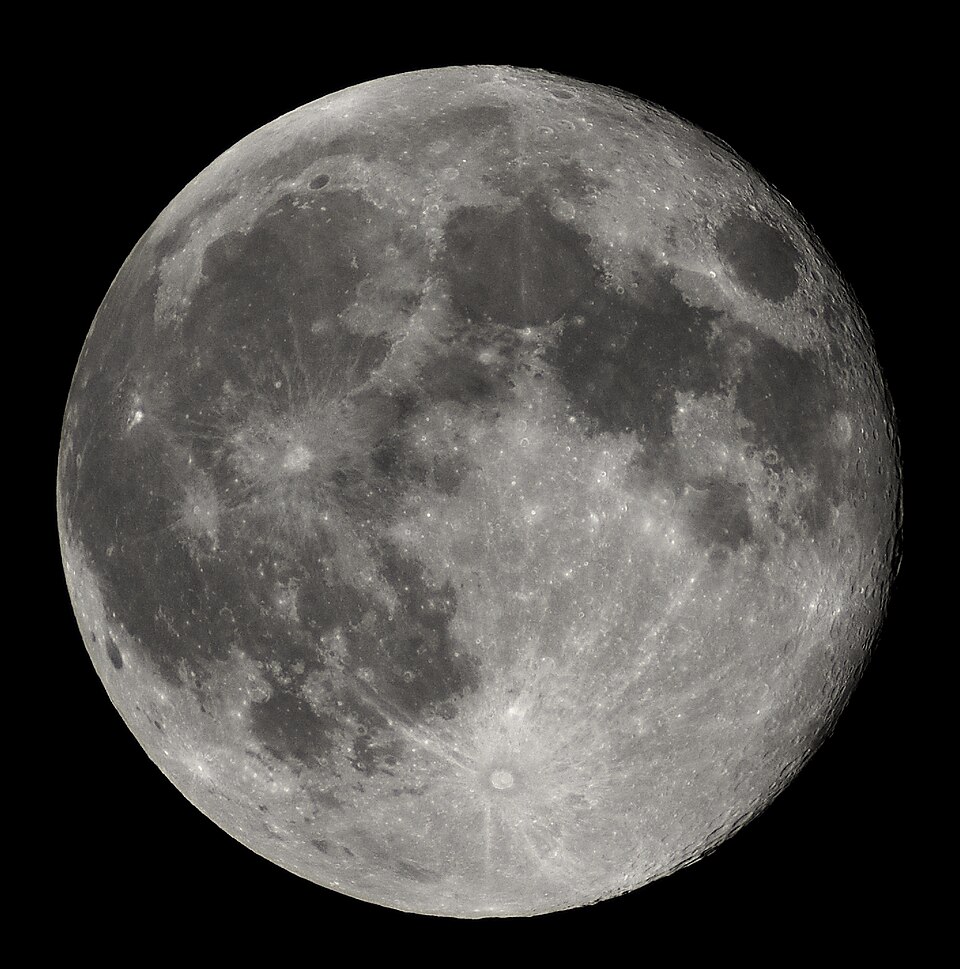
Correct — C, Escape velocity of gas molecules is less than rms velocity. Whether a body holds on to an atmosphere is decided by a single comparison: the escape velocity at its surface against the thermal speeds of the gas molecules there. Escape velocity depends only on the body's mass and radius, v = √(2GM/R), and for the Moon it works out at about 2.4 kilometres per second against roughly 11.2 for the Earth — the Moon has about one-eightieth of the Earth's mass, and although it is also smaller, the mass term dominates. Molecular speed depends on temperature and on molecular mass, through the root-mean-square speed v = √(3RT/M), and it is not a single value: the molecules of a gas are spread over a distribution, so a fraction of them always move much faster than the average. On the Moon that fraction exceeds 2.4 kilometres per second, so those molecules leave, and the distribution then repopulates its fast tail as the remaining gas re-equilibrates, and they leave too. Over geological time the whole atmosphere bleeds away. The light gases go first, because at a given temperature a lighter molecule moves faster — which is why hydrogen and helium are scarce even in the Earth's atmosphere while nitrogen and oxygen are retained. The option's wording is loose in exactly the way examination options often are: read strictly it should say that the escape velocity is less than the molecular speeds, not that gas molecules have an escape velocity of their own. But the physical criterion it names — escape velocity compared with rms velocity — is the correct one, and no other option names a criterion at all.
- (a)It revolves around Earth — Orbiting a planet has nothing to do with atmospheric retention, and there is a decisive counter-example: Titan revolves around Saturn and carries an atmosphere denser at the surface than the Earth's, made mostly of nitrogen. Titan holds it because it is more massive than the Moon and far colder, which lowers molecular speeds — the same escape-velocity criterion, applied to different numbers.
- (b)It gets light from Sun — True of every body in the solar system, including Venus with its crushing carbon dioxide atmosphere and Jupiter with its enormous one. A property shared by bodies with and without atmospheres cannot explain why one of them lacks an atmosphere. Sunlight does matter indirectly, by setting surface temperature and so molecular speeds, but the option does not say that.
- (d)It is closer to Earth — Proximity to the Earth is not a cause. If it were, the Earth's own atmosphere would be the first casualty. The governing quantity is the Moon's own small mass and hence its low surface gravity and low escape velocity — a property of the Moon alone, which would be unchanged if it orbited at twice the distance.
Atmospheric retention is a contest between gravity and heat. Escape velocity, √(2GM/R), is the speed at which a projectile launched from a surface will never fall back; it is about 11.2 kilometres per second for the Earth, 2.4 for the Moon, 5.0 for Mars, 10.4 for Venus and 59.5 for Jupiter. Molecular speed, from the kinetic theory of gases, is √(3RT/M) for the root-mean-square value — proportional to the square root of absolute temperature and inversely proportional to the square root of molecular mass. The rule of thumb used by planetary scientists is that a body retains a gas over the age of the solar system if its escape velocity is roughly six times the rms speed of that gas, because the fast tail of the distribution does the escaping long before the average molecule does. That single comparison explains the whole solar system: giant planets are massive and cold and keep even hydrogen; the Earth is massive enough to keep nitrogen and oxygen but loses hydrogen and helium; Mars, smaller, has kept only a thin carbon dioxide atmosphere; and the Moon and Mercury have effectively none.
Read a 'why' question of this kind by asking which option states a CAUSAL MECHANISM and which merely state true facts about the object. Revolving around the Earth is true of the Moon; receiving sunlight is true of the Moon; being close to the Earth is true of the Moon. None of the three is a mechanism that could remove a gas, and each is also true of bodies that do have atmospheres. Only option (c) names a physical criterion — a comparison between two speeds — and it is the criterion the syllabus actually teaches. That habit generalises: in explanation questions, eliminate the options that are descriptions rather than causes, and the field usually collapses to one. It is also worth being precise about what 'no atmosphere' means. The Moon is not a perfect vacuum; it has an extremely tenuous surface-bounded exosphere of helium, argon, neon and other species, at a pressure something like a hundred-trillionth of the Earth's, continually replenished by solar wind and radioactive decay and continually lost. For every purpose an examination cares about, it has none.
- Escape velocity is v = √(2GM/R): about 2.4 km/s at the Moon's surface against about 11.2 km/s at the Earth's.
- Root-mean-square molecular speed is v = √(3RT/M) — proportional to the square root of absolute temperature and inversely proportional to the square root of molecular mass, so lighter gases escape first.
- The Moon has roughly one-eightieth of the Earth's mass and about a quarter of its radius, which is why its surface gravity is about one-sixth of the Earth's.
- Titan, a moon of Saturn, has a nitrogen atmosphere denser at the surface than the Earth's — proof that orbiting a planet does not prevent atmospheric retention; it is more massive than the Moon and far colder.
- The Moon does retain an extremely tenuous surface-bounded exosphere of helium, argon and neon at about a hundred-trillionth of Earth's surface pressure, continually replenished and continually lost.
- Choosing an option because it states a true fact about the Moon. Revolving around the Earth and receiving sunlight are both true, and neither is a cause of anything here.
- Assuming a satellite cannot have an atmosphere. Titan has a denser one than the Earth's at the surface.
- Saying the Moon has no gas at all. It has a vanishingly thin exosphere — negligible for every practical purpose, but not literally zero.
BPSC asks physics as a one-line causal explanation with three descriptive decoys, so the mark goes to whoever can tell a mechanism from a fact. UPSC asks the same gravitation content quantitatively — what happens to mass and weight on the Moon, how orbital speed relates to altitude — or wraps it inside a question about planetary atmospheres and climate.
The mass of a body on Earth is 100 kg (acceleration due to gravity, gₑ = 10 m/s²). If acceleration due to gravity on the Moon = gₑ/6, then the mass of the body on the moon is
- (a) 100/6 kg
- (b) 60 kg
- (c) 100 kg
- (d) 600 kg
Answer(c) 100 kg
The same lunar gravity from the other side. The Moon's surface gravity is about one-sixth of the Earth's — the fact behind its low escape velocity — but mass is a property of the body and does not change; only weight does. Both questions are testing whether a candidate reasons from the formula rather than from intuition.
What is the primary objective of the Lunar Trailblazer mission?
- (a) To detect and map water on the Moon’s surface
- (b) To create a 3D model of the entire Moon
- (c) To test new lunar rovers
- (d) More than one of the above
Answer(a) To detect and map water on the Moon’s surface
The 71st CCE asked about the search for lunar water, which is the practical consequence of this card's physics. Because the Moon cannot hold an atmosphere, water can survive only as ice in permanently shadowed polar craters where it is never warmed enough to escape — which is precisely what such missions go looking for.
- practice — not a real PYQ
The escape velocity at the surface of a planet depends on
- (a)the mass of the escaping body only
- (b)the mass and radius of the planet
- (c)the temperature of the planet's atmosphere only
- (d)the planet's distance from the Sun
Answer(b) the mass and radius of the planet — escape velocity is √(2GM/R), and the mass of the escaping object cancels out entirely, which is why a molecule and a rocket need the same escape speed.
- practice — not a real PYQ
Which of the following gases escapes most readily from a planetary atmosphere at a given temperature ?
- (a)Nitrogen
- (b)Oxygen
- (c)Hydrogen
- (d)Carbon dioxide
Answer(c) Hydrogen — root-mean-square speed varies inversely with the square root of molar mass, so the lightest gas moves fastest and its molecules cross the escape threshold first. This is why hydrogen and helium are scarce in the Earth's atmosphere while nitrogen and oxygen are retained.