
 View answer copy →
Junaid AhmadAIR 3CSE 2018
Answered a very similar question
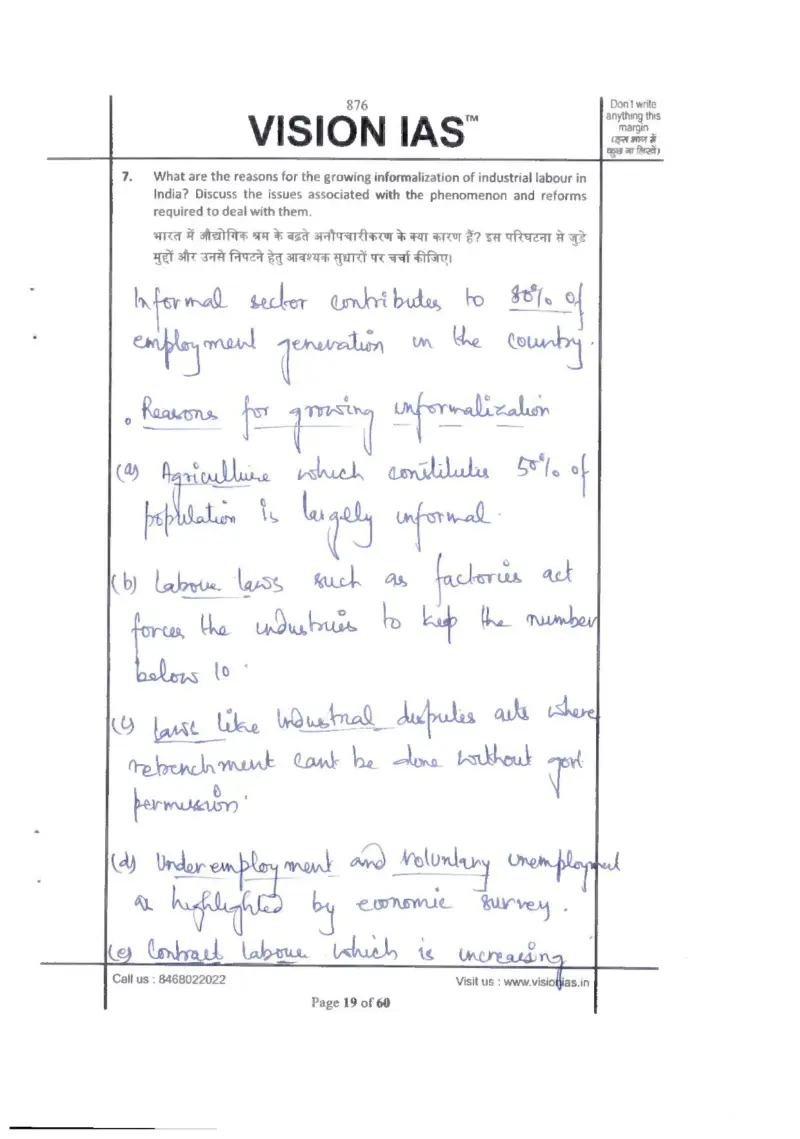
Their question: “Growing informalization of industrial labour — reasons, issues, reforms (attempted)”
The topper's answer on the reasons, issues and labour reforms behind growing informalization is directly the material the 2016 PYQ demands on informalization and whether it is detrimental to development.
Key learnings from their answer
- ›Junaid opens almost every answer with a hard data hook in the very first line, Q1 leads with 'India stands at 130 out of 190 countries', Q6 with SMEs being '~38% of GDP and over 8 crore people', Q8 with per-capita energy figures (~1075 kWh rising to ~5000 kWh by 2050), Q10 with network lengths (~66,000 km railways, ~50 lakh km roads). -> Don't warm up with a generic definition; lead with one specific number that frames the issue, so the examiner sees command of facts in the first sentence.
- ›He runs an identical, scannable skeleton across all answers, context/definition, then '•' thematic headers (Importance / Challenges / Steps taken by govt), then lettered (a)-(d) sub-parts, then a one-line forward-looking conclusion, using arrow-led (->) nested micro-bullets instead of long paragraphs. -> Build one reusable answer template you can deploy under time pressure so structure becomes automatic and every point is instantly locatable by the examiner.
What they cited: Informalization: Factories Act, Industrial Disputes Act; India Skill Report (~2.13% formally skill-trained); PMKVY, DDUGKY; Rajasthan factory-act amendment; textiles/MSME