
 View answer copy →
Utkarsh PathakRank 88CSE 2024
Answered a very similar question
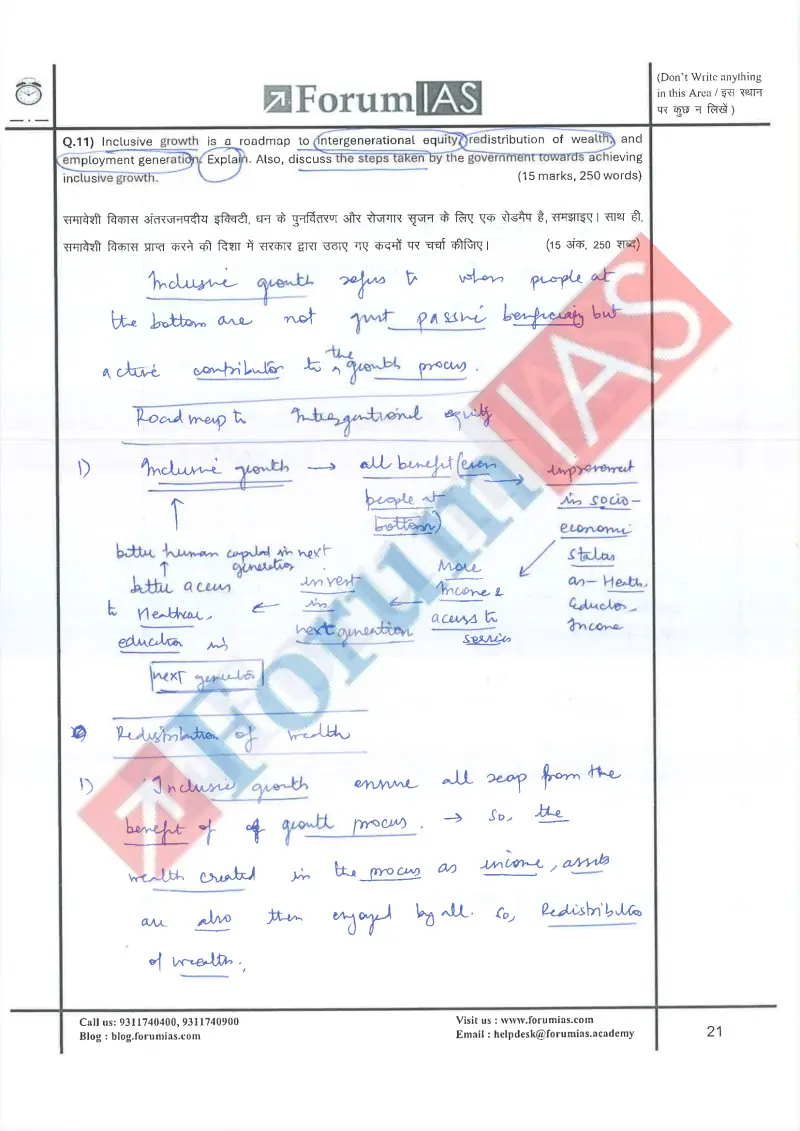
Their question: “Inclusive growth as roadmap to intergenerational equity, wealth redistribution, employment; govt steps (15m)”
The topper links inclusive growth explicitly to inter-generational equity and wealth redistribution, which is the precise intersection this PYQ asks about.
Key learnings from their answer
- ›He loads precise, sourced numbers instead of vague claims: Gini coefficient 0.462 to 0.43 (SBI), logistics cost 14-15% of GDP, roadways carrying 68% of freight, NPK use at 8:3:1 against the ideal 4:2:1, ICAR's 100+ climate-resilient varieties, and the space market at ~$8bn growing to $44bn by 2033 -> Memorise a few hard figures with their source per topic; one cited statistic (e.g. '8:3:1 vs ideal 4:2:1') signals depth far more than a paragraph of generalities.
- ›He converts abstract relationships into visuals tailored to the question: a hand-drawn India map marking the Golden Triangle and Golden Crescent (Q10), a 5G-vs-4G comparison table across speed/bandwidth/latency (Q16), an FPI hub-and-spoke diagram linking farmers F1-F7 (Q14), and 'virtuous cycle' arrow flowcharts for growth (Q1) and intergenerational equity (Q11) -> Match the diagram type to the content - a map for geography, a table for comparisons, a hub-and-spoke for one-to-many linkages, a cycle for feedback loops - so the visual actually carries argument instead of decorating.
- ›He carves every answer into demand-wise underlined sub-headings that mirror the exact parts of the question - e.g. Q4 on cropping patterns splits into 'Socio-economic consequences' then 'Consequences on environment', and Q2 on forex into 'Dependence on quantity' vs the strategy/sources angle -> Read the question for its distinct demands and turn each one into a literal heading, so the examiner sees you addressed every part rather than writing one undifferentiated block.
What they cited: SBI report Gini coefficient 0.462 to 0.43; Oxfam (1% holds 40% wealth); PM-SVANidhi, Mudra, Startup India, RAMP, PM-FBY, PM-APY, SHGs (Q11)