 View answer copy →
Anudeep DurishettyAIR 1CSE 2017
Answered a very similar question
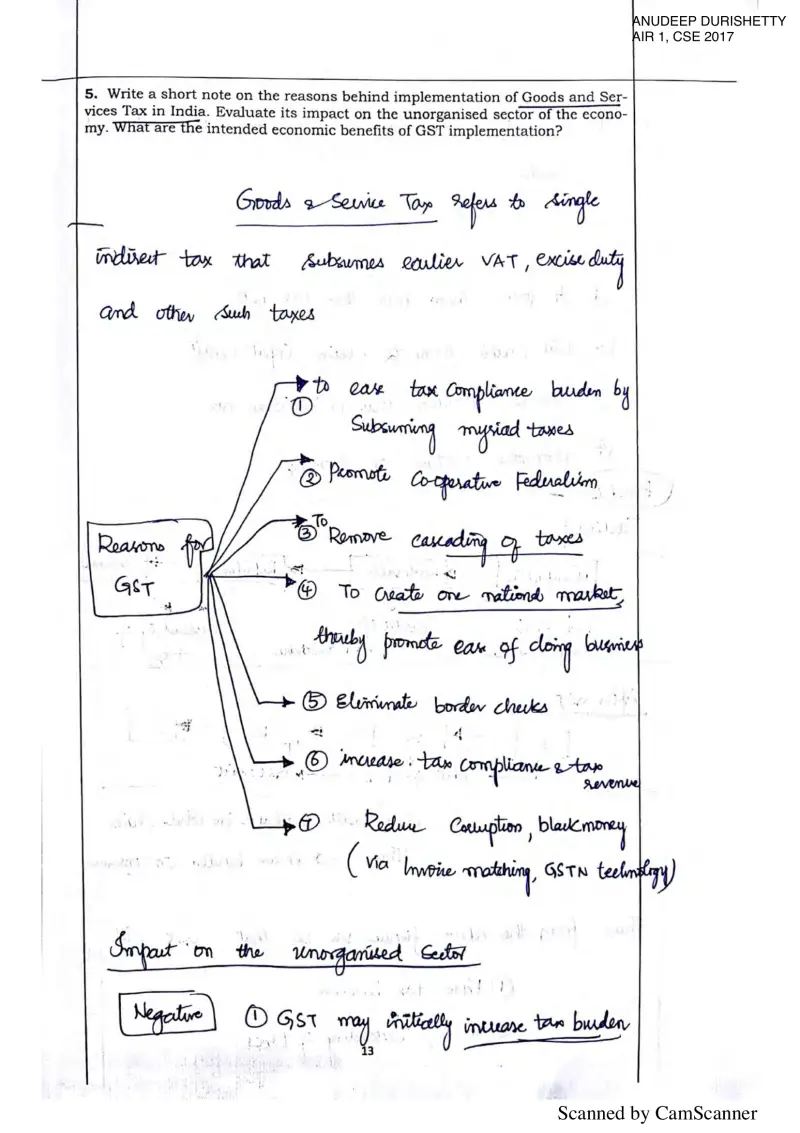
Their question: “GST: reasons for implementation, impact on the unorganised sector, intended benefits”
Anudeep's Q5 lays out the rationale and intended benefits of GST (one-nation-one-tax, self-policing, cooperative federalism), the introduction rationale 2013 Q10 asks for.
Key learnings from their answer
- ›Despite a strict ~200-word limit he keeps a consistent visual template in almost every answer, a boxed/underlined sub-heading ('Way Ahead', 'Reasons for GST', 'self policing') followed by numbered points and arrow-led spider mind-maps or process box-chains (e.g. Farm loan waiver -> fiscal burden -> more borrowing -> inflation/low growth, Q16). -> Use sub-headings and arrow chains to compress cause-effect logic into minimal words; structure itself becomes the time-saver that lets you cover more dimensions within the word limit.
- ›He anchors claims in specific named data and reports rather than adjectives, R&D spend 'India 0.7% vs China 1.7% vs S Korea 3%' (NITI Aayog, Q11), 'roads = 2% of network but 40% of goods' (Q15), Economic Survey '10.6 million youth enter workforce every year' (Q4/Q8), EoDB rank '130/189' (Q8), ISA solar '175 W/m²' (Q6). -> Replace vague phrases like 'low spending' or 'huge workforce' with a sourced figure; one precise comparative statistic per argument lifts an answer from generic to authoritative.
What they cited: Q5: GSTN, invoice matching, 'self policing', cooperative federalism, one-nation-one-tax
Quotes used: “'self policing' — used as a GST benefit heading (Q5)”