
 View answer copy →
Raj Krishna JhaRank 8CSE 2024
Answered a very similar question
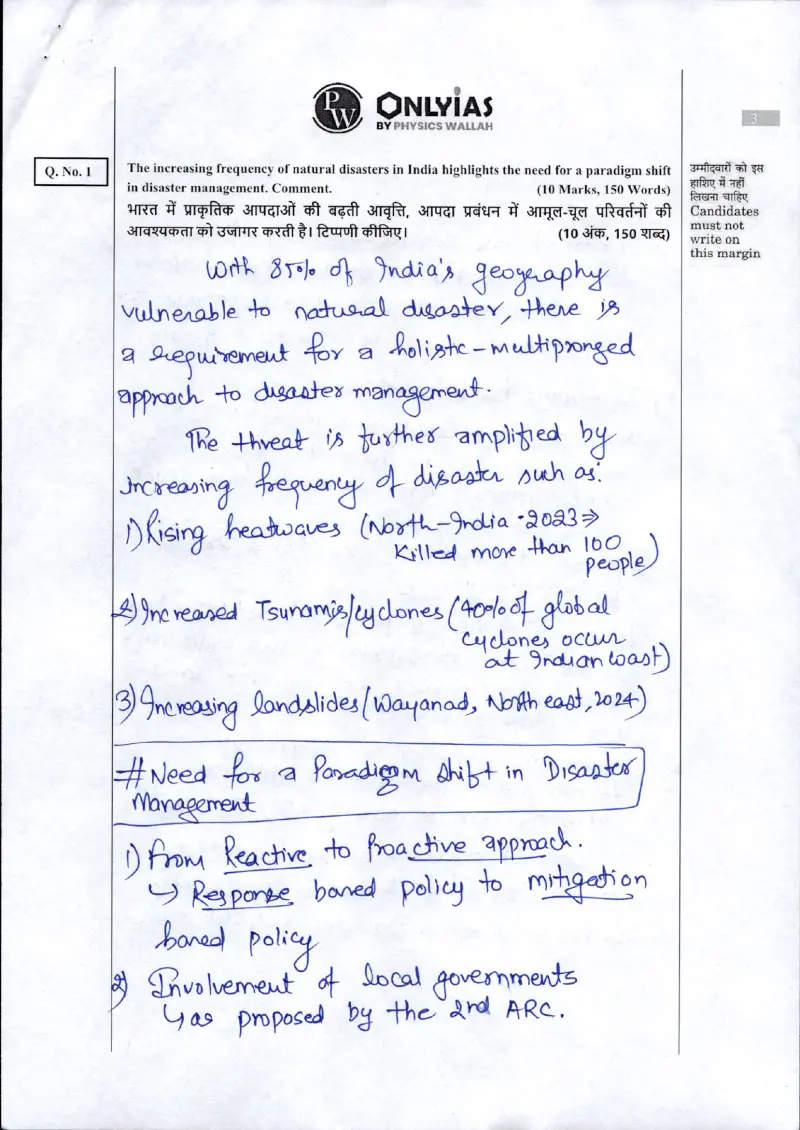
Their question: “Paradigm shift in disaster management amid rising frequency of natural disasters (10 marks, 150 words)”
The topper frames the shift from reactive to proactive disaster management anchored in named policy frameworks, exactly the 'departing from the earlier reactive approach' the PYQ asks for.
Key learnings from their answer
- ›Every single answer opens with a quantified hook that frames the scale before any argument begins, '85% of geography vulnerable', '12% flood-prone', '7576 km coast', '40% of global cyclones occur at the Indian coast'. -> Don't start a GS3 answer with a definition; open with one hard statistic that quantifies the problem's magnitude, so the examiner sees you grasp the scale in the first line.
- ›Solutions are consistently anchored to named frameworks and committees instead of vague suggestions, Sendai, Hyogo and Yokohama frameworks, 2nd ARC recommendations, and the Gadgil & Kasturirangan committees on the Western Ghats. -> Tie every 'way forward' to a specific report or framework by name; it signals you know the actual policy architecture rather than improvising remedies.
- ›Value-addition is built in without padding, a 'RESILIENT' mnemonic to structure the 2nd ARC capacity-building answer (Q6) and a 'glocalization' framing (with CBDR, WHO, adaptation-mitigation) to critically examine localizing global DRR frameworks (Q7). -> One memorable coined term or acronym per high-mark answer gives the examiner a hook to remember your script by; deploy it sparingly on the 15-markers, not everywhere.