
 View answer copy →
Kanishak KatariaAIR 1CSE 2018
Answered a closely related question
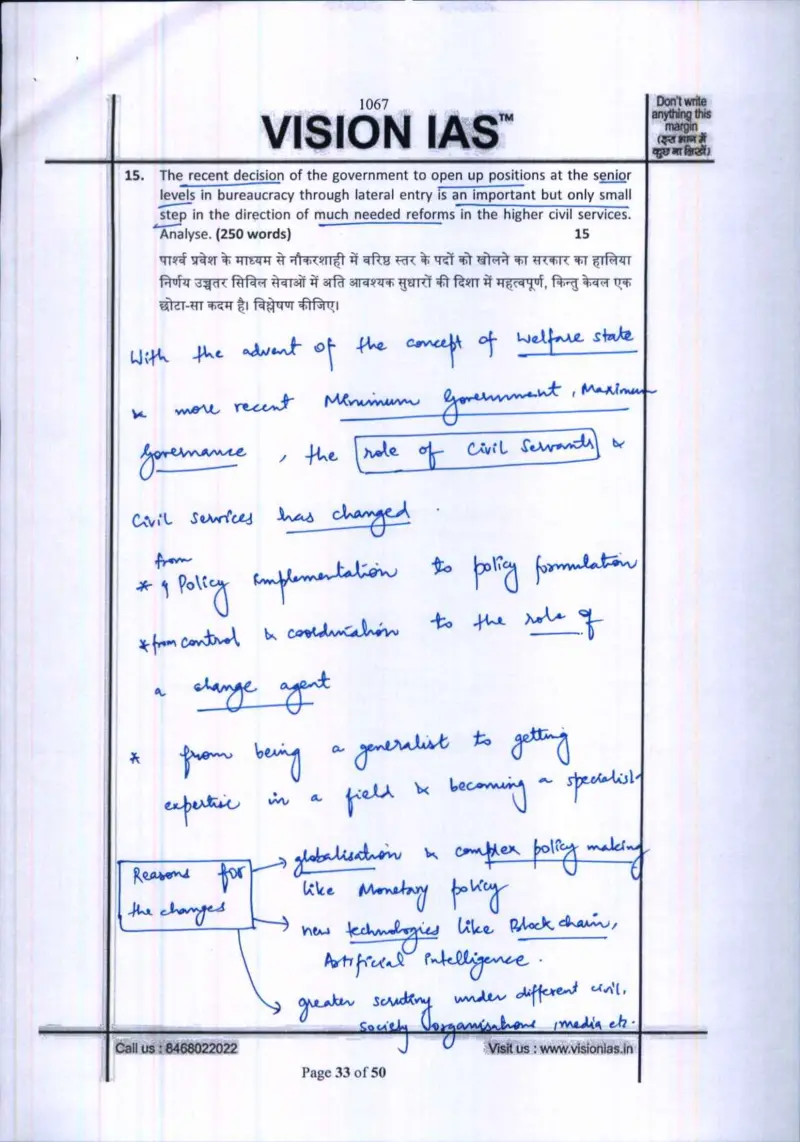
Their question: “Lateral entry into senior bureaucracy as a small step in higher civil-service reforms; analyse”
The topper's take on lateral entry and 2nd ARC reforms provides concrete measures for the PYQ asking to suggest civil-service reforms for strengthening democracy.
Key learnings from their answer
- ›He varies the answer format to fit the demand: BRICS vs IBSA (Q10) is written as a clean two-column side-by-side comparison rather than paragraphs, and NITI Aayog (Q3) and the NCM mandate (Q14) are rendered as boxed mind-map/flow diagrams with branching arrows instead of prose. -> When a question is explicitly comparative or asks for challenges/measures, switch to a two-column or boxed-flow layout, it saves time, signals structure to the examiner, and is ideal for short 10-markers.
- ›Kanishak opens analytical answers with a sharp hook instead of a textbook definition: Q4 (Article 356/Bommai) begins by quoting Ambedkar's Constituent Assembly line that Article 356 should remain a 'dead letter', and Q9 frames Strategic Autonomy through PM Modi's Shangri-La Dialogue. -> Lead a 'comment/critically analyse' answer with a one-line authoritative quote or a topical real-world anchor so the very first sentence signals depth and sets up your argument.
What they cited: Lateral entry; 2nd ARC recommendations; VRS for non-performers; citizen charters; 'Maximum Governance, Minimum Government'; blockchain and Artificial Intelligence as policy complexities (Q15)