
 View answer copy →
Jagrati AwasthiAIR 2CSE 2020
Answered a very similar question
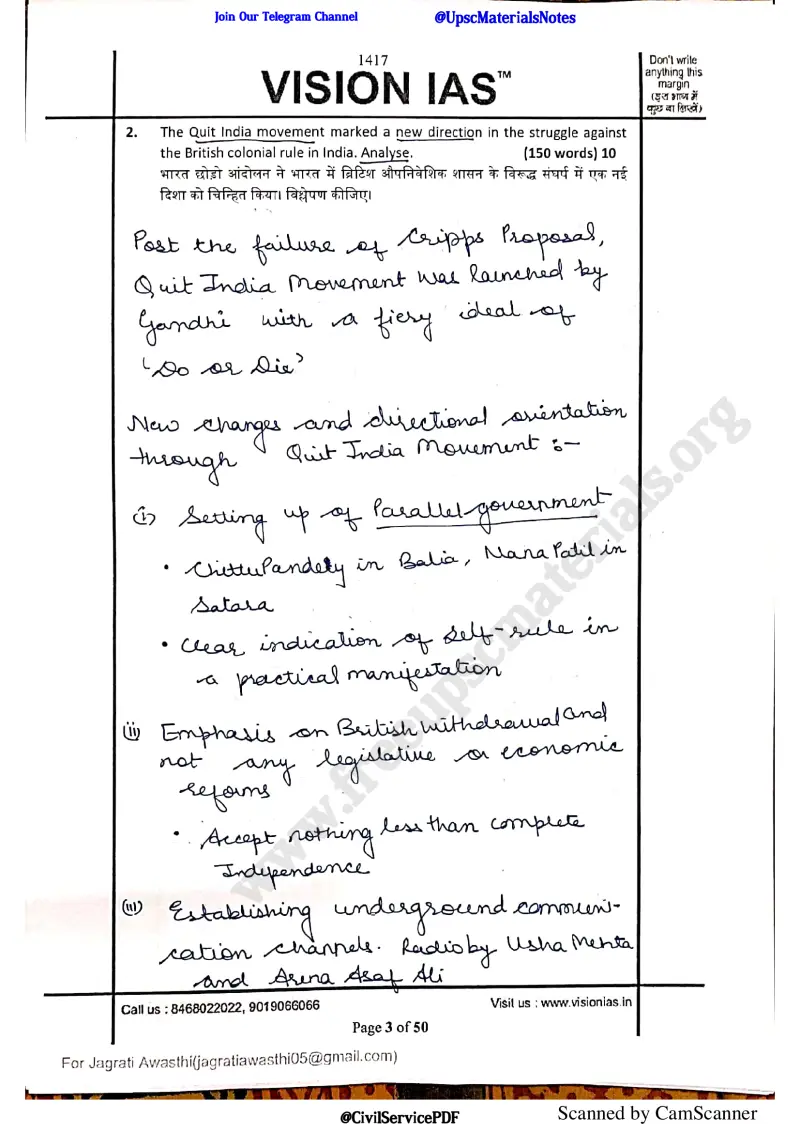
Their question: “Quit India movement marked a new direction in the struggle against British colonial rule - Analyse (10m, 150w)”
The topper's Quit India answer (Cripps trigger, 'Do or Die', parallel governments, August Revolution) supplies both the events leading to and the results of the movement the PYQ demands.
Key learnings from their answer
- ›She runs a single repeatable template across nearly every answer: a one-line definitional intro ('Naoroji is often referred to as the Grand Old Man of India...'; 'Social security refers to guarantee of a good standard of life...'), Roman-numeral body points each capped by a concrete 'Eg', and a short thesis-linked conclusion (urban forests as a 'tool for Sustainable Development', eco-tourism tied to 'Incredible India'). -> Build one disciplined intro-points-with-examples-conclusion template you can deploy under time pressure so every answer is fast to skim and structurally complete.
- ›She closes value-laden answers with a named thinker's line rather than a vague summary: Q5 on social security ends with 'According to Ambedkar, social equality is a prelude to democracy.' -> End such answers with one attributed, on-thesis quote from a constitutional figure to lift the conclusion above a routine recap.
What they cited: Q2 Quit India: Cripps Proposal, 'Do or Die', parallel governments (Chittu Pandey in Ballia, Nana Patil in Satara), underground radio by Usha Mehta and Aruna Asaf Ali, 'August Revolution', Muslim League's separate Pakistan demand
Quotes used: “'Do or Die' (Q2, attributed to Gandhi's ideal for Quit India)”