
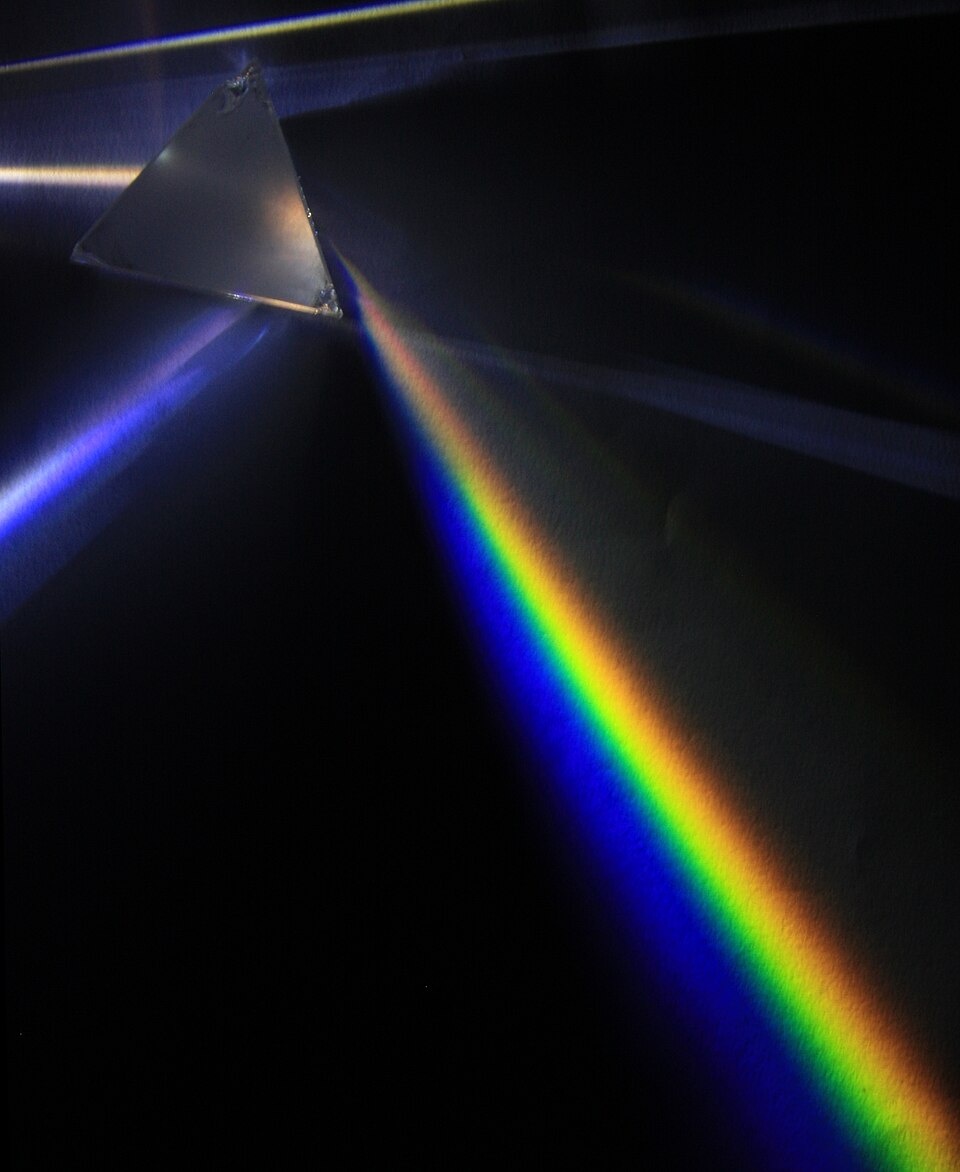
When sunlight (white light) falls on a triangular glass prism, a band of colours called a spectrum is obtained. Which one among the following represents this effect appropriately?
- (a)Reflection
- (b)Diffraction
- (c)Refraction
- (d)Dispersion
Correct — D, Dispersion. The splitting of white light into its component colours is called dispersion, and the stem describes exactly that — a band of colours, a spectrum, produced when sunlight passes through a triangular glass prism. Refraction is the underlying mechanism, since the light bends at each glass surface, but refraction alone does not separate colours; separation happens because the refractive index of glass differs slightly for each wavelength, so violet bends most and red least. The name for that colour-separating effect is dispersion, which is the term the question is asking for.
- (a)Reflection — Reflection is light bouncing back from a surface. Some light is reflected at the prism's faces, but reflection does not separate white light into colours; a plane mirror shows a white image, not a spectrum.
- (b)Diffraction — Diffraction is the bending of light around obstacles or through narrow openings and can also produce colours, as a diffraction grating or a compact disc does. It is not the prism mechanism, which depends on refraction at plane surfaces.
- (c)Refraction — Refraction is the bending of light as it changes medium, and it is genuinely the mechanism at work inside the prism. But refraction is what happens to a single colour; the specific phenomenon of white light separating into a spectrum has its own name, and the question asks for the effect, not the mechanism.
When light enters a denser medium it slows and bends, and the amount of bending is set by the refractive index. That index is not the same for every wavelength: for glass it is a little higher for violet light than for red, so violet is deviated most and red least. In a triangular prism the two refracting surfaces are inclined, so the deviations at the two faces add instead of cancelling as they do in a parallel-sided slab, and the colours emerge along visibly different paths. Newton showed with a second, inverted prism that the colours can be recombined into white light, proving that the prism separates what was already there rather than creating colour.
The pull here is towards refraction, because refraction really is what the prism does to the light. Read the stem closely: it describes the result — a band of colours called a spectrum — and asks which option represents that effect. The effect of splitting white light by wavelength has a specific name, and 'dispersion' is that name; 'refraction' would be the correct answer to a question about why a stick looks bent in water. This card marks a different letter from the answer we hold on file for this question.
- Dispersion is the splitting of white light into its constituent colours.
- It occurs because the refractive index of a medium varies with wavelength.
- Violet suffers the greatest deviation and red the least, so the spectrum runs red at one end to violet at the other.
- A parallel-sided glass slab disperses on entry but recombines on exit, which is why it shows no spectrum.
- Newton recombined the spectrum with a second inverted prism, showing that white light is a mixture.
- Answering 'refraction' because it is the mechanism; the question names the effect.
- Confusing dispersion with scattering — scattering explains the blue sky, dispersion the prism spectrum.
- Assuming a glass slab will show a spectrum; its two parallel faces undo the separation.
A one-word naming item that separates candidates who know the mechanism from those who know the mechanism's name.
A glass prism splits white light into different colours. This phenomenon is called dispersion of light by prism. Which one of the following statements is correct?
- (a) Red light will deviate the most and it is because of the reflection of light.
- (b) Violet light will deviate the most and it is because of the refraction of light.
- (c) Red light will deviate the most and it is because of the refraction of light.
- (d) Violet light will deviate the most and it is because of the reflection of light.
Answer(b) Violet light will deviate the most and it is because of the refraction of light.
Its stem names the phenomenon outright — the splitting of white light by a prism is called dispersion — and its keyed option separates the effect from the mechanism in exactly the way this question requires.
Name the scientist who first used a glass prism to obtain the spectrum of sunlight
- (a) C. V. Raman
- (b) Lord Rayleigh
- (c) Isaac Newton
- (d) S. Chandrasekhar
Answer(c) Isaac Newton
The history behind the term. Newton's two-prism experiment showed that the prism separates colours already present in white light rather than manufacturing them.
When a white light beam is made to fall on a hollow prism filled with water, it breaks into seven constituent colours. Which of the following colours suffers the maximum angle of deviation?
- (a) Red
- (b) Violet
- (c) Green
- (d) All suffer by equal amount of deviation
Answer(b) Violet
The same prism, one step further in. Once the effect is named as dispersion, the natural follow-up is which colour is bent most, and it is violet because the refractive index is greatest for the shortest wavelength.
- practice — not a real PYQ
Which colour of white light is deviated the most when passing through a glass prism?
- (a)Red
- (b)Green
- (c)Yellow
- (d)Violet
Answer(d) Violet — the refractive index of glass is highest for violet, so it bends most; red bends least.
- practice — not a real PYQ
A rainbow is formed in the sky by which combination of effects in water droplets?
- (a)Reflection and diffraction only
- (b)Refraction, dispersion and internal reflection
- (c)Scattering alone
- (d)Absorption and re-emission
Answer(b) Refraction, dispersion and internal reflection — light refracts and disperses entering the drop, reflects inside it, and refracts again on the way out.