
Abdur Razzak, the traveler to Vijayanagar, had referred to the presence of a number of flower merchants in Vijayanagar and noted a particular flower that seemed as necessary as food to the people of that part. Which variety of flower was being referred to by Abdur Razzak?
- (a)Jasmine
- (b)Lotus
- (c)Hibiscus
- (d)Rose
Correct — D, Rose. Abdur Razzaq, the Persian ambassador sent by the Timurid ruler Shah Rukh, was at Calicut and Vijayanagara between 1442 and 1445, and his account is one of the fullest descriptions of the capital in its prime. Writing of the bazaars he notes that roses were sold everywhere, that the people could not live without them, and that they looked upon roses as quite as necessary as food. The remark stands out because it is one of the few passages in which a foreign visitor records a habit of ordinary consumption rather than the wealth of the court.
- (a)Jasmine — Jasmine is the flower most associated with south Indian daily use today, which is exactly why it is offered here. Abdur Razzaq's passage names the rose.
- (b)Lotus — The lotus carries heavy religious and artistic meaning in India, but it is not the flower Abdur Razzaq describes as being sold in the markets as a daily necessity.
- (c)Hibiscus — Hibiscus is a temple flower in the south, particularly in the worship of the goddess, and does not appear in this account as an article of everyday trade.
Vijayanagara is known largely through foreign eyes. Abdur Razzaq came from Herat in the 1440s; Nicolo Conti, a Venetian, saw the city about 1420; Domingo Paes and Fernao Nuniz, both Portuguese, wrote in the reign of Krishnadevaraya and after. Their accounts supply the descriptions of markets, festivals, fortifications and irrigation that the inscriptions and the ruins alone would not give.
The flower is a small detail with a large purpose in the syllabus: it is the kind of concrete quotation that separates a candidate who has read the sources from one who has read a summary of them. Two habits help. First, tie each traveller to a ruler and a decade — Abdur Razzaq to Devaraya II in the 1440s, Paes and Nuniz to Krishnadevaraya and his successor. Second, remember what each is quoted for. Abdur Razzaq is quoted for the seven concentric fortifications, the bazaars and the roses; Paes for the city being as large as Rome and for the Mahanavami festival.
- Abdur Razzaq was the ambassador of the Timurid ruler Shah Rukh and visited Vijayanagara in 1443, during the reign of Devaraya II.
- His account describes seven lines of fortification and the bazaars of the capital.
- He records that roses were sold everywhere and were considered as necessary as food.
- Nicolo Conti from Venice, and Domingo Paes and Fernao Nuniz from Portugal, are the other principal foreign witnesses to the city.
- His travel narrative is known as the Matla-us-Sadain wa Majma-ul-Bahrain.
- Choosing jasmine because it is the flower most used in south India today.
- Confusing Abdur Razzaq with Ibn Battuta, who came a century earlier to the Delhi Sultanate.
- Attaching the Portuguese accounts of Paes and Nuniz to the wrong century.
A source-quotation item, testing recall of a specific detail from a named traveller rather than a general fact about the empire.
Domingo Paes, the medieval traveller, has described the city of
- (a) Madurai
- (b) Vijayanagara
- (c) Arikamedu
- (d) Gingee
Answer(b) Vijayanagara
The other great eyewitness to the same capital, and a reminder that the examiners test these visitors by name. Paes wrote under Krishnadevaraya, three-quarters of a century after Abdur Razzaq.
At which one of the following places is the Vitthala temple located?
- (a) Elephanta
- (b) Chidambaram
- (c) Hampi
- (d) Nagarjunakonda
Answer(c) Hampi
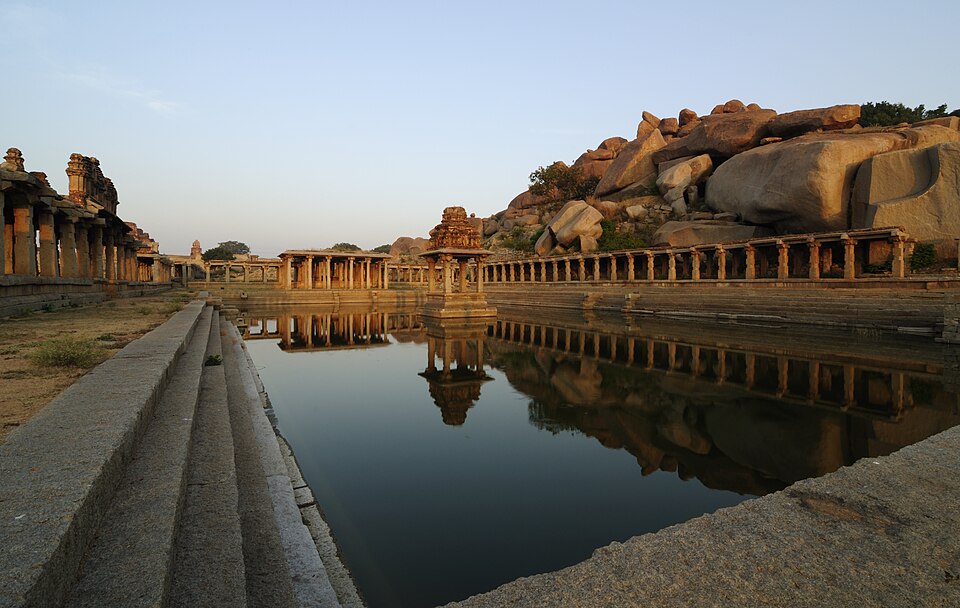
The physical remains of the city these travellers described. The Vitthala complex with its stone chariot stands in the sacred centre of the site at Hampi.
- practice — not a real PYQ
Abdur Razzaq, who has left an account of Vijayanagara, was an ambassador of
- (a)the Ottoman Sultan
- (b)the Timurid ruler Shah Rukh
- (c)the Safavid Shah
- (d)the Bahmani Sultan
Answer(b) the Timurid ruler Shah Rukh — he reached Calicut and then Vijayanagara in 1442-45.
- practice — not a real PYQ
Which foreign traveller compared Vijayanagara in size to the city of Rome?
- (a)Nicolo Conti
- (b)Domingo Paes
- (c)Ibn Battuta
- (d)Marco Polo
Answer(b) Domingo Paes — the Portuguese visitor who saw the capital under Krishnadevaraya.