
The Junagarh inscription goes on to tell us that during the reign of Rudradaman, in the year 72 of the Saka era, there occurred a terrible storm. What would be the time in CE of the occurrence of that terrible storm ?
- (a)150 CE
- (b)181 CE
- (c)130 CE
- (d)120 CE
Correct — A, 150 CE. The Saka era, the reckoning used by the Western Kshatrapa rulers and later adopted as India's national calendar, begins in 78 CE. Converting a Saka year to the Common Era therefore means adding 78: Saka 72 plus 78 gives 150 CE. That is the date historians assign to the storm that burst the embankment of the Sudarshana lake, an event the Junagadh rock inscription of Rudradaman records along with the repair he ordered.
- (b)181 CE — 181 would follow from adding 109, which corresponds to no Indian era. The Saka epoch is 78 CE.
- (c)130 CE — 130 CE is close to the start of Rudradaman's reign but does not come from the conversion. Adding 78 to 72 gives 150.
- (d)120 CE — 120 would need an epoch of 48 CE. No era of Indian chronology begins in that year.
Indian inscriptions are dated in several eras, and each needs its own conversion. The Vikrama era begins in 58 BCE, so its years run about 57 ahead of the Common Era. The Saka era begins in 78 CE, so 78 is added. The Gupta era begins in 319-320 CE and the Harsha era in 606 CE. The Saka reckoning was adopted as the national calendar of India in 1957 alongside the Gregorian.
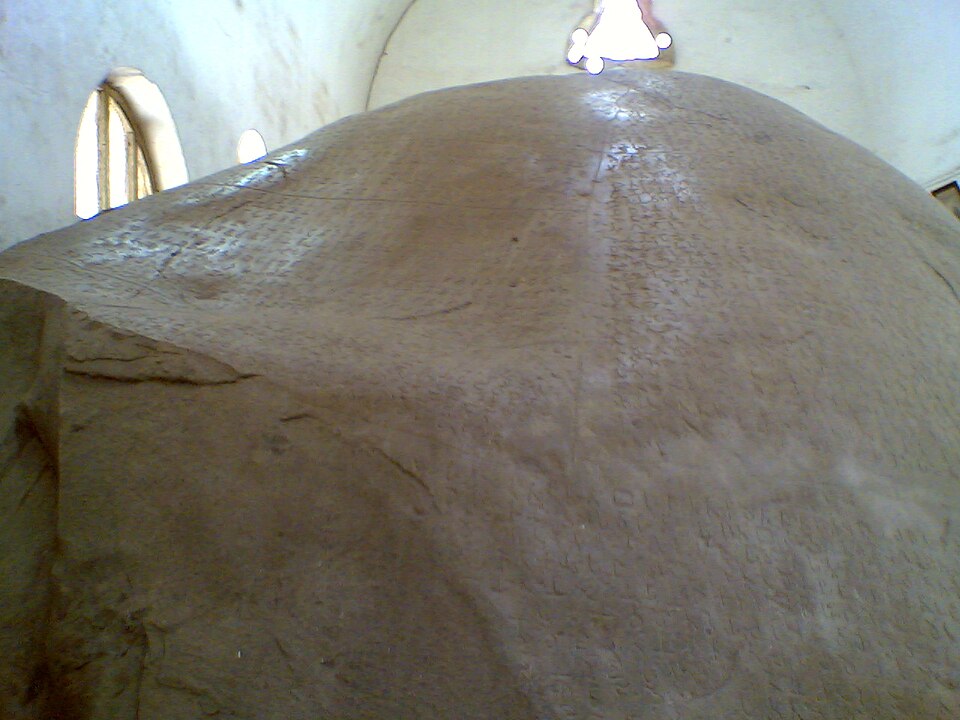
The Junagadh rock is one of the most quoted objects in early Indian history, and for more than the date. The same boulder carries an edict of Ashoka, this inscription of Rudradaman and a much later inscription of Skandagupta. Rudradaman's text is the earliest long inscription in fairly polished Sanskrit rather than Prakrit, which is why it marks a turning point in epigraphy. It records that the Sudarshana reservoir was originally built under Chandragupta Maurya by the governor Pushyagupta and given conduits under Ashoka by Tushaspha, and that Rudradaman repaired the breach from his own treasury without laying a forced levy on his subjects. The paper prints the place as Junagarh; the standard spelling today is Junagadh.
- The Saka era begins in 78 CE; add 78 to convert a Saka year to CE.
- Saka 72 corresponds to 150 CE, the date of the storm recorded in the inscription.
- The Junagadh rock inscription of Rudradaman I is the earliest long inscription in polished Sanskrit.
- It records the repair of the Sudarshana lake, built under Chandragupta Maurya and improved under Ashoka.
- The same rock carries Ashokan edicts and a later inscription of the Gupta ruler Skandagupta.
- Subtracting 78 instead of adding it, which is the rule for the Vikrama era's relation to CE.
- Confusing the Saka epoch of 78 CE with the Gupta epoch of 319-320 CE.
- Assuming the inscription and the storm must carry different dates.
A one-step chronology conversion, with the marks resting on knowing which era begins in which year.
The Badami rock inscription of Pulakesin I is dated in the Saka year 465. If the same were to be dated in Vikrama Samvat, the year would be
- (a) 601
- (b) 300
- (c) 330
- (d) 407
Answer(a) 601
The identical conversion skill on an inscription two centuries later. Saka 465 becomes 543 CE by adding 78, and then Vikrama 601 by adding a further 57 — the same two epochs this question turns on.
- practice — not a real PYQ
The Saka era, used in the Indian national calendar, begins in
- (a)58 BCE
- (b)78 CE
- (c)248 CE
- (d)320 CE
Answer(b) 78 CE — the Vikrama era begins in 58 BCE and the Gupta era in 319-320 CE.
- practice — not a real PYQ
The Junagadh rock inscription of Rudradaman records the repair of
- (a)the Grand Anicut
- (b)the Sudarshana lake
- (c)the Kallanai dam
- (d)the Bhojpur tank
Answer(b) the Sudarshana lake — an embankment built in Mauryan times and breached in a storm.