
At which one of the following places is the Vitthala temple located?
- (a)Elephanta
- (b)Chidambaram
- (c)Hampi
- (d)Nagarjunakonda
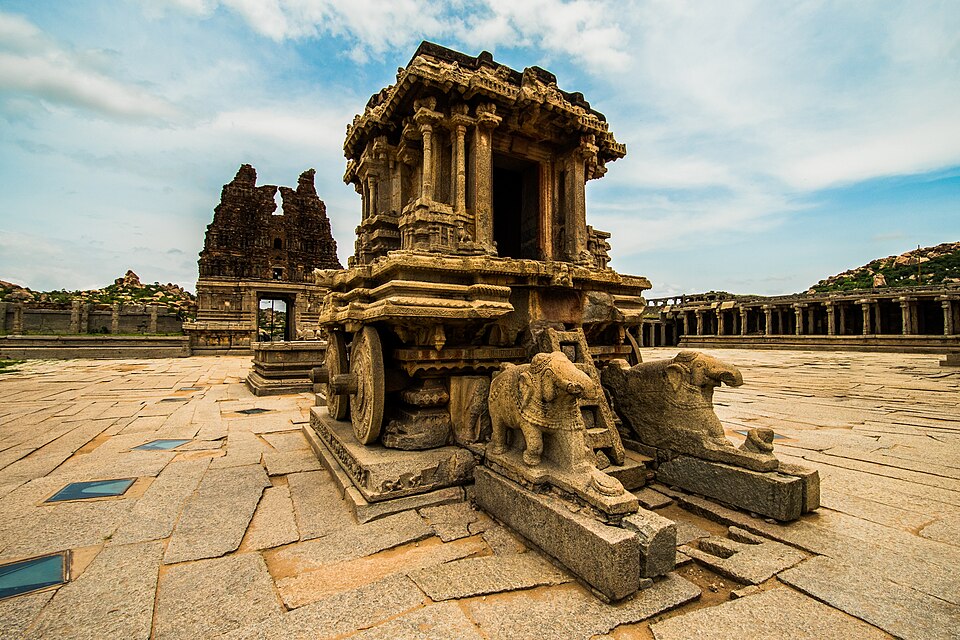
Correct — C, Hampi. The Vitthala temple stands at Hampi in Karnataka, on the Tungabhadra, in what was the capital of the Vijayanagara empire. It is the most elaborate building on the site, begun in the fifteenth century and extended under Krishnadeva Raya and Achyuta Raya, and it is famous for two things — the stone chariot in its courtyard, which is a shrine to Garuda carved to look like a temple car, and the slender pillars of its great hall, which give out musical notes when struck. Vitthala is a form of Vishnu chiefly worshipped at Pandharpur in Maharashtra, and the Vijayanagara rulers brought the cult south into their capital.
- (a)Elephanta — Elephanta, on an island off Mumbai, has a rock-cut Shiva cave with the three-headed Sadashiva image. It is Shaiva, it is cut rather than built, and it belongs to a period many centuries before Vijayanagara.
- (b)Chidambaram — The great temple at Chidambaram in Tamil Nadu is dedicated to Shiva as Nataraja and is associated with the Cholas. It is one of the most famous temples in the south, which is exactly why it appears here.
- (d)Nagarjunakonda — A Buddhist site in Andhra Pradesh, an important centre of the Ikshvaku period, most of which was submerged when the Nagarjunasagar dam was built and whose monuments were moved to higher ground.
Vijayanagara temple architecture is the last great phase of the Dravida tradition. Its marks are the towering gopuram over the gateway rather than over the sanctum, the pillared kalyana mandapa for the ritual marriage of the deity, the amman shrine for the goddess within the same enclosure, and columns carved with rearing animals. Hampi preserves the largest concentration of it, along with the secular buildings of the capital — the Lotus Mahal, the elephant stables and the great platform of the Mahanavami Dibba.
The Vitthala temple is the standard example because it carries every one of those features at once and because the two showpieces are so recognisable. The stone chariot has become one of the most reproduced images of Indian heritage — it is the monument printed on the reverse of the fifty-rupee note issued in 2017. The musical pillars have suffered from exactly that fame, and visitors are no longer allowed to strike them. Hampi as a whole has been on the UNESCO World Heritage list since 1986. Note also how the option list is built: three of the four names are famous sites of very different periods and faiths, so a candidate who can attach a period to each name can reach the answer even without knowing the temple.
- The Vitthala temple is at Hampi in Karnataka, the capital of the Vijayanagara empire on the Tungabhadra.
- Its stone chariot is a shrine to Garuda and appears on the reverse of the fifty-rupee note issued in 2017.
- The pillars of its great hall produce musical notes when struck, which is why they are called musical pillars.
- Vitthala is a form of Vishnu whose principal shrine is at Pandharpur in Maharashtra.
- The Group of Monuments at Hampi has been a UNESCO World Heritage Site since 1986.
- Placing any famous southern temple in Tamil Nadu; Hampi is in Karnataka.
- Confusing the Vitthala temple with the Virupaksha temple, which is also at Hampi and is the site's living shrine.
- Treating Nagarjunakonda as a temple site; it is a Buddhist centre of a much earlier period.
Place-identification items give one monument and four sites. Attach a period and a faith to each site name and the wrong ones fall away without needing the monument at all.
Where is the famous Vijaya Vittala Temple having its 56 carved pillars emitting musical notes located?
- (a) Belur
- (b) Bhadrachalam
- (c) Hampi
- (d) Srirangam
Answer(c) Hampi
The identical question with the musical pillars named in the stem instead of left out. Between the two, the temple has been asked about with and without its most recognisable feature, and the answer is the same place.
Where is the famous Virupaksha temple located ?
- (a) Bhadrachalam
- (b) Chidambaram
- (c) Hampi
- (d) Srikalahasti
Answer(c) Hampi
The other great temple on the same site, and its option list uses Chidambaram as a distractor exactly as this one does. Hampi carries both shrines, so either name should lead to the same place.
Which one of the following is the correct description of Kandaria Mahadeo?
- (a) A Shiva temple at Elephanta
- (b) The title of a work by Bhatti
- (c) The capital of Chandella kings
- (d) A temple at Khajuraho
Answer(d) A temple at Khajuraho
Its twin in this paper, two questions earlier, and built on the same skill. There a temple name has to be matched to Khajuraho and here to Hampi, so both are answered by holding temple names as name-and-place pairs.
- practice — not a real PYQ
The Virupaksha temple, the living shrine of a World Heritage site, is located at
- (a)Badami
- (b)Hampi
- (c)Belur
- (d)Srirangam
Answer(b) Hampi — it stands in the same complex of monuments as the Vitthala temple.
- practice — not a real PYQ
Hampi, the capital of the Vijayanagara empire, stands on the banks of which river?
- (a)The Krishna
- (b)The Kaveri
- (c)The Tungabhadra
- (d)The Godavari
Answer(c) The Tungabhadra — a tributary of the Krishna.