
In which organism did Gregor J. Mendel conduct the experiment to explain principles of inheritance?
- (a)Groundnut
- (b)Garden Pea
- (c)Four O'clock plant
- (d)Fruit fly
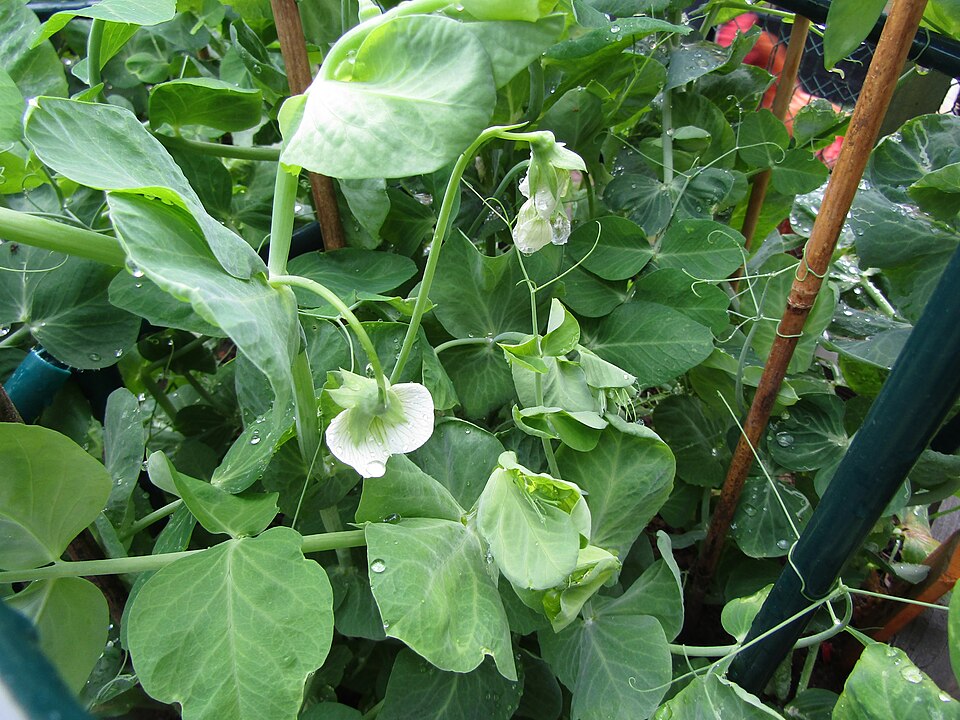
Correct — B, Garden Pea. Gregor Mendel worked on Pisum sativum, the garden pea, in the monastery garden at Brno between 1856 and 1863, and published his results in 1866. He chose the pea for reasons that made the arithmetic possible: it has sharply contrasting characters with no intermediates, such as tall against dwarf and round against wrinkled seed; it is naturally self-pollinating, so true-breeding lines were available; the flower structure allows controlled cross-pollination by removing the anthers; it has a short life cycle and produces many seeds, so ratios could be counted in large numbers. From seven such characters he derived the laws of dominance, segregation and independent assortment.
- (a)Groundnut — The groundnut has no part in Mendel's work. Its flowers are cleistogamous and it buries its developing pods underground, which makes controlled crossing and seed counting far harder.
- (c)Four O'clock plant — The four o'clock plant, Mirabilis jalapa, is the standard example of incomplete dominance, where a red and a white parent give pink offspring. That is the exception to Mendel's dominance rule and was studied by Carl Correns decades later, not by Mendel.
- (d)Fruit fly — The fruit fly, Drosophila melanogaster, was Thomas Hunt Morgan's organism from about 1908 and gave the chromosome theory of inheritance and the discovery of linkage. It came half a century after Mendel.
Mendel's three findings still frame genetics. The law of dominance says that in a hybrid only one of a contrasting pair of characters appears. The law of segregation says the two factors for a character separate during gamete formation so that each gamete carries only one. The law of independent assortment says factors for different characters are inherited independently, which holds when the genes lie on different chromosomes. The monohybrid cross gives a 3 to 1 phenotypic ratio in the second generation, and the dihybrid cross gives 9 to 3 to 3 to 1.
The three wrong options are not random: each one is the organism of a different landmark in genetics, so the item rewards knowing who worked on what. Mirabilis goes with incomplete dominance, Drosophila with Morgan and linkage, and the pea with Mendel. Mendel's paper of 1866 was overlooked for thirty-four years and was rediscovered independently in 1900 by Hugo de Vries, Carl Correns and Erich von Tschermak, which is when genetics as a discipline began.
- Mendel worked on Pisum sativum, the garden pea, from 1856 to 1863 and published in 1866.
- He studied seven pairs of contrasting characters, including tall against dwarf and round against wrinkled seed.
- The pea suited the work because it self-pollinates, can be crossed by hand, breeds true and gives many seeds.
- A monohybrid cross gives 3 to 1 in the second generation; a dihybrid cross gives 9 to 3 to 3 to 1.
- Mendel's work was rediscovered in 1900 by de Vries, Correns and von Tschermak.
- Choosing the four o'clock plant, which belongs to incomplete dominance rather than to Mendel.
- Choosing the fruit fly, which is Morgan's organism from fifty years later.
- Assuming Mendel worked on several plants; the classical experiments are all on the pea.
A single-name recall item where each wrong option is the organism of a different milestone in genetics.
Which of the following pairs is NOT correctly matched?
- (a) Reinhold Messner — Computer Technology
- (b) Harlow Shapley — Astronomy
- (c) Gregor Mendel — Hereditary Theory
- (d) Godfrey Housfield — CT Scan
Answer(a) Reinhold Messner — Computer Technology
Mendel appearing in a scientist-to-field matching item. It is the same recall in a different wrapper: knowing that Mendel belongs to heredity is what makes that pairing survive, and knowing his organism is the next step down.
- practice — not a real PYQ
The phenotypic ratio in the second generation of a Mendelian monohybrid cross is
- (a)1 : 1
- (b)3 : 1
- (c)9 : 3 : 3 : 1
- (d)2 : 1
Answer(b) 3 : 1 — three dominant to one recessive.
- practice — not a real PYQ
A red-flowered and a white-flowered Mirabilis jalapa cross to give pink offspring. This illustrates
- (a)complete dominance
- (b)incomplete dominance
- (c)independent assortment
- (d)linkage
Answer(b) incomplete dominance — neither allele fully masks the other.