
In which layer of the plant tissue Guard cells are present?
- (a)Palisade mesophyll
- (b)Spongy mesophyll
- (c)Epidermis
- (d)Xylem
Correct — C, Epidermis. Guard cells are the pair of kidney-shaped cells that flank a stoma and open or close it, and they sit in the epidermis, the outermost layer of a leaf. They are the only epidermal cells that contain chloroplasts, which matters because the sugars they photosynthesise help drive the water movement that swells and shrinks them. When potassium ions are pumped in, water follows by osmosis, the cells become turgid and the unevenly thickened inner walls bow apart to open the pore; when the ions leave, the cells go flaccid and the pore closes. Stomata are most numerous on the lower epidermis of a typical leaf, which reduces water loss.
- (a)Palisade mesophyll — The palisade mesophyll lies just below the upper epidermis and is packed with chloroplasts for photosynthesis. Its cells are column-shaped and tightly stacked, with no pores and no guard cells.
- (b)Spongy mesophyll — The spongy mesophyll fills the lower half of the leaf blade and has large air spaces through which gases diffuse to and from the stomata. It supplies the air spaces the stomata open into but does not contain the guard cells themselves.
- (d)Xylem — Xylem conducts water and dissolved minerals upward from the root, and its conducting elements are dead at maturity. Guard cells are living cells that change shape, so they cannot belong to xylem.
A leaf is layered. The epidermis on both surfaces is a single protective layer covered by a waxy cuticle, and it carries the stomata with their guard cells. Inside lies the mesophyll, divided into palisade tissue for photosynthesis and spongy tissue for gas exchange. Running through the mesophyll are the vascular bundles, with xylem carrying water up and phloem carrying sugars away. The stomata are the leaf's controllable gateway: they admit carbon dioxide and release oxygen and water vapour, and transpiration through them pulls the whole water column up the plant.
The plant has a real conflict to manage — carbon dioxide must come in, but water vapour leaves through the same pore — and the guard cells are what let it trade one against the other by the hour. That is why stomata typically close in the heat of the afternoon and in drought. Their position in the epidermis follows from the job: the pore has to open to the outside air, so the cells that control it must sit in the outermost layer.
- Guard cells are paired, kidney-shaped epidermal cells that control the opening of a stoma.
- They are the only epidermal cells with chloroplasts.
- Opening is driven by potassium ion uptake followed by osmotic entry of water, which makes the cells turgid.
- The inner wall of a guard cell is thicker than the outer, so the pair bows apart when turgid.
- In a typical dicot leaf stomata are far more numerous on the lower surface, which limits water loss.
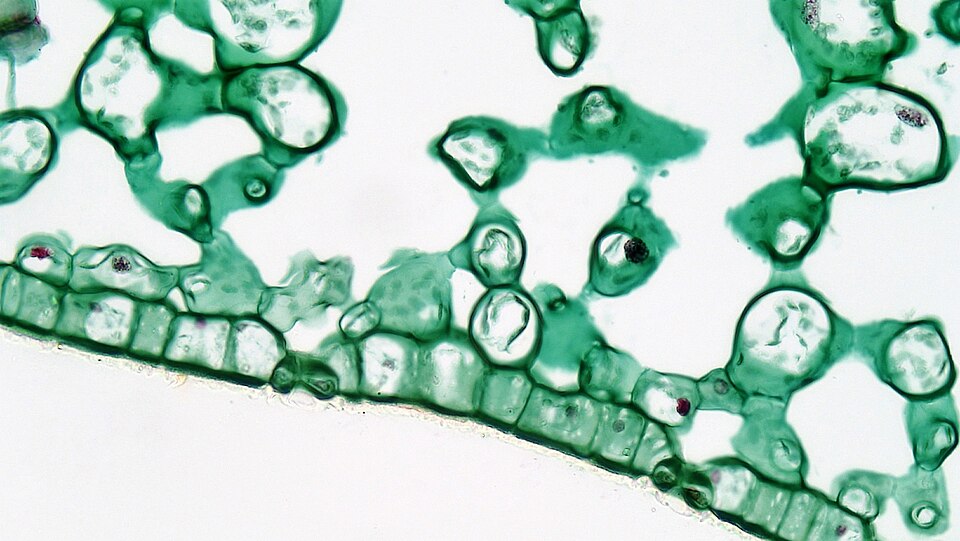
- Placing guard cells in the mesophyll because they contain chloroplasts.
- Confusing the stoma, which is the pore, with the guard cells, which surround it.
- Assuming stomata are evenly distributed on both leaf surfaces.
A one-line location item that rewards a clear mental picture of the leaf in cross-section.
Which one of the following plant tissues has dead cells?
- (a) Epidermis
- (b) Parenchyma
- (c) Collenchyma
- (d) Sclerenchyma
Answer(d) Sclerenchyma
The same tissue list sorted on a different property. The epidermis appears in both, and knowing that it is a living protective layer carrying the stomata is what places the guard cells correctly here.
- practice — not a real PYQ
Stomata in a typical dicot leaf are most numerous on which surface?
- (a)Upper surface
- (b)Lower surface
- (c)Both equally
- (d)Only along the midrib
Answer(b) Lower surface — keeping them shaded reduces water loss.
- practice — not a real PYQ
The immediate cause of a stoma opening is
- (a)loss of water from the guard cells
- (b)entry of water into the guard cells making them turgid
- (c)thickening of the outer wall of the guard cells
- (d)death of the surrounding epidermal cells
Answer(b) entry of water into the guard cells making them turgid — the unevenly thickened walls then bow apart.