
Which one of the following is the deepest, inland and protected port on the east coast of India?
- (a)Chennai
- (b)Paradip
- (c)Tuticorin
- (d)Visakhapatnam
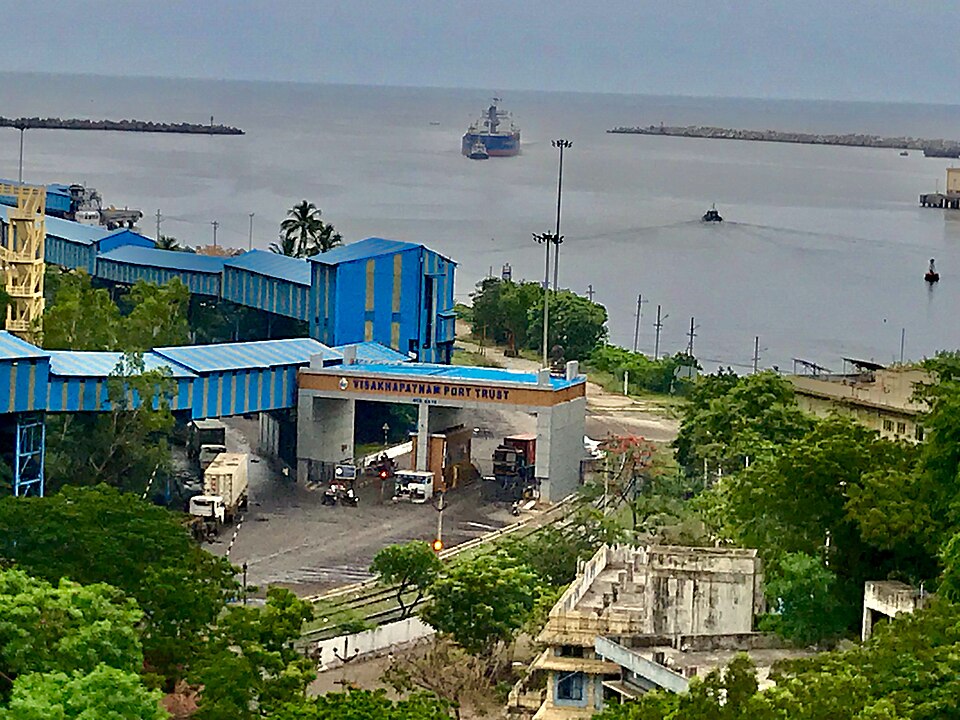
Correct — D, Visakhapatnam. Three conditions are stacked in the stem, and only one east-coast port satisfies all of them at once. Visakhapatnam is inland in the literal sense: the harbour basin lies behind the shoreline and is reached from the sea through a channel cut in solid rock and sand, so the water inside it is screened from the open Bay of Bengal and further sheltered by the Dolphin's Nose headland that guards the approach. That same enclosed basin holds the depth needed for large bulk carriers, which is why the port was developed as an outlet for iron ore. An artificial harbour on an exposed shelf coast can be given depth by dredging or shelter by breakwaters, but Visakhapatnam has depth, an inland basin and natural protection together, and that combination is what the question is asking after.
- (a)Chennai — One of the oldest ports on the east coast and an artificial harbour built in 1859, sitting on an open shoreline behind breakwaters. Shallow water close inshore limits the size of ship it can take, so it fails on depth and on natural shelter alike — and Kamarajar Port was built 25 km to the north precisely to relieve the pressure on it.
- (b)Paradip — The closest wrong answer, since Paradip does have a deep harbour developed to handle very large vessels for iron-ore export, and standard textbook treatments say so. It lies in the Mahanadi delta on an open coast, so it is neither inland nor naturally protected, and the question asks for all three qualities together.
- (c)Tuticorin — V.O. Chidambaranar Port at Tuticorin was itself developed to take load off Chennai and handles a mixed cargo of coal, salt, food grains, edible oils and chemicals. It is an artificial harbour on the open Gulf of Mannar coast and is not distinguished by depth.
Harbours are classified by how they came to be sheltered. A natural harbour uses an inlet, a bay or a headland that already breaks the force of the open sea; an artificial harbour is enclosed by constructed breakwaters and moles. A second axis is the depth of water, which decides the draught of ship the port can accept and therefore what cargo it can economically carry. A third is location relative to the coastline — riverine, deltaic, estuarine or landlocked. India's east coast, being a smooth emergent shelf coast, offers few natural harbours, which is what makes Visakhapatnam unusual.
One tension is worth naming honestly, because it is what makes the Paradip option tempting. The current NCERT text gives Paradip the superlative for the deepest harbour while describing Visakhapatnam as a land-locked harbour connected to the sea by a channel cut through solid rock and sand, so a candidate reading the textbook line about depth alone would go to Paradip. Read the stem as the conjunction it actually is — deepest and inland and protected — and Visakhapatnam is the only port that holds all three. Anchor the administrative detail to the exam as well: India's major ports were reconstituted as Port Authorities under the Major Port Authorities Act, 2021, so the older Port Trust names have been superseded.
- Visakhapatnam in Andhra Pradesh is a land-locked natural harbour reached from the sea by a channel cut through solid rock and sand.
- It was developed chiefly as an outlet for iron ore, and its hinterland is Andhra Pradesh and Telangana.
- Chennai is an artificial harbour of 1859 with shallow water near the coast; Kamarajar Port lies 25 km north of it to relieve congestion.
- Paradip stands in the Mahanadi delta and was built for large-scale iron-ore export serving Odisha, Chhattisgarh and Jharkhand.
- India's major ports are now governed by Port Authorities under the Major Port Authorities Act, 2021, which replaced the earlier port trusts.
- Answering on depth alone and stopping at Paradip without checking the other two conditions.
- Assuming the oldest port must be the deepest, which sends candidates to Chennai.
- Treating land-locked as meaning far from the sea; here it describes a basin enclosed behind the shoreline.
Asked as a multi-condition superlative — three attributes are stacked in one stem, and the marks go to the candidate who tests all three rather than the first.
Consider the following pairs: Port — Well known as 1. Kamarajar Port : First major port in India registered as a company 2. Mundra Port : Largest privately owned port in India 3. Visakhapatnam Port : Largest container port in India How many of the above pairs are correctly matched?
- (a) Only one pair
- (b) Only two pairs
- (c) All three pairs
- (d) None of the pairs
Answer(b) Only two pairs
A useful check on how far the superlatives about this port actually run. Visakhapatnam is the deepest sheltered inland harbour on the eastern seaboard, but it is not India's largest container port — that pairing is the false one there, and Jawaharlal Nehru Port holds the title.
Match List–I with List–II and select the correct answer using the code given below the Lists : List–I (Major Port) A. Kolkata B. Mormugao C. Visakhapatnam D. Paradip List–II (Location) 1. Landlocked area 2. In the delta region 3. On the riverside 4. On the entrance of the estuary Code : A B C D
- (a) 3 1 4 2
- (b) 3 4 1 2
- (c) 2 4 1 3
- (d) 2 1 4 3
Answer(b) 3 4 1 2
The same distinction set out as a matching exercise, and it settles this question on its own. Visakhapatnam is paired with the landlocked location while Paradip is paired with the delta, which is precisely why one of them meets the inland-and-protected test and the other does not.
- practice — not a real PYQ
Which one of the following ports on India's east coast lies in the Mahanadi delta?
- (a)Visakhapatnam
- (b)Paradip
- (c)Chennai
- (d)Tuticorin
Answer(b) Paradip — it stands in the Mahanadi delta about 100 km from Cuttack and was developed for large-scale iron-ore export.
- practice — not a real PYQ
Kamarajar Port was developed mainly for which one of the following reasons?
- (a)To serve as India's largest container terminal
- (b)To relieve congestion at Chennai Port
- (c)To handle India's crude oil imports on the west coast
- (d)To replace Paradip as the iron-ore outlet
Answer(b) To relieve congestion at Chennai Port — the port was built about 25 km north of Chennai for that purpose, and it was also the first major port in India registered as a company.