
Which one of the following is a permeable rock that allows water to pass through it?
- (a)Granite
- (b)Limestone
- (c)Quartzite
- (d)Sill
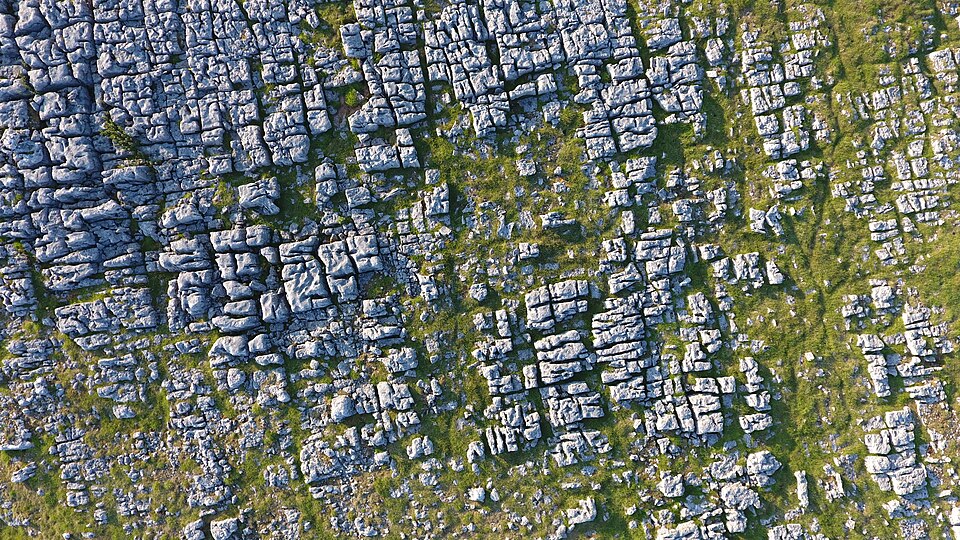
Correct — B, Limestone. Permeability asks whether water can travel through a rock, and limestone lets it through along a close network of joints and bedding planes — then widens the route as it goes, because rainwater carrying dissolved carbon dioxide is a weak acid and calcium carbonate dissolves in it. Water sinks vertically through the joints, moves sideways along the bedding planes, and enlarges the openings into swallow holes, sinkholes, caves and underground streams. The result is karst country, whose signature is a surface with almost no streams on it because the drainage has gone underground. That vanishing drainage is the permeability of the rock made visible. The three rejected options are all dense masses of interlocking crystals with no continuous passage for water.
- (a)Granite — A plutonic igneous rock whose quartz, feldspar and mica crystals grew tightly against one another as the magma cooled slowly at depth, leaving essentially no pore space. Water moves through a granite mass only along fractures, and not through the rock itself.
- (c)Quartzite — The neatest trap in the set, because quartzite is metamorphosed sandstone and sandstone is a permeable rock. Metamorphism recrystallises the quartz grains and welds the pore spaces shut, so the process turns a water-bearing rock into a watertight one.
- (d)Sill — A sill is not a rock type but an intrusive body — a sheet of magma injected along the bedding planes of existing rock. It cools into a dense crystalline mass, commonly dolerite, and acts as a barrier that holds groundwater up rather than a path that lets it through.
Porosity and permeability are separate properties and a rock can have one without the other. Porosity is the share of the rock's volume that is empty space; permeability is whether those spaces connect well enough for water to travel. Clay is highly porous yet almost impermeable, because its pores are minute and poorly linked. Limestone runs the other way: its permeability comes less from spaces between grains than from joints, bedding planes and solution passages, which is why it is sometimes called pervious rather than porous. A rock that transmits and yields water is an aquifer; one that blocks it is an aquiclude.
The NCERT treatment of groundwater work states the condition directly — percolation is good where the rocks are permeable, thinly bedded and highly jointed and cracked — and then names limestones and dolomites rich in calcium carbonate as the rocks in which solution and precipitation build a whole family of landforms. That family is karst topography, named after the limestone country of the Karst region in the Balkans next to the Adriatic. Once the mechanism is clear the question answers itself in the other direction too: it is no accident that India's cave systems at Borra and Belum are in limestone rather than in granite.
- Permeability is the ability to transmit water; porosity is only the share of empty space, and the two do not always go together.
- Limestone's permeability comes mainly from joints and bedding planes, widened by solution, rather than from spaces between grains.
- Rainwater with dissolved carbon dioxide is a weak acid that dissolves calcium carbonate, so limestone passages enlarge over time.
- Karst topography — swallow holes, sinkholes, caves, underground streams — takes its name from the limestone Karst region of the Balkans.
- Quartzite is metamorphosed sandstone whose recrystallisation closes the parent rock's pore spaces, making it impermeable.
- Choosing quartzite because sandstone is permeable and forgetting what metamorphism does to the pores.
- Treating porosity and permeability as the same property, which makes clay look permeable.
- Reading a sill as a rock name rather than as a form of igneous intrusion.
Asked as a property-identification item where the wrong options are three dense rocks and the discriminator is how water behaves rather than how the rock formed.
Consider the following statements: Statement I: In the context of effect of water on rocks, chalk is known as a very permeable rock whereas clay is known as quite an impermeable or least permeable rock. Statement II: Chalk is porous and hence can absorb water. Statement III: Clay is not at all porous. Which one of the following is correct in respect of the above statements?
- (a) Both Statement II and Statement III are correct and both of them explain Statement I
- (b) Both Statement II and Statement III are correct but only one of them explains Statement I
- (c) Only one of the Statements II and III is correct and that explains Statement I
- (d) Neither Statement II nor Statement III is correct
Answer(c) Only one of the Statements II and III is correct and that explains Statement I
The same property tested on chalk, which is a limestone, and it turns on the porosity-permeability distinction directly. The claim that clay has no pores at all is the one to reject, because clay is highly porous and still will not let water through.
Which one of the following karst landforms is the largest in size ?
- (a) Polje
- (b) Uvala
- (c) Swallow Hole
- (d) Sink Hole
Answer(a) Polje
The landscape that limestone's permeability produces, examined one level further in. Its four options run in order of size from a swallow hole up to a polje, all of them hollows opened by water dissolving its way through the rock.
- practice — not a real PYQ
Karst topography develops mainly in regions underlain by which one of the following?
- (a)Granite and gneiss
- (b)Limestone and dolomite
- (c)Basalt and gabbro
- (d)Slate and schist
Answer(b) Limestone and dolomite — both are rich in calcium carbonate, which groundwater dissolves and re-deposits to build the whole karst landform family.
- practice — not a real PYQ
Clay has a high porosity but a very low permeability. The reason is that
- (a)clay contains no pore spaces at all
- (b)its pore spaces are very small and poorly connected
- (c)clay dissolves in water
- (d)clay is an igneous rock
Answer(b) its pore spaces are very small and poorly connected — the water is held rather than transmitted, which is exactly why porosity and permeability have to be kept apart.