
Consider the following observations about the largest stupa at Sanchi: 1. Going by information available from the inscriptions on the railings of the stupa, the construction of part of one of its gateways was financed by the Guild of Ivory workers. 2. In its original early form, this stupa was plain except for the stone railings and the gateways, which were richly carved. 3. The panels on the four gateways contain sculptures only in the front and have no sculptures on the rear side. 4. In 1918, when the stupa was discovered, all of its four gates were intact but the mound was in poor condition. 5. Art historians have established clear connections between the sculptures of the stupa with events described in Jataka Tales. 6. War scenes have also been depicted in these sculptures. Which of the observations given above are correct?
- (a)1, 2, 3 and 4 only
- (b)2, 3, 4 and 5 only
- (c)3, 4, 5 and 6 only
- (d)1, 2, 5 and 6 only
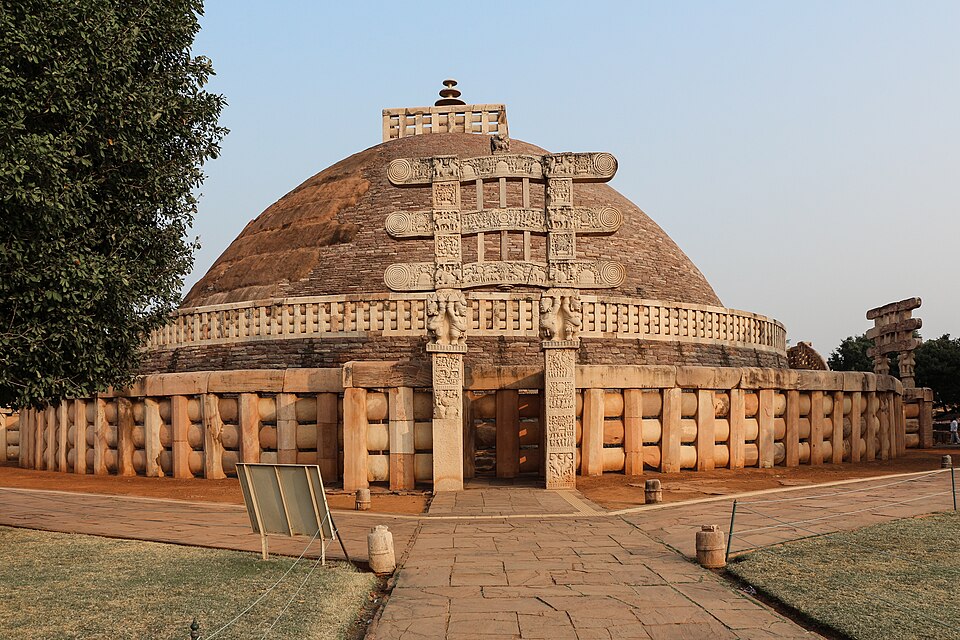
Correct — D, 1, 2, 5 and 6 only. The railing and gateway inscriptions at Sanchi record hundreds of small donations, from monks and nuns and from ordinary householders, and one of them names the ivory workers of Vidisha as the donors of part of a gateway, so statement 1 stands. Statement 2 describes the building sequence correctly: the mound itself is plain, and the carving is concentrated on the stone railing and on the four gateways added later. Statement 5 is right, since art historians read several of the reliefs as episodes from the Jataka stories, and so is statement 6, because the sculptures include a siege — the war fought over the Buddha's relics. Statement 3 fails because the gateway panels are carved on both faces, and statement 4 fails on every particular: the site was reported in 1818, not 1918, three of the four gateways were still standing with the fourth lying where it had fallen, and the mound was in good condition.
- (a)1, 2, 3 and 4 only — Keeps the two genuine observations but adds both false ones. The gateway panels carry sculpture front and back, and the 1918 date with four intact gates and a ruined mound reverses what the early reports describe.
- (b)2, 3, 4 and 5 only — Drops the ivory workers' inscription, which is one of the best-known donative records in Indian art history, and retains both of the false statements.
- (c)3, 4, 5 and 6 only — Retains the two false statements and discards the two the question opens with, both of which are standard descriptions of the monument.
The Great Stupa at Sanchi, in Madhya Pradesh near Vidisha, began as a brick mound of the third century BCE in Ashoka's reign, was enlarged in stone with a railing and processional path in the second century BCE, and received its four carved gateways around the turn of the first century BCE and CE. The relief sculpture is aniconic — the Buddha is suggested by an empty seat, a pair of footprints, a wheel or the bodhi tree rather than shown in person — and the inscriptions on the railing and gateways record who paid for which piece.
Statement 4 is the one to learn from, because the true version of it is itself a favourite question. When the site was reported in 1818 three gateways stood, the fourth lay fallen, and the mound was in good condition; what followed was decades of amateur digging that did far more damage than time had. Conservation came later, funded in part by Shahjehan Begum and Sultan Jehan Begum of Bhopal, who also paid for the museum and the guesthouse and for the publication of John Marshall's volumes on the site. Statement 3 is worth checking against any photograph of a gateway: the panels are carved on both faces, since the gateways were meant to be walked around.
- The core of the Great Stupa dates to the third century BCE; the stone railing came in the second century BCE and the four gateways around the turn of the era.
- Donative inscriptions on the railings and gateways name individual donors and craft guilds, among them the ivory workers of Vidisha.
- Buddha figures are absent from the earliest reliefs; an empty seat, footprints, a wheel or the bodhi tree stand in his place.
- The site was reported in 1818 with three gateways standing, the fourth fallen, and the mound in good condition.
- Sanchi was inscribed as a UNESCO World Heritage Site in 1989.
- Reading 1918 for 1818, which is the whole of statement 4's mischief.
- Assuming a gateway panel is carved only on the side facing the visitor.
- Looking for mural painting at Sanchi; its art is sculpture in stone.
Asked as a six-observation code item mixing art history with the record of the site's rediscovery, so the examiner is testing close reading of a single monument.
Consider the following historical places: 1. Ajanta Caves 2. Lepakshi Temple 3. Sanchi Stupa Which of the above places is/are also known for mural paintings?
- (a) 1 only
- (b) 1 and 2 only
- (c) 1, 2 and 3
- (d) None
Answer(b) 1 and 2 only
Fixes what Sanchi is famous for. Its art is stone sculpture on the railing and gateways rather than wall painting, which is what the observations in this item are all describing.
Consider the following statements regarding Sanchi and its archaeological findings : 1. When Sanchi was discovered in 1818, three of its four gateways were still standing, the fourth was lying on the spot where it had fallen 2. Animals depicted at Sanchi include elephants, horses, monkeys and cattle Which of the statements given above is/are correct ?
- (a) Only 1
- (b) Only 2
- (c) Both 1 and 2
- (d) Neither 1 nor 2
Answer(c) Both 1 and 2
The direct test of the fact that sinks statement 4 here. Its first statement is the accurate version — 1818, three gateways standing and the fourth fallen — which the CAPF paper has altered on every count.
Which of the following statements about sculptures at Sanchi is/are correct? 1. In some sculptures there is representation of Shalabhanjika. 2. The figure of Shalabhanjika is represented by a woman surrounded by lotuses and elephants. 3. The Shalabhanjika motif was not directly inspired by Buddhist ideas. Select the correct answer using the code given below:
- (a) 1, 2 and 3
- (b) 2 and 3 only
- (c) 2 only
- (d) 1 and 3 only
Answer(d) 1 and 3 only
Goes one layer deeper into the same sculptures. The woman grasping a branch over her head is a shalabhanjika, a motif older than Buddhism that the Sanchi carvers absorbed; the woman flanked by elephants pouring water is Gajalakshmi.
- practice — not a real PYQ
In the earliest Buddhist art at Sanchi and Bharhut, the presence of the Buddha is conveyed by
- (a)standing images in monastic robes
- (b)symbols such as an empty seat, footprints and the wheel
- (c)portrait busts on the railing pillars
- (d)inscriptions naming him at each panel
Answer(b) symbols such as an empty seat, footprints and the wheel — the early phase of Buddhist art is aniconic.
- practice — not a real PYQ
The four carved gateways of a stupa are known by which term?
- (a)Harmika
- (b)Medhi
- (c)Torana
- (d)Yashti
Answer(c) Torana — the harmika is the railing on top, the medhi the raised drum and the yashti the central mast.