
Which of the following soil formation process takes place in Phumdis (floating fields) in Loktak Lake of Manipur ?
- (a)Laterization
- (b)Podzolization
- (c)Gleization
- (d)Calcification
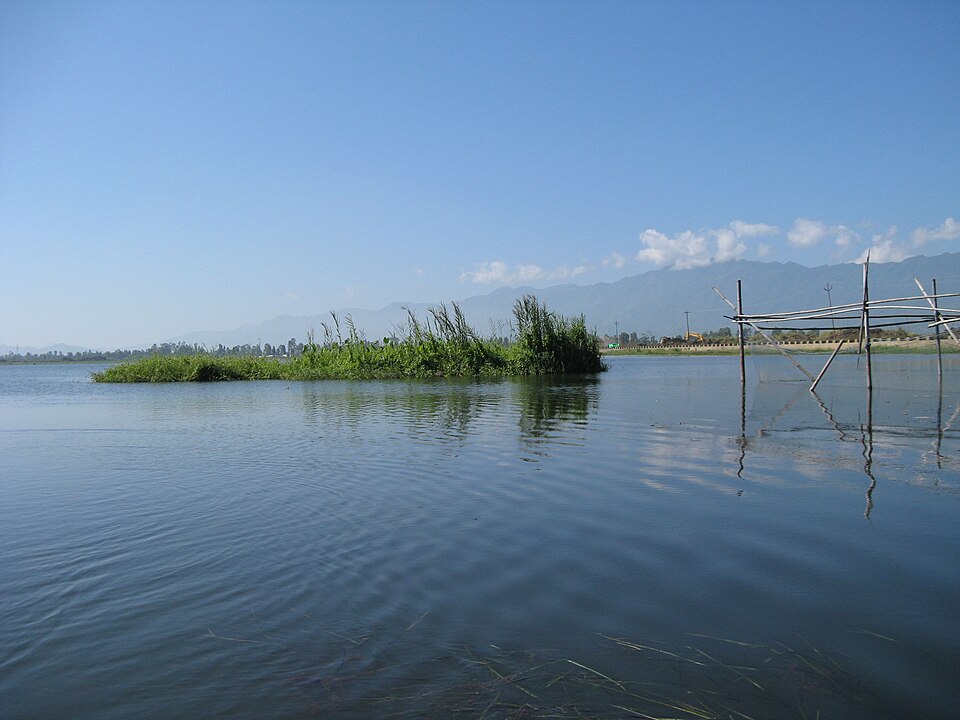
Correct — C, Gleization. Phumdis are floating mats of vegetation, soil and organic matter on Loktak Lake, so the material under them is permanently waterlogged and starved of oxygen. That is the exact condition gleization describes. In the absence of air the iron in the soil is reduced from its ferric to its ferrous state, which turns the horizon a bluish or greenish grey, and organic matter decays so slowly that it accumulates instead of breaking down. The other three processes all require conditions the phumdis do not have — free drainage, or a cold acid forest floor, or a dry climate.
- (a)Laterization — Laterisation needs heavy rain moving freely down through the profile in a hot climate, carrying silica away and leaving iron and aluminium oxides. Water that never drains cannot leach anything.
- (b)Podzolization — Podzolisation belongs to cool humid coniferous forest, where acids from the litter strip the upper horizon to an ash-grey colour. It is a process of cold well-drained uplands, not of a warm floating swamp.
- (d)Calcification — Calcification is the accumulation of calcium carbonate in the profile where evaporation exceeds rainfall, giving the kankar of semi-arid India. It is the opposite climatic setting from a permanently flooded lake.
Soil-forming processes are named by what water and temperature do to the profile. Where rain is heavy and drainage free in a hot climate, leaching strips the soil and laterisation results. Where the climate is cool and humid under conifers, acidic leaching gives podzolisation. Where evaporation exceeds rainfall, salts and carbonates move upward and accumulate, giving calcification and, in the extreme, salinisation. Where water stands and cannot drain away, oxygen is excluded and gleization results.
Loktak is worth knowing in full, because it is asked about repeatedly. It is the largest freshwater lake in north-east India, a Ramsar site since 1990 and on the Montreux Record since 1993, and its phumdis carry Keibul Lamjao, the only floating national park in the world and the last natural refuge of the sangai, the brow-antlered deer that is Manipur's State animal. The phumdis themselves are a mass of decayed and living vegetation buoyant enough to be built on and farmed, and it is precisely because their organic matter does not fully decompose in the waterlogged, oxygen-poor conditions that they hold together at all.
- Gleization occurs in permanently waterlogged, oxygen-poor conditions and produces a bluish-grey gley horizon with an accumulation of undecomposed organic matter.
- Phumdis are floating masses of vegetation, soil and organic matter on Loktak Lake in Manipur.
- Loktak is the largest freshwater lake in north-east India, a Ramsar site since 23 March 1990 and on the Montreux Record since 16 June 1993.
- Keibul Lamjao National Park sits on a phumdi of about 40 square kilometres and is the world's only floating national park.
- The sangai or brow-antlered deer, Manipur's State animal, survives naturally only at Keibul Lamjao.
- Reaching for laterisation because the question is about a tropical Indian location; the process needs free drainage.
- Assuming podzolisation applies to any acidic organic-rich soil; it is a process of cool coniferous uplands.
- Confusing gleization with salinisation, which happens where water leaves the soil rather than where it stands in it.
As a single-answer item that gives an unusual local phenomenon and expects the candidate to reason back to the general process it belongs to.
Some people in Manipur live in houses built on floating islands of weeds and decaying vegetation held together by suspended silt. These islands are called
- (a) Tipis
- (b) Barkhans
- (c) Phumdis
- (d) Izba
Answer(c) Phumdis
The term itself, asked as vocabulary. That item establishes what a phumdi is; this one goes one step further and asks what the waterlogged material inside it is doing chemically.
Which of the following National Parks is unique in being a swamp with floating vegetation that supports a rich biodiversity?
- (a) Bhitarkanika National Park
- (b) Keibul Lamjao National Park
- (c) Keoladeo Ghana National Park
- (d) Sultanpur National Park
Answer(b) Keibul Lamjao National Park
The park that sits on these very phumdis. Between the two, a candidate has the lake, the floating mats and the protected area that rests on them.
Loktak lake is situated in the State of
- (a) Sikkim
- (b) Manipur
- (c) Odisha
- (d) Mizoram
Answer(b) Manipur
The simplest form of the same knowledge, and worth checking because north-eastern lakes are easily shuffled between States in a hurried reading.
- practice — not a real PYQ
The bluish-grey colour of a gley horizon is caused by
- (a)the oxidation of iron in free-draining conditions
- (b)the reduction of iron under waterlogged, oxygen-poor conditions
- (c)the accumulation of calcium carbonate
- (d)the leaching of silica
Answer(b) the reduction of iron under waterlogged, oxygen-poor conditions.
- practice — not a real PYQ
Keibul Lamjao National Park is notable as
- (a)India's largest national park by area
- (b)the world's only floating national park
- (c)India's first marine national park
- (d)the only national park in the Thar desert
Answer(b) the world's only floating national park — it sits on a phumdi in Loktak Lake.