
Consider the following statements about Ramsar Wetland sites in India: 1. Gahirmatha is the habitat of Olive Ridley Turtles. 2. Chilika Lake is the habitat of Irrawaddy Dolphin as its flagship species. 3. Nalsarovar Wetland is also the habitat of Indian Wild Ass (Khur). 4. Tso Moriri Wetland is the habitat and breeding ground of Black-necked Crane. Which of the statements given above are correct?
- (a)1 and 3 only
- (b)1, 3 and 4 only
- (c)2 and 4 only
- (d)1, 2, 3 and 4
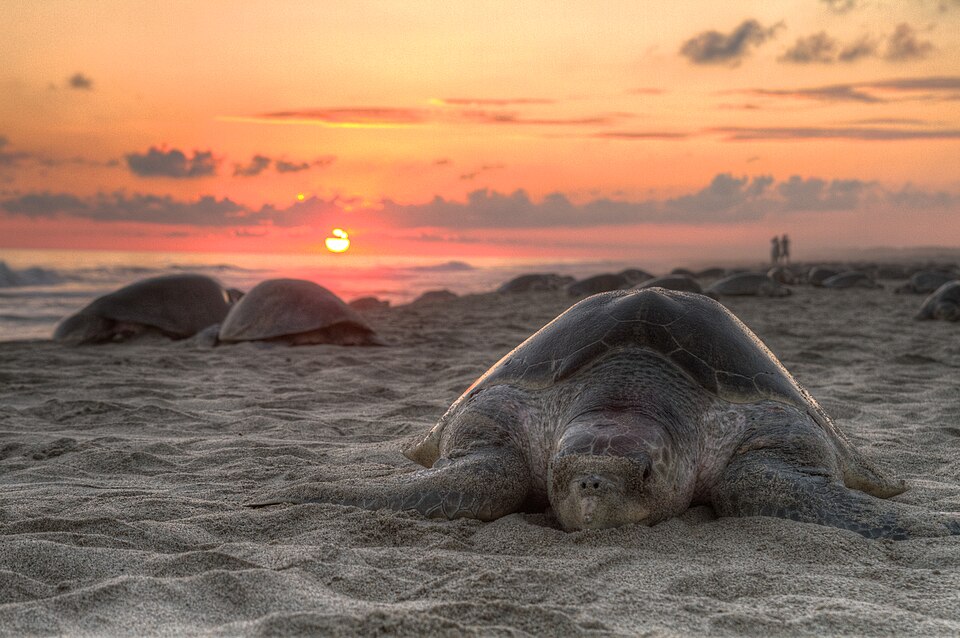
Correct — D, 1, 2, 3 and 4. Every one of the four pairings holds. The Odisha coast at Gahirmatha carries the largest known mass-nesting beach of the olive ridley turtle, and the arribada there is the reason the stretch was protected in the first place. Chilika is the great brackish lagoon of Odisha and holds a resident population of Irrawaddy dolphins, which is the species the lagoon's conservation programme is built around. Nalsarovar in Gujarat is known first as a waterbird wetland, but it lies on the fringe of the country the Indian wild ass ranges over, and the ass is recorded among the mammals the site supports. Tso Moriri, high in Ladakh, is a breeding ground of the black-necked crane, one of very few in India. With no statement to strike out, the answer takes all four.
- (a)1 and 3 only — Leaves out both Chilika and Tso Moriri, although the Irrawaddy dolphin of Chilika and the black-necked crane of Tso Moriri are the best-known single species of each of those wetlands.
- (b)1, 3 and 4 only — Leaves out Chilika, whose dolphin population is among the most widely reported facts about any Indian lagoon.
- (c)2 and 4 only — Leaves out Gahirmatha and Nalsarovar, both of which are correctly paired with their animals.
The Ramsar Convention, signed at Ramsar in Iran in 1971, commits its parties to the wise use of wetlands and to designating wetlands of international importance. India became a party in 1982, and its first two designations, in 1981, were Chilika in Odisha and Keoladeo in Rajasthan. A site usually qualifies because of the waterbirds it supports or because it holds a threatened species or an unusual wetland type, and the flagship species of each site is therefore worth learning with the site.
One point of precision that the stem itself glosses over. Gahirmatha is protected as a marine sanctuary, and the Ramsar designation on that stretch of the Odisha coast belongs to the Bhitarkanika mangroves adjoining it rather than to Gahirmatha under that name; the turtle claim in statement 1 is nevertheless true, which is what the question asks about. Both spellings, Chilika and Chilka, are in ordinary use for the same lagoon, so neither should be taken as a signal that something is wrong. As for the crane, Tso Moriri and the Changthang wetlands around it are effectively the Indian breeding range of the black-necked crane, which winters in Bhutan and on the Tibetan plateau.
- Chilika in Odisha and Keoladeo in Rajasthan were India's first Ramsar sites, designated on 1 October 1981; India acceded to the convention in 1982.
- Gahirmatha on the Odisha coast is the largest known mass-nesting site of the olive ridley turtle.
- Chilika is the largest brackish-water lagoon in Asia and holds a resident Irrawaddy dolphin population.
- Nal Sarovar in Gujarat is the State's largest wetland bird sanctuary and supports the Indian wild ass among its mammals.
- Tso Moriri in Ladakh is a high-altitude Ramsar site and a breeding ground of the black-necked crane.
- Assuming the Irrawaddy dolphin is a river dolphin of the northern rivers; in India it is a coastal and lagoon animal.
- Treating Nal Sarovar as a bird site only and rejecting the wild ass on that ground.
- Confusing the black-necked crane with the sarus crane, which is a bird of the northern plains and not of Ladakh.
As a wetland-and-species pairing set, in which the sites are famous and the discrimination lies in whether the flagship species has been attached to the right one.
Consider the following pairs: Wildlife — Naturally found in 1. Blue-finned Mahseer — Cauvery River 2. Irrawaddy Dolphin — Chambal River 3. Rusty-spotted Cat — Eastern Ghats Which of the pairs given above are correctly matched?
- (a) 1 and 2 only
- (b) 1 and 3 only
- (c) 2 and 3 only
- (d) 1, 2 and 3
Answer(c) 2 and 3 only
The Irrawaddy dolphin pairing tested by moving it to the wrong water. Its Indian home is the coastal and lagoon water of Chilika, not an inland river of the north, which is exactly the pairing this paper prints correctly.
The sea coast of which one of the following states has become famous as a nesting place for the giant Olive Ridley turtles from South America?
- (a) Goa
- (b) Gujarat
- (c) Orissa
- (d) Tamil Nadu
Answer(c) Orissa
The turtle half of this item, asked as a location question. The Odisha coast, and Gahirmatha in particular, is the mass-nesting ground that makes statement 1 here true.
Operation Olivia, an initiative to protect Olive Ridley turtles, is undertaken by
- (a) Indian Navy
- (b) Indian Coast Guard
- (c) Ministry of Environment, Forest and Climate Change
- (d) Ministry of Earth Sciences
Answer(b) Indian Coast Guard
How the nesting ground in statement 1 is actually guarded. The Coast Guard mounts an annual protection effort off the Odisha coast during the nesting season, which is a natural follow-up for a candidate preparing for a uniformed service.
- practice — not a real PYQ
India's first two Ramsar sites, designated in 1981, were
- (a)Chilika and Keoladeo
- (b)Loktak and Wular
- (c)Sambhar and Harike
- (d)Kolleru and Ashtamudi
Answer(a) Chilika and Keoladeo — designated on 1 October 1981.
- practice — not a real PYQ
The black-necked crane breeds in India mainly in
- (a)the Rann of Kutch
- (b)the Changthang plateau of Ladakh
- (c)the Sundarbans
- (d)the Chilika lagoon
Answer(b) the Changthang plateau of Ladakh, including the wetlands around Tso Moriri.